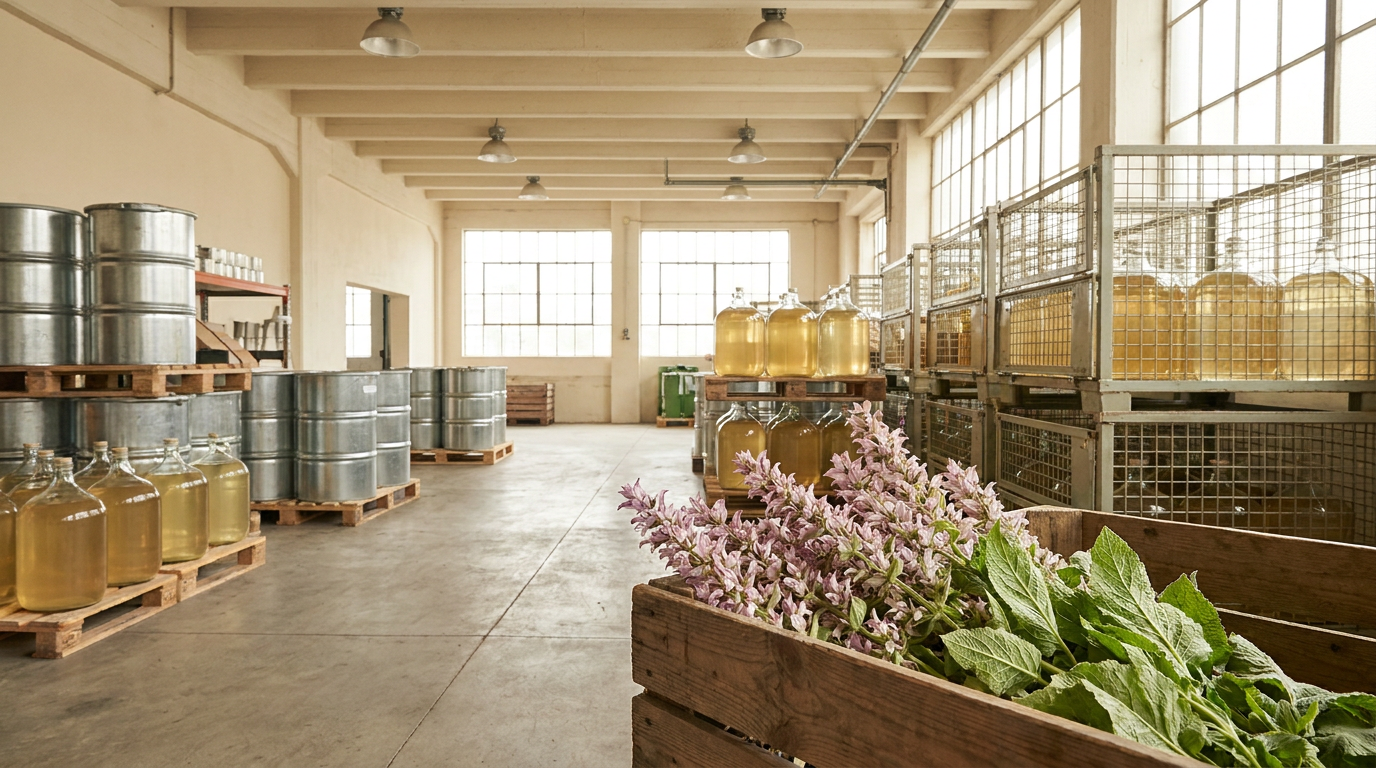
Clary sage oil moves through wholesale channels for reasons that have little to do with a single diffuser bottle. Soapmakers, perfumers, and cosmetic formulators buy it by the pound because its sweet, dry, herbal character holds up in a blend far better than most heart notes. This guide covers what separates real distilled clary sage from the fragrance-oil and seed-oil look-alikes on the market, and how bulk ordering works once you've settled on a supplier.
Compare pound and drum pricing on the bulk order page before you request a quote.
Clary sage oil is steam-distilled from the flowering tops and stems of Salvia sclarea, a lilac-blossomed biennial grown across France, Russia, and the Balkans. The plant's naturally occurring sclareol once made it a companion to winemaking, where it deepened muscatel character long before it became a perfumery staple, a history covered in full in our complete guide to the muscatel herb.
The distillation itself determines yield and aroma: flowering tops go into the still while sclareol and linalyl acetate carry over into the finished oil, giving clary sage its soft sweetness rather than the sharp, camphoraceous edge of garden sage. How clary sage oil is made walks through that process step by step, and the chemistry behind that softness explains why linalyl acetate content is the marker buyers should ask about.
Buyers who assume 'sage' on a label means the same plant are usually wrong. Clary sage and garden sage are close botanical relatives with distinct oils, and the two are not interchangeable in a formulation, whatever a supplier's marketing copy implies.
| Sold as | What it actually is | How to recognize it |
|---|---|---|
| Distilled clary sage essential oil | Steam-distilled from the flowering tops of Salvia sclarea, sold with a batch Certificate of Analysis | Botanical name Salvia sclarea on the label, a published COA, sweet dry herbal aroma with nutty, tea-like undertones |
| Clary sage fragrance oil | A synthetic aromatic compound built to mimic the scent, not a plant distillate | No botanical name, no COA, priced well under distilled oil; see clary sage fragrance oil vs essential oil |
| Clary sage seed oil | A cold-pressed carrier oil from the seeds, chemically unrelated to the aromatic essential oil | Sold in larger bottles at carrier-oil prices with little aromatic strength; see clary sage seed oil vs essential oil |
| Organic clary sage essential oil | Distilled from organically grown Salvia sclarea, priced at a premium over conventional stock | A certification number on the documentation, not just the word 'organic' on the label; see is organic clary sage worth the upgrade |
Price alone is not a reliable signal. Our price guide lays out what a fair bottle costs at retail scale, and the spread only widens at wholesale volume, which is why our bulk buyer's guide is worth reading before requesting a quote.
The sourcing trap here is not fraud so much as substitution: a supplier quotes a low price on 'clary sage oil' that turns out to be a fragrance compound or a seed-pressed carrier oil, both legal to sell under related names but neither one the aromatic essential oil a formulation calls for. Ask what plant part was distilled and request the COA before the invoice, not after.
Soap and candle makers are the steadiest wholesale buyers of clary sage, drawn to how the sweet, dry, herbal note holds through saponification and stays detectable once poured into wax. Our buyer's guide for soap and candle makers covers usage rates and scent retention, and a documented cold-process trial shows how the aroma performs batch to batch.
Perfumers and cosmetic formulators are the other core group, using clary sage as a middle-to-base note that rounds out lavender, bergamot, geranium, and sandalwood. The muscatel note in classic and modern perfumery traces that role, while home fragrance and cosmetic-care brands buy in similar volume for diffuser blends, room sprays, and hair and skin lines built around clary sage oil for hair and skin.
Before signing off on a supplier, a wholesale buyer should confirm the same handful of things every time.
Documentation is the cheapest due diligence available: our batch Certificate of Analysis is published at /docs/clarysageoil-coa.pdf, and any supplier unwilling to produce the equivalent before a wholesale order ships is not one to build a formulation around.
Sizing for this oil runs from a 0.5 oz sampler bottle up to a 400 lbs drum, and our sizing guide is written for retail buyers choosing their first bottle, but the same ladder underpins wholesale ordering: formulators typically start at the pound tier to run a trial batch, then step up once a formulation is finalized.
Full pricing across every size, including the pound and drum tiers, is posted on the bulk order page, which is the fastest way to see where a given order volume lands on the ladder.
Order a small bottle first to confirm aroma and performance in your own formulation before committing to volume.
Request the Certificate of Analysis for the batch you'd be buying against, and check the botanical name and extraction method match what's listed here.
Place a pound-tier order through the bulk order page, or reach out via our contact page for drum-scale volume.
Once a formulation is set, standing reorders can be scheduled against the same batch source to keep aroma consistent across production runs.
The sections below break out the wholesale buyer categories this oil actually serves, each with its own sourcing and sizing notes.
Cold-process soap and container candles are the highest-volume wholesale use for this oil, prized for how the aroma survives saponification and hot wax.
Read the sourcing guide →Independent and mid-size perfumers buy clary sage by the pound as a base note that rounds out lavender, bergamot, geranium, and sandalwood.
Read the sourcing guide →Home fragrance brands buy clary sage for diffuser blends and room sprays where a soft, herbal note is wanted without an overpowering top note.
Read the sourcing guide →Cosmetic formulators buy clary sage for hair and skin product lines, almost always diluted into a carrier oil rather than used neat.
Read the sourcing guide →Bath and body brands buy clary sage for soaking oils and body oil blends, where it's diluted into a carrier base rather than used on its own.
Read the sourcing guide →Craft suppliers and small-batch DIY brands buy clary sage in smaller pound increments for room sprays, sachets, and other scented craft goods.
Read the sourcing guide →Carrier-oil blenders and body oil manufacturers buy clary sage at drum scale to lend body and a soft herbal scent to finished body oil products.
Read the sourcing guide →Reach out and we'll walk through batch documentation, sizing, and lead times.