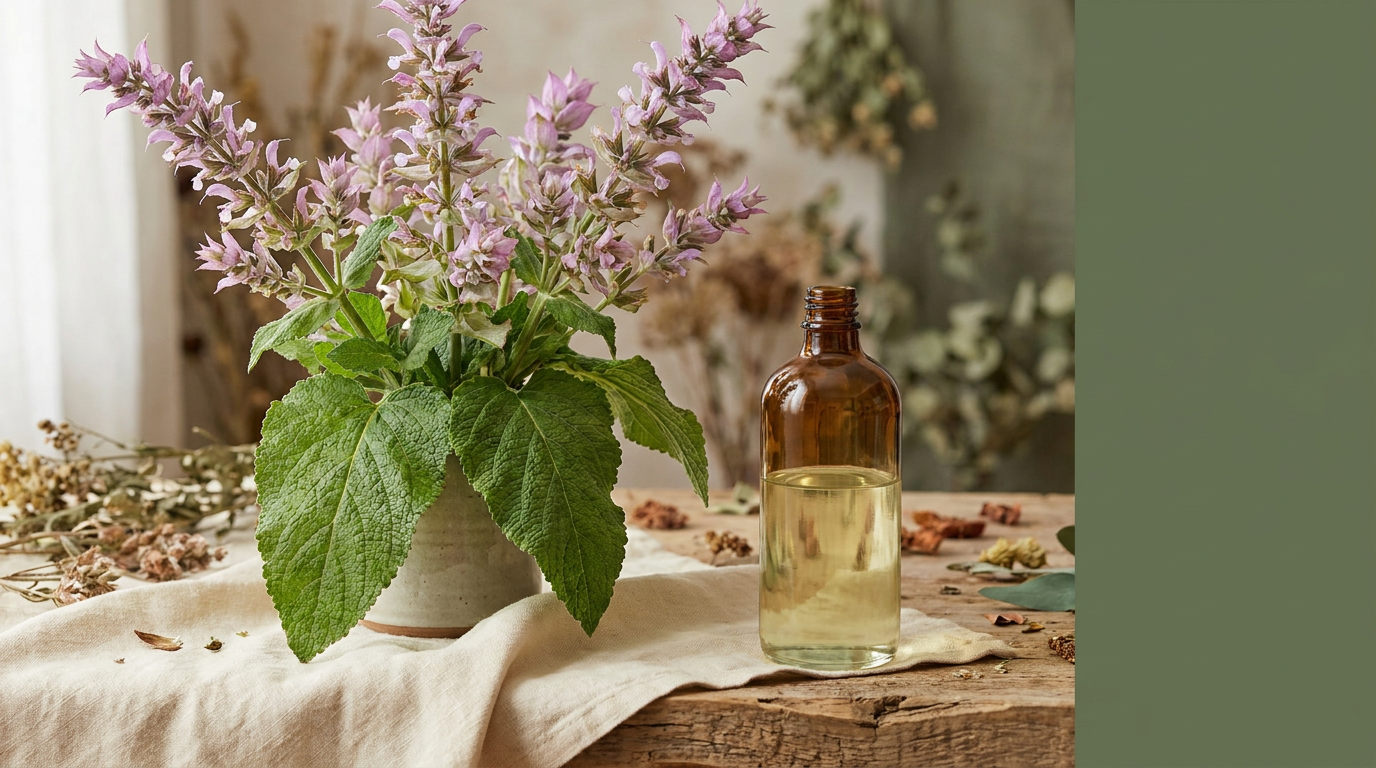
Linalyl Acetate in Clary Sage Oil: The Chemistry of Its Soft Sweetness
Ask a perfumer what clary sage smells like and you'll get answers that sound almost contradictory: herbal but sweet, dry but rounded, a little like tea and a little like hay left in the sun. That paradox has a name, and it's mostly one molecule. Linalyl acetate, an ester that makes up the bulk of clary sage oil's chemical profile, is the compound most responsible for the soft, unhurried sweetness that separates clary sage from sharper culinary sages like Salvia officinalis. Understanding clary sage oil chemistry isn't just an academic exercise for people who like organic chemistry diagrams. It's the fastest way to judge whether a bottle on a shelf is worth its price, and to understand what the oil can and can't reasonably be expected to do.
This piece walks through what's actually inside a bottle of clary sage oil, how linalyl acetate behaves as a molecule, what research has observed (and hasn't), and how to read a lab report like someone who's done it before.
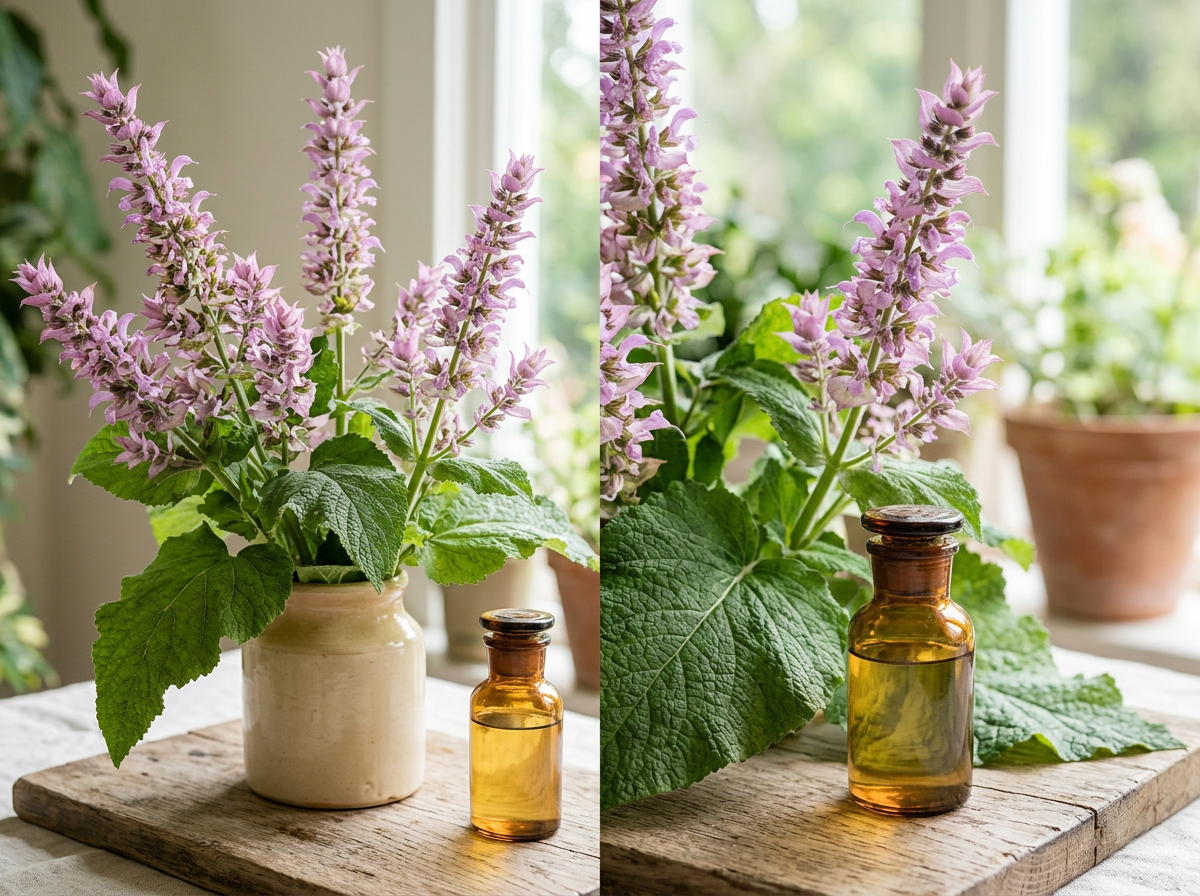
What's Actually in the Bottle: Clary Sage Oil's Chemical Composition
Clary sage oil is steam distilled from the flowering tops and leaves of Salvia sclarea, and like most essential oils it isn't a single substance. It's a mixture of dozens of volatile compounds, most present in trace amounts, with a handful of major players doing most of the aromatic work. A typical GC-MS (gas chromatography-mass spectrometry) analysis of a good-quality clary sage oil looks something like this:
| Compound | Typical Range | Role in the Oil |
|---|---|---|
| Linalyl acetate | 55% to 78% | Dominant ester; soft, sweet, slightly fruity backbone of the scent |
| Linalool | 6.5% to 24% | Free alcohol form; floral, slightly citrusy top note |
| Germacrene D | 1% to 9% | Sesquiterpene; adds a green, woody undertone |
| Sclareol | Under 1% to 2% | Diterpene alcohol; heavy, waxy, long-lasting base note |
| Alpha-terpineol | 0.5% to 3% | Mild, lilac-like sweetness |
| Neryl acetate / Geranyl acetate | Trace to 3% combined | Rounds out the fruity-floral character |
Those ranges are wide on purpose. Clary sage oil chemical composition shifts noticeably depending on where the plant was grown, how mature the flowers were at harvest, how quickly they were distilled, and even the specific growing season. French clary sage tends to run higher in linalyl acetate; oil grown in cooler or more marginal climates sometimes shows a higher proportion of free linalool relative to its ester form. Neither is automatically "better," but the ratio matters for anyone trying to match a specific scent profile or formulate consistently.
The Ester That Makes the Scent: Linalyl Acetate Explained
So what gives clary sage its scent, chemically speaking? Linalyl acetate is formed when linalool, a monoterpene alcohol found across dozens of aromatic plants, bonds with acetic acid to form an ester. Esterification changes the molecule's behavior in a few useful ways. Compared to free linalool, linalyl acetate is generally perceived as smoother and less sharp, with a sweetness that reads more like pear or bergamot than like the more overtly floral, almost soapy character of linalool on its own.
Lavender is the other essential oil most people associate with linalyl acetate, and the comparison is useful. Good lavender oil typically runs somewhere between 25% and 45% linalyl acetate. Clary sage frequently doubles that. That difference is part of why clary sage smells rounder and less bright than lavender, even though the two oils share a meaningful chemical overlap. The higher ester load in clary sage also means it tends to hold its base character longer once applied to skin or diffused, since esters generally evaporate a bit more slowly than the free alcohols and monoterpenes that make up an oil's initial top notes.
Linalyl acetate clary sage content is also the single biggest lever quality control labs pull on when they're deciding whether a batch meets spec. A drop below roughly 55% often signals either an early or over-mature harvest, a distillation run that lost volatile esters to heat or time, or dilution with a cheaper filler oil. It's the number experienced buyers check first.
Sclareol and the Diterpene Fraction: Beyond the Esters
Linalyl acetate gets most of the attention, but sclareol deserves a mention because of how disproportionately it affects the oil's character relative to its small percentage. Sclareol is a diterpene alcohol, a larger and heavier molecule than the monoterpenes that dominate most of the oil. It contributes almost none of the top-note brightness people notice first, but it's largely responsible for the amber, slightly musky depth that lingers underneath the sweetness. It's also the reason the perfume industry has historically valued clary sage as a natural substitute in blends built around ambery, warm base notes.
Sclareol content is harder to standardize than linalyl acetate because it's present in such small amounts that minor extraction or distillation differences show up as large percentage swings. Some labs treat it as a secondary marker for authenticity rather than a quality benchmark on its own.
Research Observations on Linalyl Acetate and Linalool
A fair amount of laboratory and small-scale research has looked at linalyl acetate and linalool, the two compounds that make up the bulk of clary sage oil's profile. It's worth being precise about what this research actually shows, because aromatherapy discussions online often overstate the certainty of the findings.
Some research suggests that inhaling linalool and linalyl acetate may be associated with changes in self-reported mood and a subjective sense of calm during evening wind-down routines, based on small studies using questionnaires and, in some cases, physiological markers like heart rate variability. These are observational findings from limited sample sizes, not large clinical trials, and the mechanisms proposed (interaction with certain scent-related neural pathways) are still being investigated rather than established. Anecdotal evidence from aromatherapy practitioners and everyday users points in a similar direction: people report finding the scent pleasant for quiet evenings or as part of a bedtime atmosphere, though personal response to any aroma varies quite a bit from person to person.
Other lab work has focused on how linalool behaves once an essential oil bottle is opened repeatedly and exposed to air and light over time. Research in this area has observed that linalool oxidizes fairly readily, forming secondary compounds like linalool hydroperoxides. This oxidation research matters more for the safety section below than for any scent claim, since oxidized linalool behaves differently on skin than the fresh molecule.
None of this research should be read as evidence that clary sage oil or linalyl acetate addresses any specific health condition. The honest summary is that the aroma is well-studied at a chemical level, that some small studies have looked at mood-related associations with inhalation, and that a lot remains unknown about individual variation in response. Anyone looking for a rigorous answer should look at the primary literature (searchable through databases like PubMed) rather than secondary aromatherapy blog summaries, and should bring specific questions to a qualified healthcare provider rather than relying on scent alone.
Safety Profile and Who Should Be Cautious
Because linalyl acetate and linalool make up such a large share of clary sage oil, the safety profile of the whole oil tracks closely with what's known about those two molecules individually.
- Dilution first. Clary sage oil is highly concentrated and should never be applied to skin undiluted. A common starting ratio for topical use is 1% to 2% in a carrier oil like jojoba or sweet almond oil, roughly 5 to 10 drops per ounce of carrier, though formulators working on more sensitive skin sometimes go lower.
- Patch test every new bottle. Apply diluted oil to a small area of skin, such as the inner forearm, and wait 24 to 48 hours before broader use. This matters more with clary sage than with some other oils because of the oxidation point below.
- Oxidized oil carries more risk of skin reactivity. Once linalool and linalyl acetate are exposed to air, light, and heat over time, they can form oxidation byproducts that are more likely to trigger skin reactions than the fresh compounds. Store bottles in dark amber or cobalt glass, keep the cap tight, keep the oil away from direct sunlight and heat, and treat oil that's more than a year or two old (or that smells noticeably different from when it was purchased) with extra caution.
- Pregnancy. Clary sage is one of the essential oils commonly flagged for caution during pregnancy due to compounds that may interact with hormone-sensitive processes. Anyone pregnant or trying to become pregnant should check with a qualified healthcare provider before using it in any form.
- Children and pets. Essential oils in general are typically used at much lower concentrations, or avoided altogether, around young children and household pets, whose smaller body size and different metabolism change how concentrated aromatic compounds are handled. Ask a pediatrician or veterinarian before use.
- Medication and existing care. If you're under a healthcare provider's care for any reason or taking any medication, talk to that provider before adding clary sage oil to a routine. Essential oils are not a substitute for guidance from a licensed professional, and no one should stop or change any prescribed regimen based on aromatic use of an oil.
- Not the same risk profile as citrus oils. Unlike cold-pressed citrus oils, clary sage doesn't contain meaningful levels of furocoumarins, so it isn't associated with the sun-sensitivity reactions that oils like bergamot or lime can cause. That's a point in its favor for daytime topical blends, though general dilution and patch-testing guidance still applies.
If you experience any skin reaction, redness, or discomfort, discontinue use and consult a healthcare provider.
How to Read a GC-MS Report Like a Formulator
Reputable clary sage suppliers publish a GC-MS report, sometimes called a certificate of analysis, for each batch. Learning to read one takes about five minutes and pays off every time you buy.
- Check the linalyl acetate percentage first. Anything meaningfully below 55% on a report claiming to be pure clary sage is worth a second look. It doesn't automatically mean the oil is adulterated, since some legitimate regional variation exists, but it's a flag to ask the supplier directly about growing origin and harvest timing.
- Look at linalool as a ratio, not just a number. A healthy clary sage profile shows linalyl acetate well above free linalool. If the two numbers are close together, or if linalool is unusually high, that can point to a partially hydrolyzed batch (esters breaking back down into their alcohol form, often from age or heat) or to blending with a different oil entirely.
- Confirm sclareol is present. Because sclareol is a distinctive marker compound for true Salvia sclarea, its complete absence on a detailed report is a red flag for adulteration or substitution with a cheaper oil.
- Ask about the testing lab. Reports from independent third-party labs carry more weight than in-house testing, particularly for smaller or newer brands.
- Match the batch number. The report should reference a batch or lot number that matches the bottle you're holding. A generic report with no batch reference tells you very little about the specific oil in your hand.
Sourcing and Quality Indicators
Clary sage grows across a fairly wide geographic range, but the major essential oil producing regions are France, Russia, Bulgaria, and Morocco, with smaller production in the United States and elsewhere. Growing region influences the linalyl acetate clary sage ratio through climate, soil, and harvest timing, but it isn't the only variable that matters.
- Harvest timing. Clary sage is typically harvested at full flower, when ester content is at its peak. Fields cut too early or too late tend to yield oil with lower linalyl acetate and a flatter, less rounded scent.
- Distillation method and duration. Steam distillation is standard for clary sage. Shorter, lower-pressure distillation runs tend to preserve more of the delicate ester fraction; rushed, high-heat processing can degrade linalyl acetate before it ever makes it into the collection flask.
- Storage and packaging. Oil bottled in dark glass with a tight-fitting cap and stored away from heat holds its chemical profile far longer than oil sitting in clear plastic under warehouse lighting. This matters for chemistry, not just aesthetics.
- Certifications and transparency. Organic certification (USDA, EU organic, or equivalent) speaks to growing practices, while a published GC-MS report speaks to what actually ended up in the bottle. The two aren't interchangeable, and the best suppliers offer both.
- Price as a rough signal. Clary sage isn't among the most expensive essential oils to produce, but pure, well-distilled oil still costs meaningfully more than diluted or reconstituted versions. A price that seems unusually low relative to comparable bottles is worth investigating before buying.
Bringing the Chemistry Back to the Bottle
Clary sage oil's chemical composition is unusually well documented compared to a lot of essential oils, which makes it a good candidate for anyone who wants to shop with more than just a label and a scent memory to go on. Linalyl acetate does most of the work behind that soft, sweet character, linalool and sclareol round out the edges, and the ratio between them says more about how a given batch was grown and distilled than any marketing copy will. A GC-MS report isn't just a piece of paper for skeptics. It's the closest thing to a recipe card the oil comes with, and reading it takes the guesswork out of deciding whether a bottle is worth what's being asked for it.