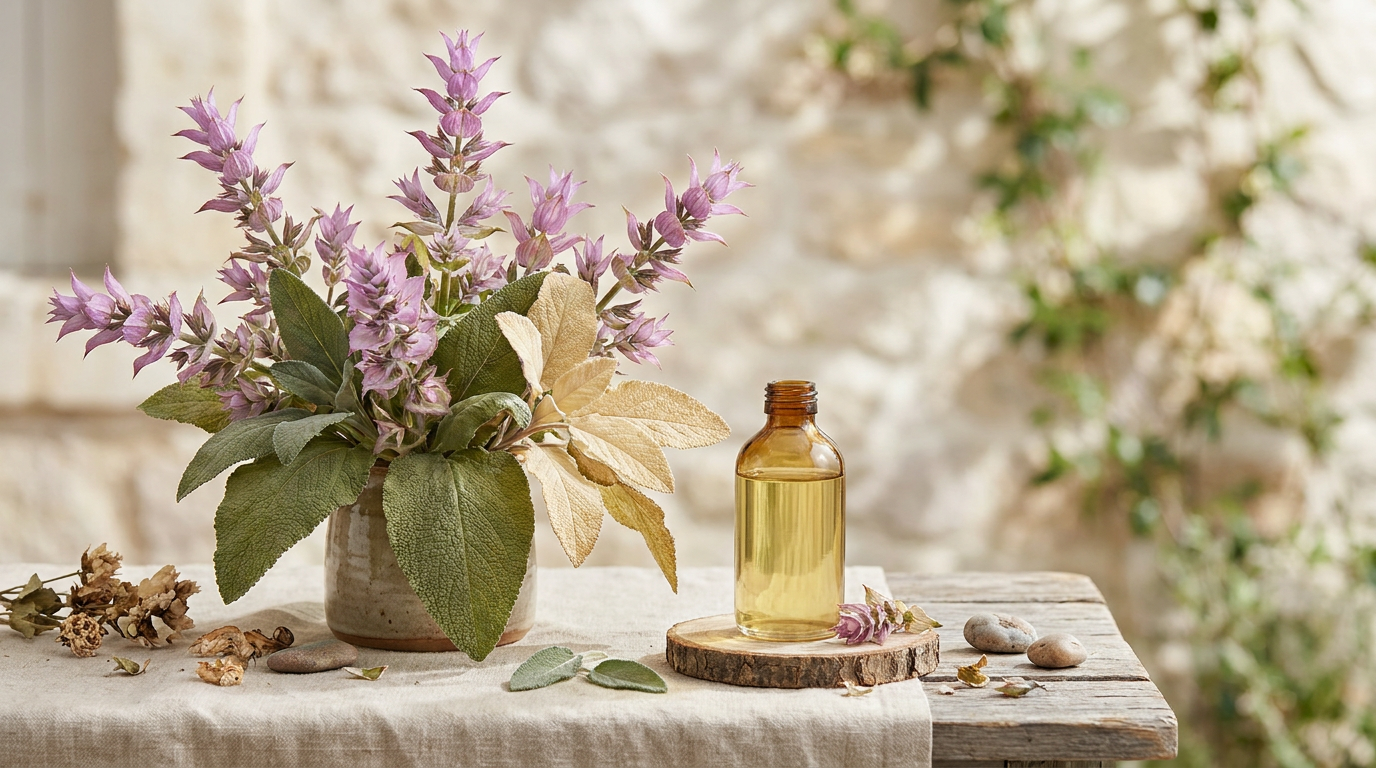
A Soapmaker's Clary Sage Trial: Six Cold-Process Batches, Documented
Clary sage shows up often in essential oil soap making conversations, usually with a caveat attached: people love the herbaceous, faintly floral scent in the bottle, then find it fades to almost nothing by the time a bar is ready to use. A home soapmaker who has been running small cold process batches for about three years decided to stop trusting forum anecdotes and test it directly. Over eight weeks, she ran six batches that varied one factor at a time, from usage rate to the exact point in the process where the oil went in, and kept a written log of what she smelled at day one, week four, and week eight.
This is not a lab study, and it was never meant to be one. It is a documented soap making experience from a single kitchen setup, with all the variability that implies. But detailed batch notes are surprisingly hard to find for this particular oil, so her log is worth walking through for anyone weighing clary sage oil in cold process soap for their own next batch.
Why Clary Sage Raised a Formulation Question in the First Place
Cold process soap making is an alkaline environment from the moment lye water meets oils, and it stays that way until saponification finishes. Some aromatic materials hold their character through that chemistry without much trouble. Others soften, shift, or seem to disappear almost entirely, and reports on which category clary sage falls into were inconsistent. Some soapers described a scent that lingered for months. Others said their bars smelled like plain soap within a couple of weeks.
Cost was part of her motivation too. Clary sage is not the least expensive essential oil on a soaper's shelf, and buying it repeatedly to chase a scent that vanishes fast is not a great use of a small-batch budget. She wanted a clearer, more concrete essential oil soap batch notes record before committing to it as a regular addition, rather than relying on secondhand impressions from people using different base recipes, different water discounts, and different climates.
The Approach: Six Batches, One Variable at a Time
All six batches shared the same base recipe: a blend of olive, coconut, and sustainably sourced palm oil with a small percentage of castor oil for lather, mixed at a 5% superfat and a standard water discount she uses for most of her cold process work. Keeping the base fixed meant any differences in how the scent behaved could be attributed to the variable she was actually testing, rather than to a different oil ratio doing something unrelated.
The six variables she chose to isolate were:
- Usage rate, comparing a lighter application against a heavier one, both within the general range soap makers commonly reference for essential oils in a rinse-off product.
- Addition point, adding the oil at a very light trace versus waiting until a thicker, near-pour consistency, since heat and mixing time both affect how much of a volatile aromatic survives.
- Single-note versus blended, one batch used clary sage alone, another paired it with a heavier, longer-lingering base note to see whether blending extended the perceived scent life of the whole bar.
- Gel phase versus no gel, she forced one batch into full gel with insulation and kept a parallel batch in the refrigerator to prevent gelling, to compare scent outcomes across the two common cold process paths.
- Wrapped versus unwrapped resting, half the bars rested loosely wrapped in wax paper, the other half sat uncovered on a rack in the same room.
- Additive support, one batch included a small amount of kaolin clay, which some soap makers use as a scent-holding aid, to see whether it made a noticeable difference against a batch with no additive.
She logged her impressions on day one (right after unmolding), at the four-week mark, and again at eight weeks, when the bars were considered ready to use. Scent strength was rated on a simple personal scale rather than any instrument, since this was a kitchen trial, not a laboratory one.
Batch Notes: What She Recorded
Below is a simplified version of her log. She was clear in her own notes that a single soapmaker's nose, working from one supplier's oil, in one climate, is not a substitute for controlled testing. Other soap makers working through their own clary sage soap making experience may see different results depending on their base recipe, water content, and storage conditions.
| Batch | Variable Tested | Day 1 Scent | Week 4 Scent | Week 8 Scent |
|---|---|---|---|---|
| 1 | Lower usage rate, added at light trace | Noticeable but soft | Faint | Barely perceptible |
| 2 | Higher usage rate, added at light trace | Strong | Moderate | Soft but present |
| 3 | Higher usage rate, added near pour | Strong | Moderate to strong | Moderate |
| 4 | Blended with a base-note oil | Strong, layered | Moderate, base note dominant | Soft, base note carrying it |
| 5 | Full gel phase | Moderate | Faint | Barely perceptible |
| 6 | No gel (fridge-processed) | Strong | Moderate | Moderate |
A few patterns stood out enough that she flagged them in her notes, though she was careful to frame them as observations from one small trial rather than settled fact.
Addition Point Seemed to Matter
Batch 3, added closer to pour, appeared to hold its scent noticeably better through week eight than Batch 1, which used a similar usage rate but went in earlier at a lighter trace. Less time exposed to the mixture's heat and continued stirring may explain the difference, though she did not measure batter temperature precisely enough to say so with confidence. This lines up with something a lot of experienced soap makers already suspect about volatile aromatics generally: less handling time before the pour tends to correspond with more scent surviving into the finished bar.
Usage Rate Had an Obvious Effect, But With Diminishing Returns
The gap between Batch 1 (lower rate) and Batch 2 (higher rate) was the most dramatic difference in the whole trial. That part was expected. What surprised her was that pushing rate alone did not seem to buy much beyond a certain point in her informal side comparisons with a batch she made outside this formal trial at an even heavier rate. Diminishing returns showed up faster than she anticipated, which suggests usage rate has a practical ceiling worth respecting rather than a straightforward more-is-better relationship.
Gel Phase Appeared to Work Against Scent Retention
Batch 5, which she pushed into a full gel with extra insulation, lost noticeable scent strength faster than Batch 6, processed in the refrigerator specifically to avoid gel. She suspects the additional heat generated during gel accelerates the loss of more volatile aromatic compounds, which would be consistent with why some soap makers deliberately avoid gel phase for lighter, top-note-heavy scents. This is anecdotal evidence from a two-batch comparison, not a controlled study, so it should be read as a starting hypothesis rather than a conclusion.
Blending Extended the Bar's Perceived Life, But Changed Its Character
Batch 4, blended with a heavier base note, still had a detectable scent at week eight, arguably the best retention of the whole set. But by that point the clary sage character itself had faded into the background, with the base note doing most of the work. Anyone specifically chasing the clary sage note on its own, rather than a generally pleasant lingering scent, may find blending solves the fading problem while sacrificing the thing they wanted in the first place.
Wrapping and the Clay Additive Made a Smaller Difference Than Expected
She had expected wrapped bars to hold scent meaningfully better than unwrapped ones sitting in open air, and expected the clay-containing batch to outperform its plain counterpart. Neither comparison showed a difference large enough that she felt confident calling it real rather than noise. It is possible a larger sample of batches, or a longer resting window, would reveal something her small trial could not detect.
Key Learnings for Other Soap Makers
Pulling her batch notes together, a few practical takeaways emerged that other soap makers working with clary sage oil in cold process soap may find useful as a starting point for their own testing, rather than as a fixed recipe:
- Adding the oil later in the process, closer to pour, appeared to support better clary sage soap scent retention than adding it at a lighter trace with more stirring time ahead.
- Usage rate matters, but pushing it higher and higher did not scale as cleanly as expected. It may be more efficient to find a moderate rate that performs well than to keep increasing it.
- Avoiding a full gel phase may help preserve more of the top-note character, based on the limited comparison run here.
- Blending with a longer-lasting base note is a reasonable strategy for a bar meant to smell pleasant at week eight, with the tradeoff that the clary sage note itself becomes less distinct over time.
- Wrapping and clay additives did not show a clear benefit in this particular trial, though other soap makers' experiences may differ with different storage conditions.
As with any essential oil used in a leave-on or rinse-off cosmetic product, standard soap making safety practices still apply regardless of how the scent performs. Stay within usage rates recommended by a reputable supplier or safety reference for the specific oil and product type, and always allow finished bars a full resting period before use so the bar can harden and the pH can settle. Anyone with known skin sensitivities should patch test a small area before regular use of any new soap formulation, and people with specific skin concerns or sensitivities are encouraged to speak with a qualified healthcare provider or dermatologist before introducing a new essential oil into their routine.
Six batches is a small sample, made by one person, with one supplier's oil, in one kitchen. The patterns here are worth testing further, not treating as settled.
What this trial mostly demonstrated is that small, deliberate changes in a soap making process can produce noticeably different outcomes with the same starting oil. For a soap maker trying to decide whether clary sage belongs in a regular lineup, the more useful move may be running a scaled-down version of this same kind of test with their own base recipe, rather than assuming any single set of results will transfer directly. Documented batch notes, even informal kitchen ones like these, tend to be worth more than a general reputation the oil has picked up online.