Does Clary Sage Oil Go Bad? Checking an Old Bottle
Unscrew a bottle of clary sage oil you bought a while ago and the first question is simple: does it still smell like itself, sweet and dry with a little hay in it? Essential oils do not turn the way milk does, with a sudden sour edge. They drift, so the useful question is how far this particular bottle has moved and whether that matters for what you plan to do with it.

Clary Sage Essential Oil
Our own Clary Sage Essential Oil, in sizes from 0.5 oz to bulk.
From $19.99
Shop Now →The short answer
Yes, clary sage oil changes with time, and the process is oxidation. The Tisserand Institute puts it plainly: all essential oils eventually degrade, and most keep well for at least one to two years before oxidation takes effect, with a wide spread between oils. We say that a tightly capped bottle in a shaded cupboard typically stays vibrant for 3 to 4 years. Both are general ranges rather than measurements of the bottle in your hand, so we would rather you judge the bottle than the calendar. For cupboard setup, our storage article covers it. This one is about checking a bottle you already own.
What is actually changing
Oxidation is oil constituents combining with oxygen. Heat, light, moisture and air all speed it up, and the Tisserand Institute notes that the more air there is in the bottle, the faster the oil oxidises. That is why a bottle that is a quarter full ages faster than a full one: more air above the oil, and more cap openings.
The reason this matters most is skin. Linalyl acetate is one of the main components of clary sage oil. In a mouse sensitisation assay, a high-purity linalyl acetate sample was a weak sensitiser, and after ten weeks of air exposure the same material needed roughly seven times less to trigger the same response (Sköld et al., 2008). A separate patch-test study found that fresh linalool and limonene did not irritate at any concentration tried, while their air-oxidised forms did (Bråred Christensson et al., 2009). Neither study used clary sage oil itself, so we read them as a reason for a habit, not a forecast: oil that has oxidised is more likely to bother skin than the same oil fresh.
A two-minute bench check
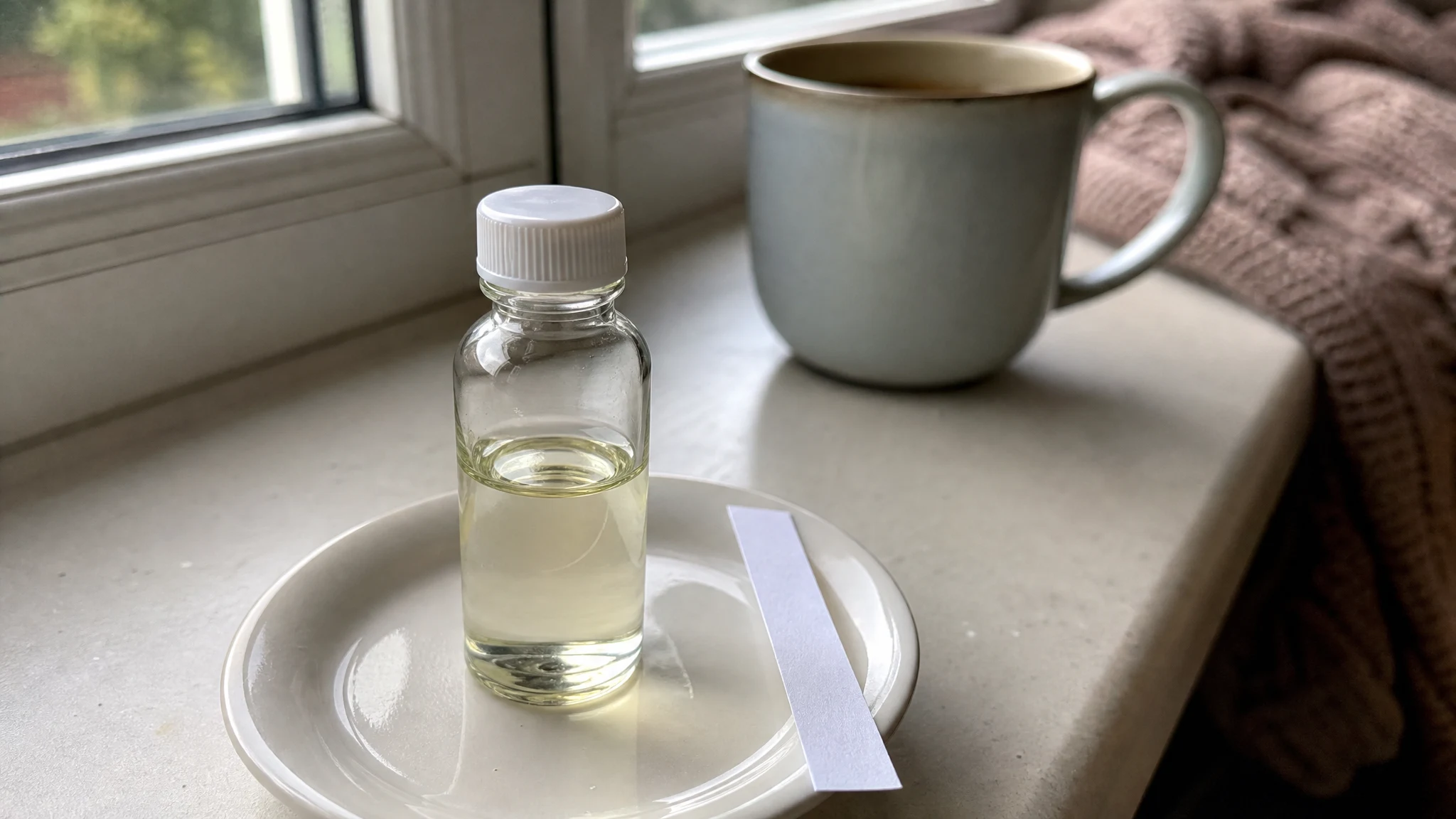
- Smell it first, from the cap. Then put a drop on a clean paper blotter and smell it again after a few minutes. Fresh clary sage opens sweet and dry, then settles into something soft and herbal. An oil that has moved will smell flatter, sharper or simply wrong. The Tisserand Institute lists a changed odour as the first perceptible sign.
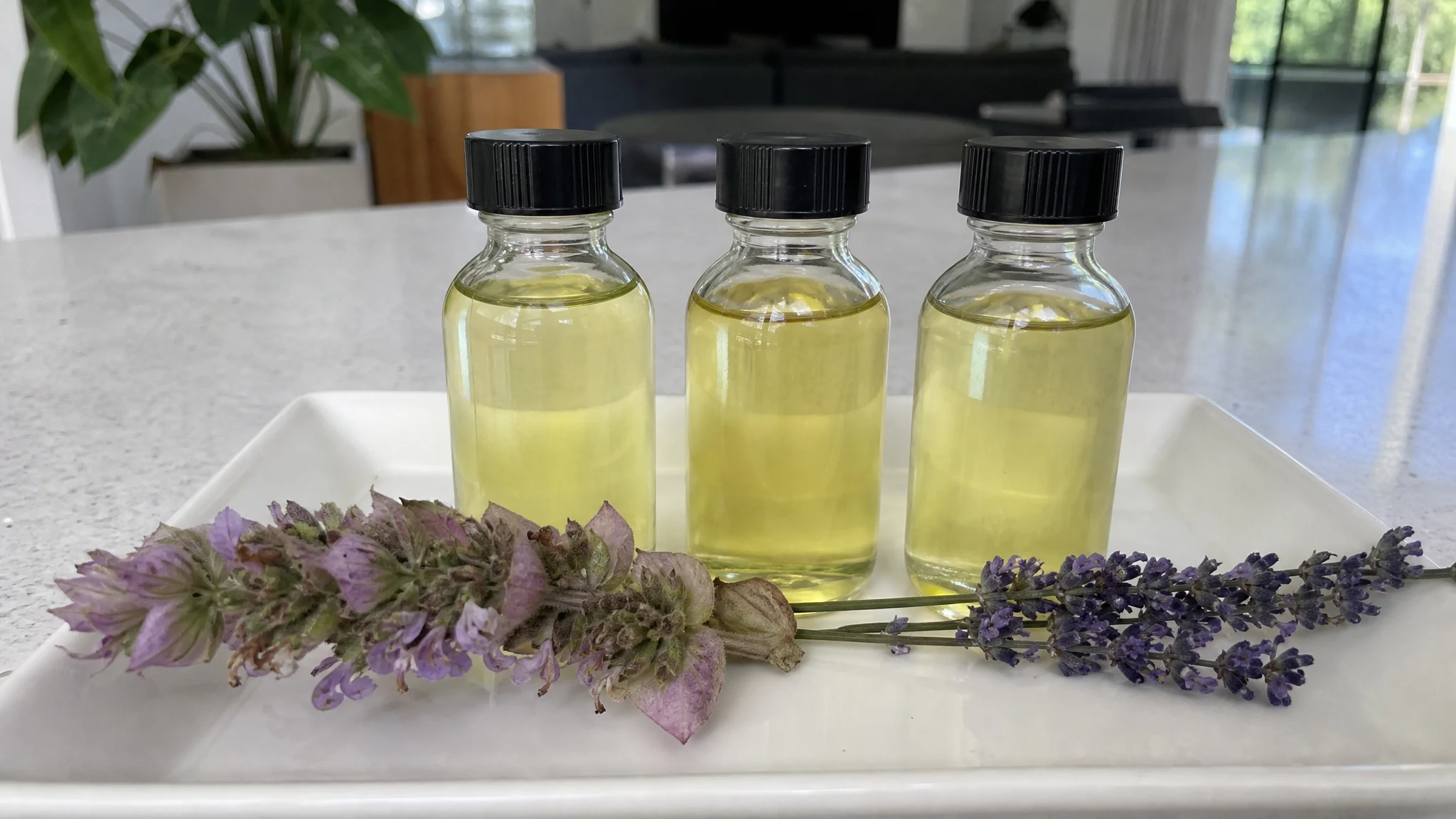
- Look at it. Our oil is typically a pale yellow to light olive liquid. Tip a little onto a white saucer in daylight. A clear shift from the colour it arrived in is a reason to pause. Haziness deserves the same suspicion: the Tisserand Institute links cloudiness in citrus oils to moisture getting into the bottle, and a hazy clary sage would suggest the same thing.
- Tilt it. Fresh oil runs freely. Very old oils may thicken and eventually solidify, although the Tisserand Institute says this usually takes years. A sticky film around the neck of the bottle is worth wiping and noting, since it shows the oil has been sitting in air there.
- Check the dates you wrote down. We stamp the day it was distilled, the day it was filled and the lot on our bottles. The date only you know is the day you broke the seal, so write it on the bottle.
One honest limit: a nose test catches the later stages. Early oxidation can be invisible, which is why the opening date is as useful as any sniff.
What we would do with the result
- Smells right, looks right, and opened within about a year: use it as normal. For skin we recommend 0.5% to 2% in a carrier oil, with a patch test first. Our dilution guide has the arithmetic and our patch test routine covers the first-use step.
- Older than that, but it still smells like itself: we would use a fresher bottle for anything that goes on skin and keep this one for scent-only uses. That is our judgement from the research above, not a rule from an authority.
- Smell, colour or texture has changed: retire it from anything that touches skin. The Tisserand Institute says oxidation products tend to be slightly toxic and increase the risk of adverse skin reactions, and a leftover half-ounce is not worth a rash. Disposal rules differ by town, so check with your local waste service before pouring anything away.
Slowing it down
The Tisserand Institute says refrigeration will about double an oil's useful life. If you use clary sage rarely, a small bottle kept cold is a reasonable plan; let it come back to room temperature before you open it so condensation does not form inside the cap. That last step is our reasoning from the moisture point above, not a quoted instruction. Keep the cap on between uses, keep the bottle out of direct sun, and match the size to how fast you get through it; our sizes guide shows how that works out in practice. A smaller bottle you finish within a year or two leaves less air and less time for any of this to matter.
Oils are forgiving, and most of the checking comes down to paying attention. A bottle you know the history of, and have smelled lately, is rarely a surprise.
Clary Sage Essential Oil
Clary Sage Essential Oil from our own shop, in sizes from 0.5 oz to bulk.
From $19.99
Shop Now →Sources & Further Reading
- Is my bottle of essential oil oxidized or no longer good to use?, Tisserand Institute.
- Autoxidation of linalyl acetate, the main component of lavender oil, creates potent contact allergens. Sköld M, Hagvall L, Karlberg AT. Contact Dermatitis, 2008.
- Air oxidation increases skin irritation from fragrance terpenes. Bråred Christensson J, Forsström P, Wennberg AM, Karlberg AT, Matura M. Contact Dermatitis, 2009.