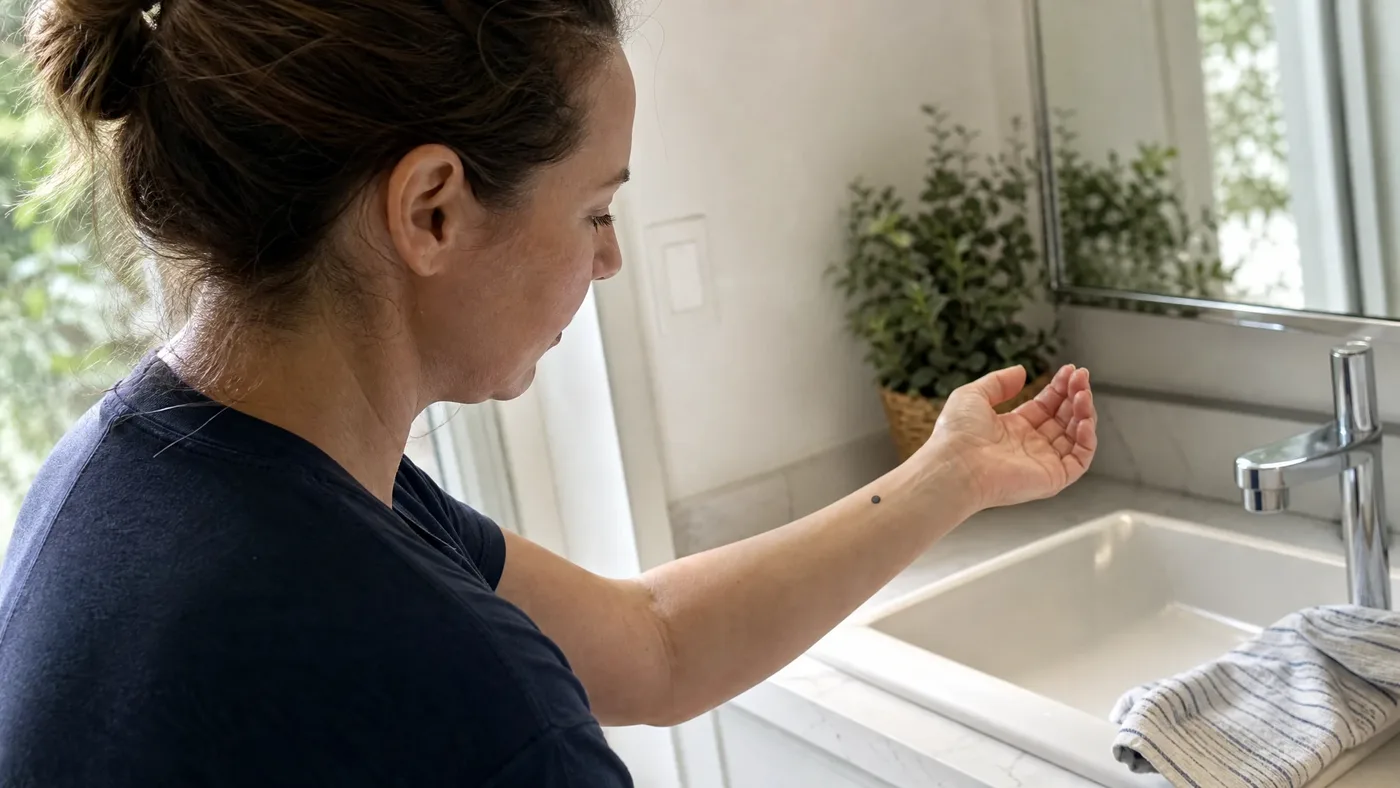
Patch Testing Clary Sage Oil at Home, Step by Step
A home patch test is worth the few minutes it takes, but a single dab checked an hour later only catches the quickest reactions. Allergic skin responses are slower than that. The good news is that a better version is just as easy: a short, repeated test on your forearm, done with a diluted oil rather than a neat one. Here is how to do it and how to read what you see.

Clary Sage Essential Oil
Our own Clary Sage Essential Oil, in sizes from 0.5 oz to bulk.
From $19.99
Shop Now →Irritation is quick, allergy is slow
Two different things can happen on skin. Irritation is a direct reaction and tends to show soon after contact. Allergic contact dermatitis is an immune reaction, and it takes longer: DermNet, the New Zealand dermatology resource, explains that clinic patch tests are applied for 48 hours and read at 96 hours because reactions usually take 48 to 96 hours to develop (DermNet, patch tests). So a quick check the next morning is a good catch for obvious irritation and can miss a slow allergy. That is why we recommend a longer routine.
A week-long home routine
DermNet also describes a repeat open application test for a suspect product: apply it twice a day to a 5 cm area of forearm skin for 5 to 10 days; no visible redness or swelling means contact allergy to that product is unlikely. The routine below adapts that schedule, and it is a home check, not a substitute for a test at a dermatology clinic.
- Mix a small batch at the low end. Our guidance is 0.5% to 2% in a carrier oil; start at 0.5%. As a rough guide, 1 drop in 10 ml of carrier is about 0.5% (20 drops to the millilitre is only a convention). The Tisserand Institute's advice to start low and increase only if needed follows the same logic (Tisserand Institute, dilution). The sums for other batch sizes are in our dilution guide. Carrier oils such as jojoba and sweet almond come from a cosmetic-ingredient or craft supplier, as we do not sell them.
- Test the carrier too. Put a second 5 cm patch of plain carrier beside the first, so that if the skin reacts you know which one did it.
- Choose intact skin. The inner forearm, not freshly shaved, broken or already irritated.
- Apply twice a day for 7 days, leaving the patches uncovered.
- Look each morning in good light for redness, bumps, blisters, swelling or itching, and note the day. Check once more around day 10 to 14 in case something shows late.
Reading the result
| What you see | What to do |
|---|---|
| Nothing on either patch through day 7, and nothing by day 14 | Go ahead at 0.5%. That is a lower chance of trouble, not a guarantee. Increase in small steps, if at all. |
| Both patches are pink or itchy | The carrier is the likely culprit. Stop, and change it before judging the oil. |
| Only the oil patch is pink and it fades within hours | Possible irritation. Stop. If you try again, use a lower percentage, and ask a pharmacist if unsure. |
| Redness that lasts or spreads, itch, bumps, blisters or swelling at any point | Stop and do not re-test. Wash the area and ask a pharmacist or doctor. Do not use the oil on skin until a professional says otherwise. |
| Swelling of the face, lips or throat, hives or trouble breathing | Emergency care now. |
A clear result is not a certificate
- Allergy can start later. A week-long test samples one week of exposure.
- The bottle changes. Linalool, a main component of clary sage oil, reacts with air, so a result from a fresh bottle does not describe the same oil two years on. We say clary sage typically stays vibrant for 3 to 4 years in a tightly capped bottle in a shaded cupboard, and our storage article explains how to keep it that way.
- A forearm result covers the forearm. If you plan to use the oil near the face, stay near the bottom of our range; the Tisserand Institute's band for facial products is 0.5% to 1.2%.
When a dermatologist is the better route
If you have ever reacted to perfume, a scented product or another essential oil, or you get unexplained dermatitis on your hands or face, a clinic patch test is the better option. DermNet notes that a standard baseline series picks up about 70% of contact dermatitis, and clinic results are read by people who interpret them for a living. No seller can tell you whether your skin will react to clary sage, and that includes us. For the wider picture, see our side effects article and clary sage on skin.
A week of careful forearm checks is a small price for knowing how your skin feels about an oil you want to enjoy, and it is easy to repeat when you start a new bottle.
Clary Sage Essential Oil
Clary Sage Essential Oil from our own shop, in sizes from 0.5 oz to bulk.
From $19.99
Shop Now →Sources & Further Reading
- DermNet. Patch tests. dermnetnz.org/topics/patch-tests
- Tisserand Institute. Dilution of essential oils. tisserandinstitute.org/dilution-essential-oils