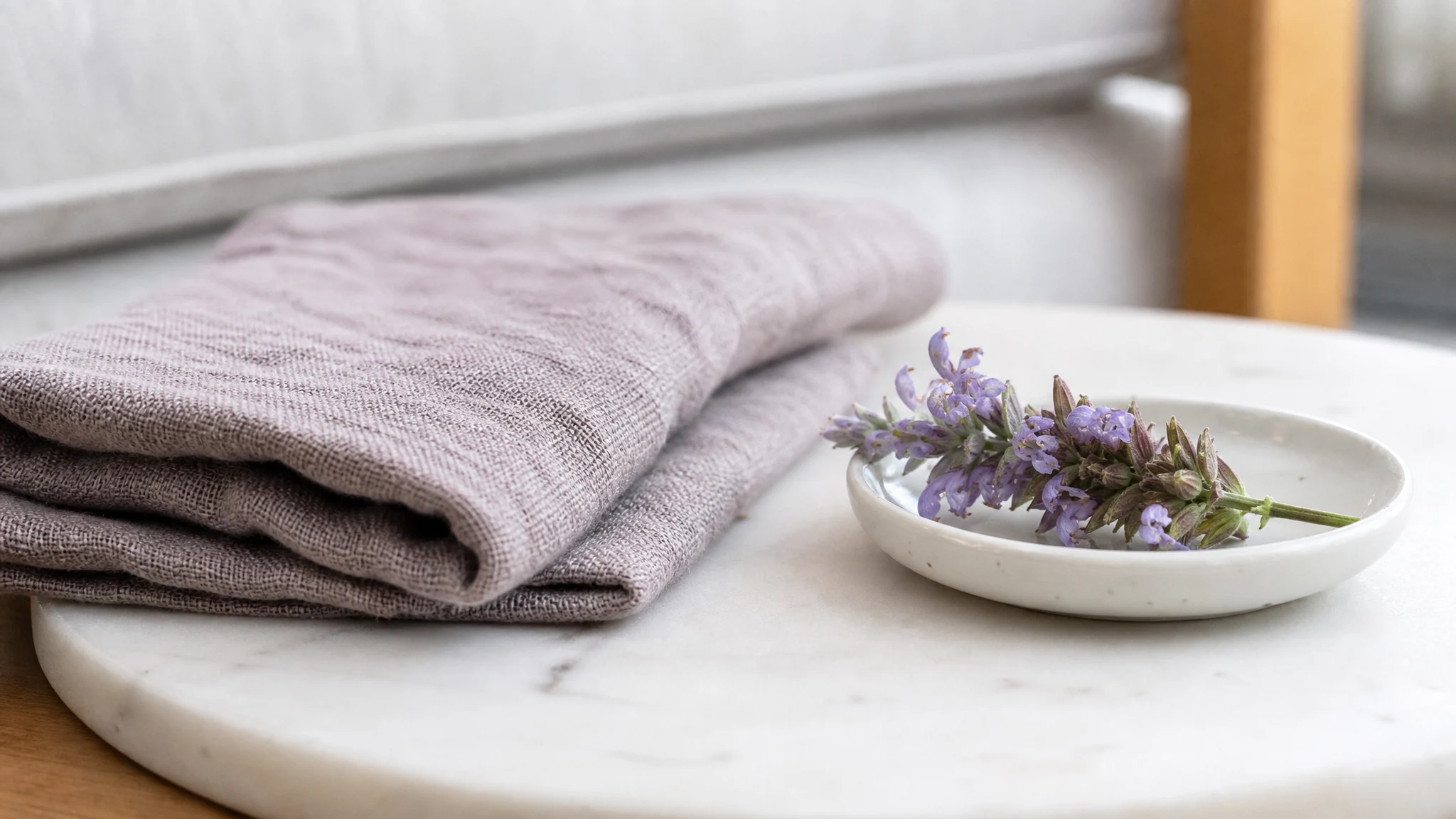
Clary Sage on Skin: Light Dilution, Fresh Bottle
Clary sage oil earns its place in a body oil for its aroma: dry, sweet and softly herbal, with a nutty, tea-like edge. That is a perfectly good reason to use it. Two habits make it a pleasure to wear rather than a source of trouble, and neither is complicated: keep the dilution light, and keep the bottle fresh.

Clary Sage Essential Oil
Our own Clary Sage Essential Oil, in sizes from 0.5 oz to bulk.
From $19.99
Shop Now →What is in the bottle
Most of a clary sage oil is two scent molecules. In the European Food Safety Authority's 2024 assessment of a steam-distilled clary sage oil, the three batches analysed averaged about 68% linalyl acetate and about 15% linalool (EFSA FEEDAP Panel, 2024). Those figures describe that dossier, not our lot. If you need composition numbers for a particular bottle of ours, ask us in writing through the contact page, and our guide to reading a GC/MS report will help you make sense of what comes back.
The same EFSA document says that people handling this oil should treat it as an irritant to skin and eyes and as a skin and respiratory sensitiser. It is a feed-additive opinion, not a cosmetic one, but it explains why every sensible guide, ours included, starts with dilution.
Why a fresh bottle matters
Linalool reacts with air. In a patch-test study, linalool that had not oxidised did not irritate at any concentration tested, while air-oxidised linalool (and limonene) did (Bråred Christensson et al., Contact Dermatitis, 2009). That study used the single compounds, not clary sage oil, so what follows is our reasoning: an oil that is roughly one part in seven linalool is worth protecting from air. Keep the cap tight, keep the bottle somewhere cool and dark, note the date you opened it, and choose a bottle size you will actually finish. Our storage article has the details.
Choosing the percentage
We recommend 0.5% to 2% in a carrier oil such as jojoba or sweet almond, with a patch test first. The Tisserand Institute's general ranges for essential oils, which are guidelines rather than rules, put sensitive or impaired skin at 0.2% to 1%, facial products at 0.5% to 1.2%, and body oils at 1% to 3% (Tisserand Institute, dilution). They give no figure specific to clary sage, so we read across the two:
- For a body oil on healthy skin, anywhere from 0.5% to 2% works, and a scent you can only just notice is a good target.
- For the face, or for skin that has ever reacted to perfume, stay at or under 1%.
- Start at the low end and move up one small step at a time, if at all.
The sums for turning those percentages into drops are in our dilution guide. Carrier oils, like jojoba and sweet almond, are sold by cosmetic-ingredient and craft suppliers, as we do not sell them. If you have a nut allergy, jojoba is the gentler pick over almond.
Who should skip it on skin
- Anyone who has reacted to a perfumed product, to lavender or to another linalool-rich fragrance.
- Anyone with eczema, or any skin condition under a dermatologist's care. Ask first.
- Anyone who is pregnant or breastfeeding; we recommend avoiding clary sage oil during pregnancy, and our pregnancy page has the sources.
- Children, unless a pediatrician says otherwise.
- Anyone about to drive; it is not the oil to reach for before getting behind the wheel.
Test it, then enjoy it
Dilute first, patch test the dilution you plan to use on your inner forearm (here is how), keep it away from your eyes, and wash with soap and water if anything stings or reddens. Never apply it undiluted. For the wider list of documented reactions, our side effects page collects them in one place.
We sell an external cosmetic oil and make no health claims for it. If you are using clary sage for its scent in a massage oil, you are using it for the right reason, and a light hand will serve you best.
Clary Sage Essential Oil
Clary Sage Essential Oil from our own shop, in sizes from 0.5 oz to bulk.
From $19.99
Shop Now →Sources & Further Reading
- EFSA FEEDAP Panel, 2024. Safety and efficacy of a feed additive consisting of an essential oil derived from the flowering stems of Salvia sclarea L. (clary sage oil). EFSA Journal 22(11):e9016. pmc.ncbi.nlm.nih.gov/PMC11561422
- Bråred Christensson J. et al., 2009. Air oxidation increases skin irritation from fragrance terpenes. Contact Dermatitis 60(1):32-40. pubmed.ncbi.nlm.nih.gov/19125719
- Tisserand Institute. Dilution of essential oils. tisserandinstitute.org/dilution-essential-oils