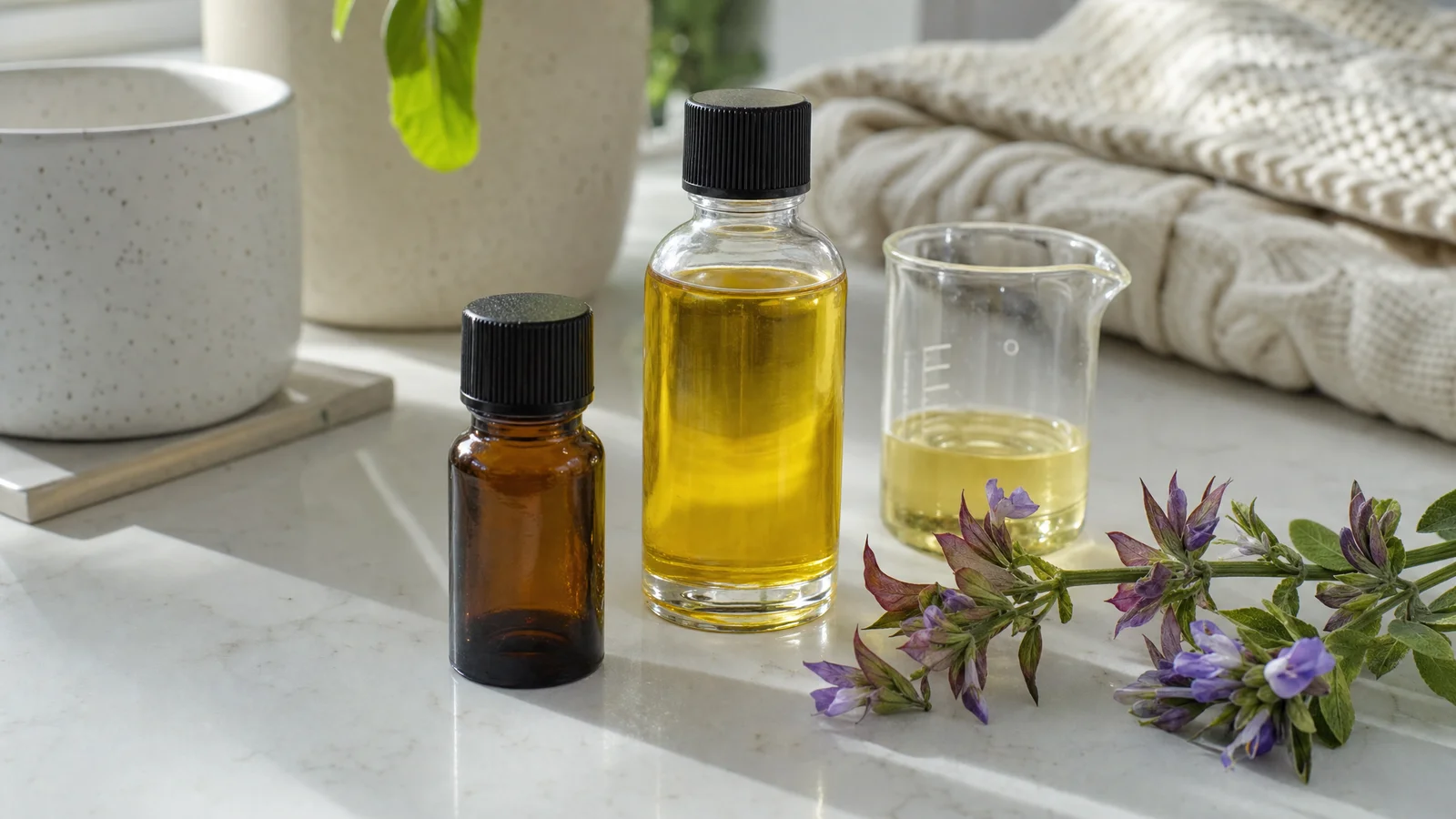
How to Dilute Clary Sage Oil, Drop by Drop
Diluting clary sage oil is a percentage sum, and most slips come from guessing the percentage by eye. A 1% blend is one part oil to 99 parts carrier, which is about 6 drops in a 30 ml (1 fluid ounce) bottle, using the rough convention of 20 drops to a millilitre. The rest of this page is how to pick the percentage, do the sum for your own bottle, and keep the blend fresh.

Clary Sage Essential Oil
Our own Clary Sage Essential Oil, in sizes from 0.5 oz to bulk.
From $19.99
Shop Now →Pick the percentage from the use
There is no single "standard ratio", and "2% is the safe dilution" is the idea we would most like to retire. We recommend 0.5% to 2% in a carrier oil, with a patch test first. The Tisserand Institute's general ranges for essential oils, which it calls guidelines rather than rules, vary with where the product goes: 0.2% to 1% for sensitive skin, 0.5% to 1.2% for facial products, 1% to 3% for body oils and 2% to 4% for wash-off products such as soap (Tisserand Institute, dilution). That page gives no figure for clary sage specifically, so we take the lower of the two sources:
- Face, or anyone whose skin reacts to fragrance: 0.5% to 1%.
- Body oil on healthy skin: 1% to 2%.
- Higher figures exist for spot treatments and roll-ons, and we do not suggest them for clary sage; the EFSA panel that assessed it classes the oil as an irritant and skin sensitiser (EFSA FEEDAP Panel, 2024).
Our skin article explains the reasoning behind the cautious end.
Do the sum for your bottle
A percentage here means the share of the finished blend that is oil. Blend volume in ml times the percentage as a decimal gives ml of oil, and multiplying by 20 gives drops. Thirty ml at 1% is 30 x 0.01 = 0.3 ml, or 6 drops. Real droppers vary, so treat drop counts as approximate.
| Blend size | 0.5% | 1% | 2% |
|---|---|---|---|
| 10 ml roller bottle | 0.05 ml (1 drop) | 0.1 ml (2 drops) | 0.2 ml (4 drops) |
| 30 ml (1 oz) | 0.15 ml (3 drops) | 0.3 ml (6 drops) | 0.6 ml (12 drops) |
| 100 ml | 0.5 ml (10 drops) | 1 ml (20 drops) | 2 ml (40 drops) |
If you weigh instead, as soapmakers and formulators do, work in grams. The certificate of analysis we have for one batch lists a relative density of 0.892, so 1 ml of that batch weighs about 0.89 g, and another batch will differ slightly. For 100 g of blend at 1%, you need 1 g of oil. Pick one method and stay with it; mixing "1% by volume" with a weighed carrier is off by roughly a tenth.
A pharmacy oral syringe measures 0.1 ml more reliably than counting drops. It matters because one extra drop in a 10 ml roller moves 1% to 1.5%.
For a sense of scale, a half-ounce bottle holds about 14.8 ml, roughly 300 drops, enough for around 50 blends of 30 ml at 1%.
The carrier
We do not sell carrier oils; a cosmetic-ingredient or craft supplier does. Jojoba and sweet almond oil are the classic partners. Sweet almond comes from a nut, so anyone with a nut allergy should ask an allergist first, and jojoba is the alternative. Carriers age as well: vegetable oils oxidise and can go rancid (Tisserand Institute, oxidation). Buy a size you will finish, write the mixing date on the bottle, and make small batches for use within a few weeks.
Lower is often better
People read a range as "use the top end to make it work". For a scent, the opposite is true. Clary sage has a distinctive dry, herbal aroma, and the measure of success is whether you can smell it, not how much oil is in the bottle. Start at 0.5%, give it a day, and climb one step at a time. That matches Tisserand's own advice to start low.
Where blends go wrong
- Adding oil to water. Oil and water do not mix, so drops in a bath float and cling to skin. Dilute in a carrier first.
- Layering. A 2% blend over a scented lotion and a perfume is no longer 2%. If the area already carries fragrance, use less.
- Scaling without redoing the sum. "10 drops" in 30 ml is about 1.7%, and doubling the drops without doubling the carrier doubles the percentage.
- Using an old bottle. Oxidised linalool was more irritating than fresh linalool in a patch-test study (Bråred Christensson et al., Contact Dermatitis, 2009). Dilution lowers the dose; it does not refresh the oil. Our storage article helps.
- Skipping the patch test. Test the dilution you plan to use; here is how.
Who should skip it
We recommend avoiding clary sage oil during pregnancy (see the pregnancy page, and ask an obstetric clinician or midwife), and it is not the oil to reach for before driving. Keep it away from eyes, children and pets. If you have eczema or tend to react to fragrance, ask a dermatologist first and stay at the bottom of the range. Diluting does not make it suitable to swallow.
When you want finished formulations worked out with this arithmetic, the massage oil batches and the roll-on sums are built from the same guidance.
Clary Sage Essential Oil
Clary Sage Essential Oil from our own shop, in sizes from 0.5 oz to bulk.
From $19.99
Shop Now →Sources & Further Reading
- Tisserand Institute. Dilution of essential oils. tisserandinstitute.org/dilution-essential-oils
- Tisserand Institute. Oxidation and shelf life of essential oils. tisserandinstitute.org/learn-more/oxidized
- EFSA FEEDAP Panel, 2024. Safety and efficacy of a feed additive consisting of an essential oil derived from the flowering stems of Salvia sclarea L. pmc.ncbi.nlm.nih.gov/PMC11561422
- Bråred Christensson J. et al., 2009. Air oxidation increases skin irritation from fragrance terpenes. pubmed.ncbi.nlm.nih.gov/19125719