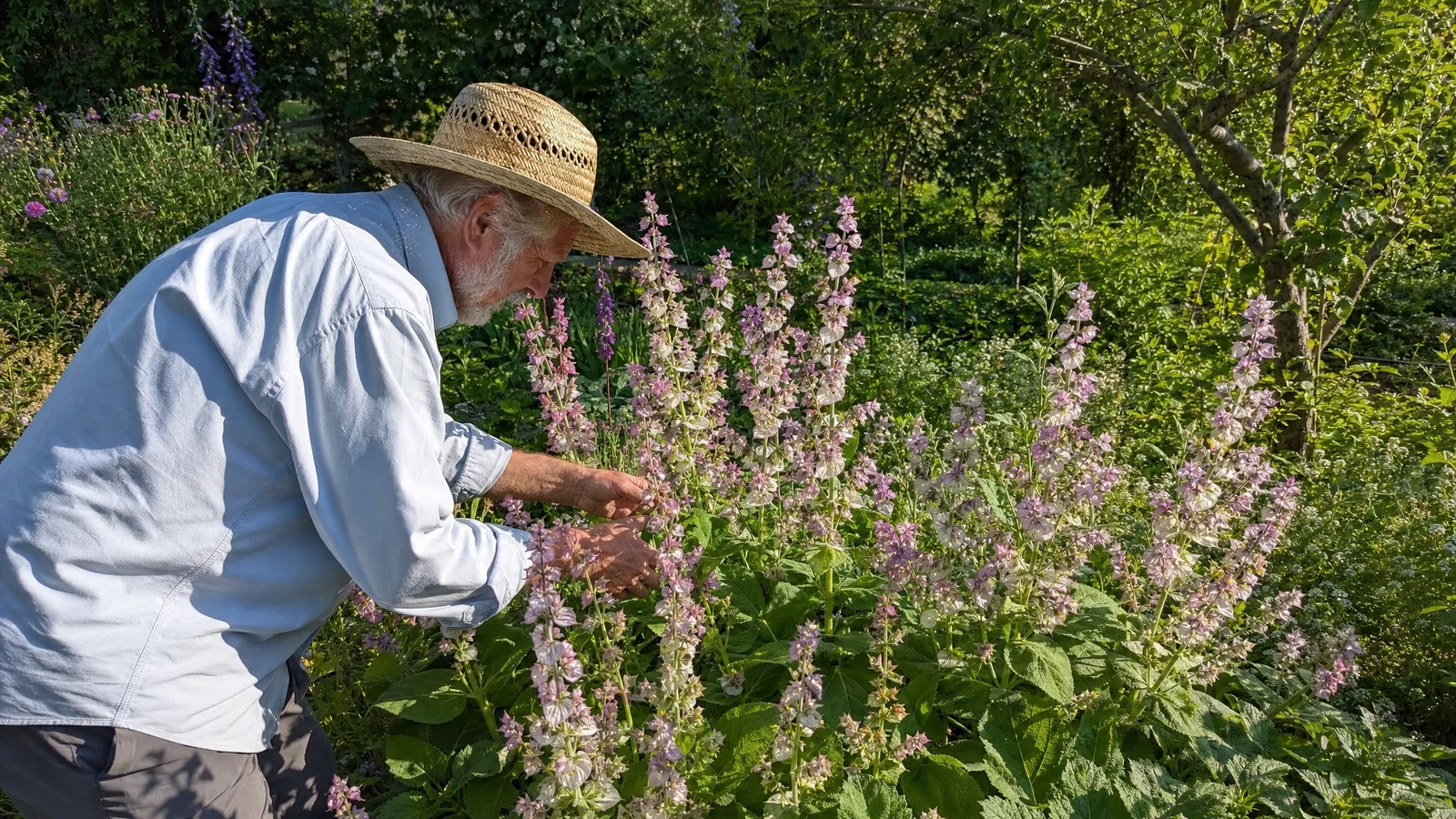
Growing Clary Sage: A Tall Plant, Not an Oil Plan
Grow clary sage for the plant, not for the oil. A research-farm trial that did everything right, with fertiliser, mulch and a laboratory still, collected about two grams of oil from each square metre of plants. A garden bed will not do better, and the oil is perhaps the least interesting thing the plant gives a gardener.

Clary Sage Essential Oil
Our own Clary Sage Essential Oil, in sizes from 0.5 oz to bulk.
From $19.99
Shop Now →What you are planting
Clary sage is Salvia sclarea, a mint-family herb from southern Europe. It grows tall, up to around 130 cm, with flowering spikes up to 40 cm carrying lilac to whitish flowers in clusters tucked under coloured bracts (Kačániová et al., Int J Mol Sci, 2023). Plants in the trial below stood roughly 104 to 118 cm at harvest. Give it space, because this is a back-of-the-border plant.
It is usually described as a biennial: a rosette of leaves and roots in the first year, flowering stems in the second. Local climate and sowing date decide how closely a given plant follows that script, so check the seed packet or ask a nursery or extension service near you for sowing times and hardiness.
What a research farm managed
A 2024 field trial in Palampur, India, at 1,393 m elevation, planted 60-day-old seedlings at 0.45 m by 0.30 m, tested mulch and different nitrogen rates, harvested the flower spikes at full bloom and distilled them in a laboratory still (Dhiman et al., Sci Rep, 2024). Oil made up about 0.16% of the plant material without fertiliser and about 0.19% with the full nitrogen rate, which worked out to roughly 17 and 24 kilograms of oil per hectare. Mulch made no significant difference to oil content.
That is a hill-climate field crop managed for oil, so a garden in a hot or wet region will behave differently. It is still the best yardstick we have for the question every grower asks.
The garden sum
The trial's spacing gives each plant 0.135 square metres, about 7.4 plants per square metre. At the top yield of roughly 24 kg per hectare, that is about 2.4 g of oil per square metre, or a third of a gram per plant. Taking oil as roughly 0.9 g per ml, a 10 square metre bed planted that densely might give 25 ml or so, and only if you had a still, cut every spike at full bloom and matched a research farm. That is less than a single one-ounce bottle (29.57 ml).
This is our own arithmetic from the trial's figures, not something anyone has measured in a garden, but it answers "can I make my own oil?" fairly clearly. It is possible and charming and not very rewarding. The plant is a lot more fun than the yield.
What to do with the harvest
- Cut and dry the flower spikes. The tall stems and coloured bracts hold well in a vase and in dried arrangements, no still required.
- Rub a leaf and see what you think. The living plant smells different from the distilled oil, which we describe as sweet, dry and softly herbal with nutty, tea-like undertones. This scent profile describes the oil.
- Leave the kitchen alone. Clary sage oil is not for swallowing, and our ingestion article shows the arithmetic.
Ornamental clary sage cultivars are often selected for flower colour rather than oil, so a nursery plant and a field crop are not necessarily the same thing. If a pet has chewed on plant material, call a veterinarian.
If it is the oil you are after
The distillation side of the story, from cut stems to the still, is in How Clary Sage Oil Is Made, and the complete guide covers the oil itself. The two make good companions to a garden bed: one tells you what the plant gives, the other what the still does with it.
So plant a few, give them room, and let them stand up tall at the back of the bed in early summer. If you ever do distil a handful of stems, you will have a new respect for every drop in a bottle.
Clary Sage Essential Oil
Clary Sage Essential Oil from our own shop, in sizes from 0.5 oz to bulk.
From $19.99
Shop Now →Sources & Further Reading
- Dhiman D. et al., 2024. Synergistic effect of mulch and nitrogen management on growth and essential oil yield of Salvia sclarea L. Sci Rep 14:32075. pmc.ncbi.nlm.nih.gov/PMC11686162
- Kačániová M. et al., 2023. Salvia sclarea essential oil chemical composition and biological activities. Int J Mol Sci. pmc.ncbi.nlm.nih.gov/PMC10049179