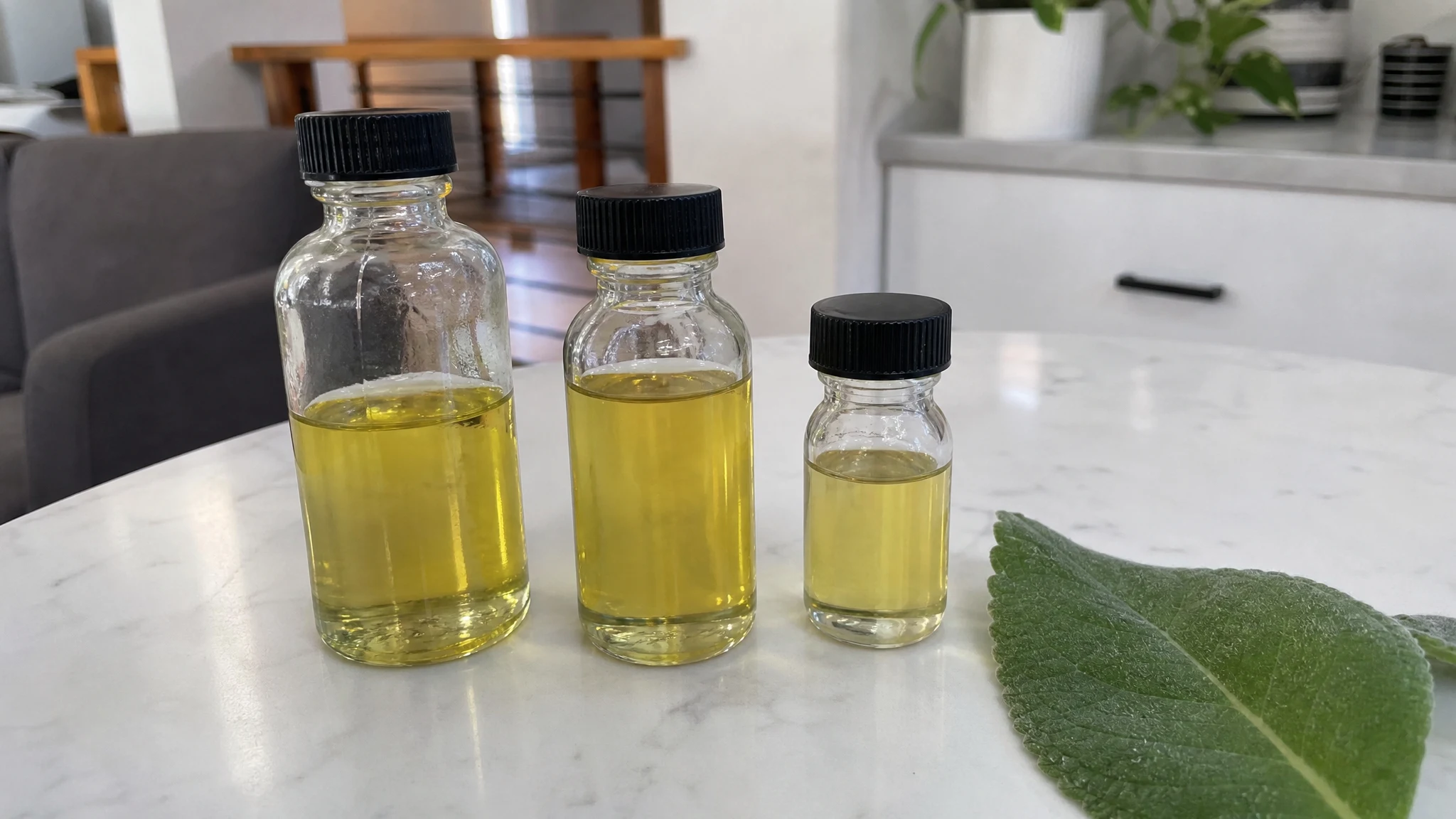
Which Clary Sage Oil Size to Order First
Clary sage oil is a few-drops-at-a-time oil, and a half-ounce bottle holds more than most people expect. Before you reach for the bigger size because it looks sensible, it helps to see what each bottle holds and what your project actually uses.

Clary Sage Essential Oil
Our own Clary Sage Essential Oil, in sizes from 0.5 oz to bulk.
From $19.99
Shop Now →What each size holds
We sell one clary sage oil, Salvia sclarea, in six bottle sizes (0.5, 1, 2, 4, 8 and 16 oz) and four bulk sizes (5, 25, 100 and 400 lb). One fluid ounce is 29.57 ml, so a 0.5 oz bottle is about 14.8 ml and a 16 oz bottle about 473 ml. The Certificate of Analysis we publish for one batch lists a relative density of 0.892, which means 1 ml weighs about 0.892 g and a 1 oz bottle about 26 g. Drops are a rough convention, around 20 to the millilitre, and vary with the dropper, the temperature and the oil. By that measure a 0.5 oz bottle is nearly 300 drops.
Turn the project into millilitres
- A 100 ml skin oil at 1%. That is 1 ml of clary sage oil, about 20 drops. Our dilution guidance is 0.5% to 2% in a carrier oil such as jojoba or sweet almond, with a patch test first. A 0.5 oz bottle covers roughly fourteen of those batches at 1%.
- A 10 ml perfume roller at 3%. About 0.3 ml, or six drops. Check a perfume percentage against published dermal limits for your formulation; our roll-on article works through a 10 ml roller.
- Soap or candles. Makers work in weights, so use the grams above: 1% of a 500 g batch is 5 g. Whether a rate suits your base is something your own test batch will tell you.
- A diffuser. A few drops a session means a half-ounce bottle outlasts most habits.
Why we point first-timers to the small bottle
You are choosing a scent, and a nose is the only judge that counts. We describe ours as sweet, dry and softly herbal with nutty, tea-like undertones; you may find it earthier or sweeter than that, and a small bottle is the kind way to find out.
The second reason is air. Oils change as oxygen reaches them, and the emptier a bottle gets, the more air sits above the oil each time you open it. Tisserand Institute notes that most essential oils keep for at least a year or two, that using an oil within six to twelve months makes oxidation mostly a non-issue, and that heat, light and air all speed it along. Oxidised oils are more likely to cause skin reactions, which is why Tisserand advises writing the purchase or opening date on the bottle. Our own guidance is that the oil typically stays vibrant for 3 to 4 years in a tightly capped bottle kept in a shaded cupboard, and the sensible way to honour that is to buy what you will use well inside it.
Third, a larger bottle only saves money if you use it. Do the division yourself on the current figures in our shop, and count the portion you would not finish.
When to step up
Once you know the scent and your use is predictable, work backwards from your annual millilitres, add a small margin, and pick the nearest size at or below it. A maker pouring 100 ml batches at 1% every month uses about 12 ml a year, which still fits a half-ounce bottle. Someone running weekly soap batches may sensibly move to 8 oz. Beyond 16 oz you are in bulk territory, where samples, lot reports and decanting come into the conversation; our bulk guide covers that side.
When any bottle arrives, write the date on it and keep the lot number. Our bottles carry the lot, so that is how a report is matched to the oil in your hands. The Certificate of Analysis we publish covers one batch and gives density, refractive index and optical rotation. If you need a composition report for your lot, ask us in writing through the contact page.
Who should wait
We recommend avoiding clary sage oil during pregnancy, and it is not the oil to reach for before driving. Keep it away from eyes, children and pets, and do not ingest it. Pets deserve a note of their own: the EFSA panel that assessed clary sage oil as a feed additive set a much lower safe feed level for cats (4 mg/kg complete feed) than for dogs (20 mg/kg), citing cats' reduced capacity for glucuronidation, one of the ways a body clears compounds. That is feed guidance, not advice on diffusing, so ask a veterinarian about any pet question, and an obstetric clinician or physician about pregnancy or a medical condition.
New to the oil? Start small, patch test any skin dilution, read what it smells like, and storage tips in our storage guide. Then reorder in the size your own use has earned.
Clary Sage Essential Oil
Clary Sage Essential Oil from our own shop, in sizes from 0.5 oz to bulk.
From $19.99
Shop Now →Sources & Further Reading
- Tisserand Institute. Oxidized essential oils. tisserandinstitute.org
- Tisserand Institute. Dilution of essential oils. tisserandinstitute.org
- EFSA FEEDAP Panel, 2024. Safety and efficacy of a feed additive consisting of an essential oil derived from the flowering stems of Salvia sclarea L. (clary sage oil). EFSA Journal 22(11):e9016. PMC11561422