Blending Clary Sage Oil: Ratios, Dilution, Mistakes
Most blending slips come from treating it as one sum when it is two. First you decide how much of each oil goes into the oil blend: that is a ratio. Then you decide how much of the finished blend goes into the carrier: that is a dilution. Mix them up and a bottle meant to be 1% ends up at 3%, or a careful ratio is lost to drop counting.

Clary Sage Essential Oil
Our own Clary Sage Essential Oil, in sizes from 0.5 oz to bulk.
From $19.99
Shop Now →Step one: set the ratio in parts
Write the oils as parts, not drops. Take 3 parts clary sage, 2 parts lavender and 1 part sandalwood: six parts in all, with clary sage making up half. The ratio stays the same whether a part is one drop or one millilitre, which is why it is the thing to settle first. Choosing the partners is its own question, and our pairing guide goes through the reasons. We would keep clary sage as the largest share only if you want its sweet, dry, hay-like character to lead; for a background note, give it one part in five or so. The lavender and sandalwood here are things to pick up at a craft supply or aromatherapy shop, since our shelf holds clary sage alone.
Step two: dilute the whole blend, not each oil
Here the common error appears. A 1% dilution means the oils together make up 1% of the finished product. It does not mean each oil gets 1%.
Take a 30 ml bottle of carrier oil. At 1%, the total essential oil is 30 x 0.01 = 0.3 ml. Using the rough convention of 20 drops to a millilitre, that is 6 drops across everything, so 3 clary sage, 2 lavender and 1 sandalwood. The Tisserand Institute's drop-size page reports a spread of roughly 20 to 40 drops per ml in published studies and calls a drop never a precise measure, so a different dropper changes the real percentage. Work in millilitres on a syringe or weigh in grams if you want the number to hold.
| Finished size | 0.5% | 1% | 2% |
|---|---|---|---|
| 10 ml | 1 drop in total | 2 drops | 4 drops |
| 30 ml | 3 drops | 6 drops | 12 drops |
| 100 ml | 10 drops | 20 drops | 40 drops |
Notice the 10 ml row. Two drops cannot be split three ways, so a small bottle cannot honour a 3:2:1 ratio. The fix is a stock blend.
The stock-blend method
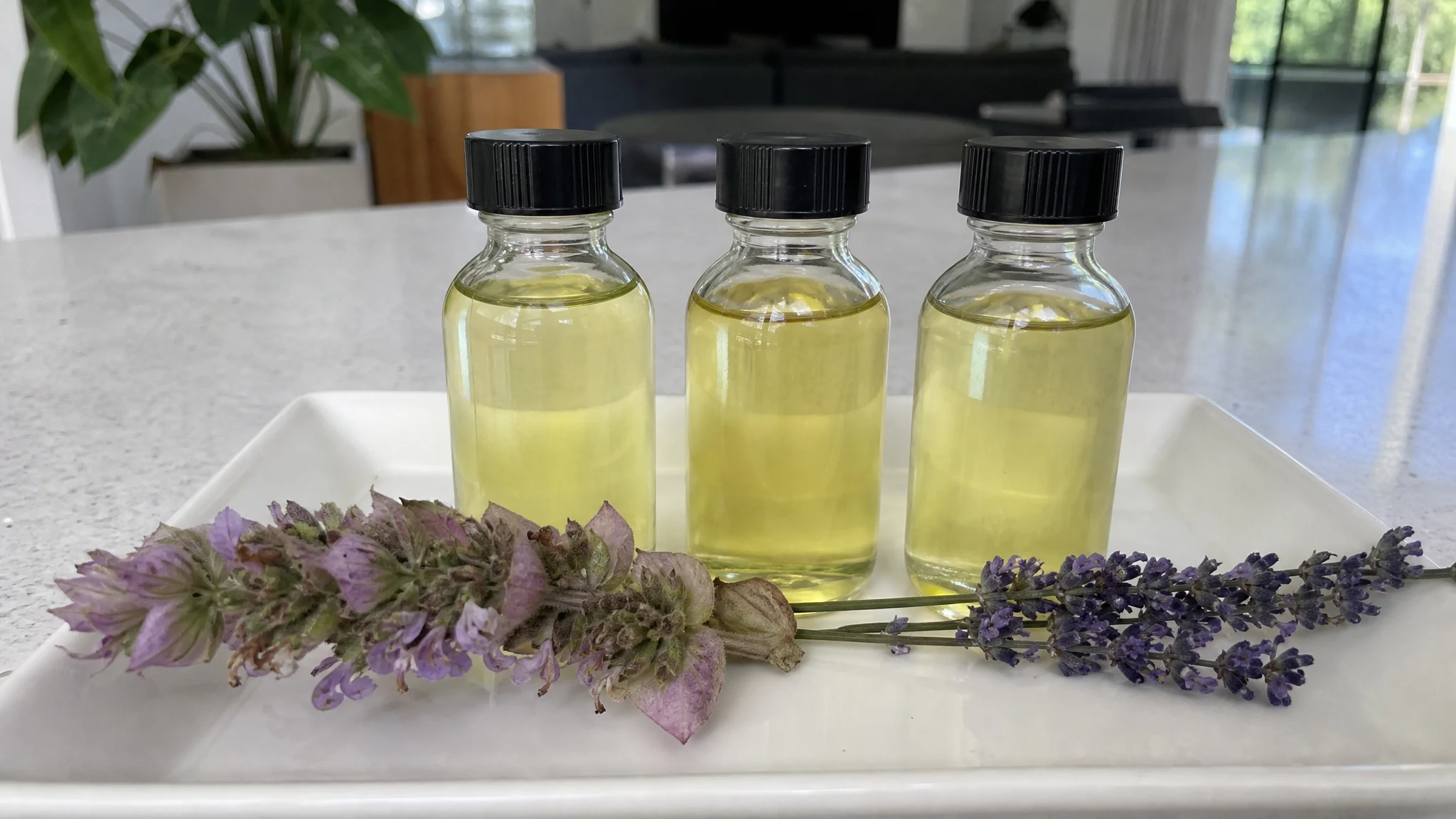
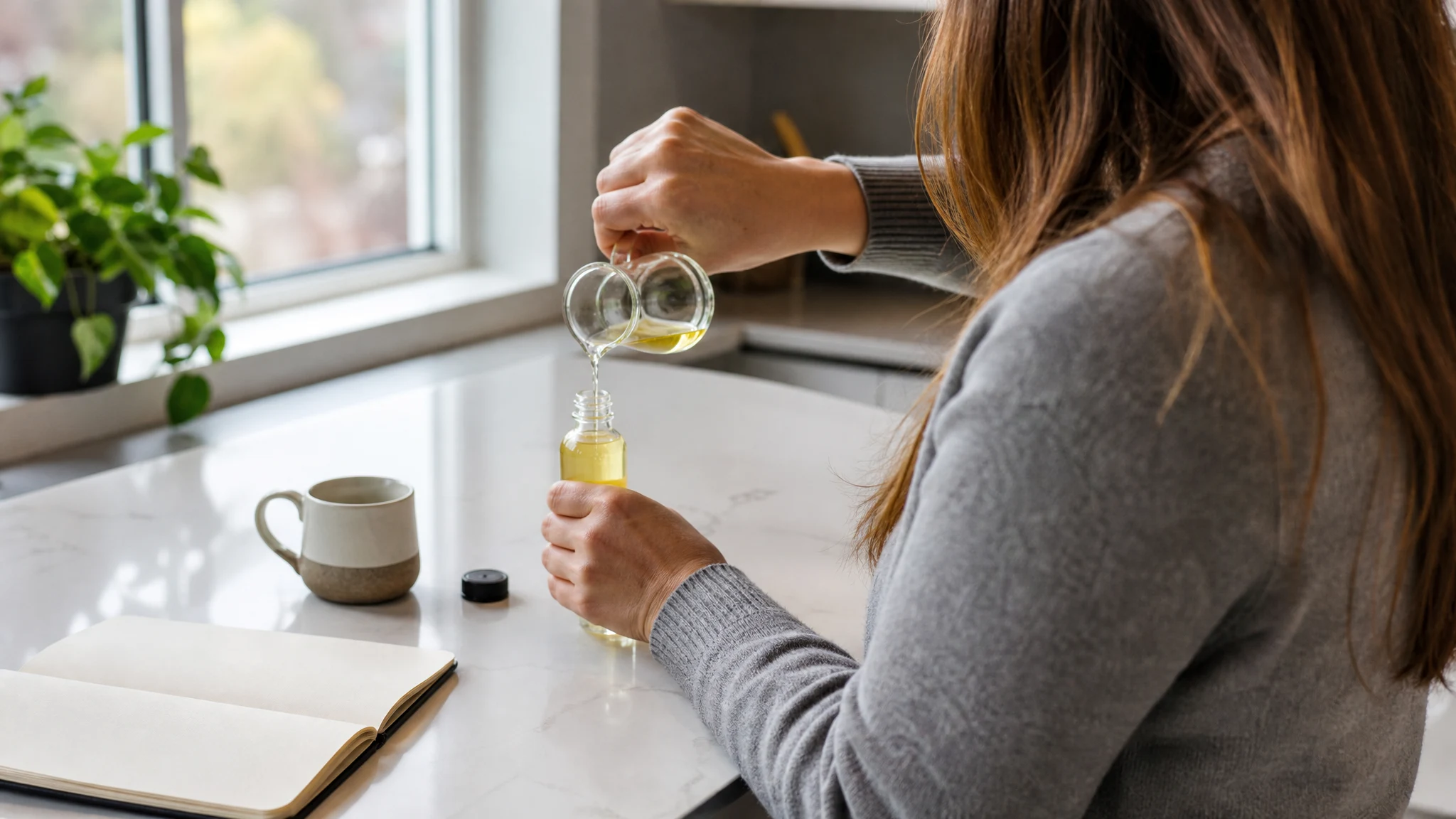
Mix the oils, undiluted, in a small glass vial at the ratio you chose: 6 drops clary sage, 4 lavender, 2 sandalwood, twelve in all. That stock is 0.6 ml of oil. For your 30 ml bottle at 1% you need 0.3 ml, which is half the vial, or 6 drops of stock. The ratio is built in, and you can scale the bottle size without recounting each oil. Write the date on the vial: it holds undiluted oil, so use it within the freshness window our storage article covers.
Which percentage?
We recommend 0.5% to 2% in a carrier oil, with a patch test first. The Tisserand Institute's general ranges, which it calls guidelines rather than rules, are 0.2% to 1% for sensitive or impaired skin, 0.5% to 1.2% for facial products and 1% to 3% for body oils. That page gives no figure for clary sage specifically, so when a range overlaps ours we start at the lower end. We do not offer 2% as a safe figure, and for any blend you plan to sell or use beyond your own skin, check the IFRA standards for your own formulation. Our dilution guide works through percentages for different uses.
Let the strictest oil set the ceiling
A blend is only as flexible as its most restricted ingredient. Bergamot is the textbook case: the Tisserand Institute, citing the IFRA guideline, gives a maximum of 0.4% bergamot oil in a leave-on product used on sun-exposed skin, unless you use a furanocoumarin-free version. In a 30 ml bottle, 0.4% is 0.12 ml, about 2 drops of bergamot, however much room the overall percentage leaves. So check each partner oil before you finalise a ratio, and build the blend downward from the tightest limit.
Smaller mistakes worth avoiding
- Adding oils to water. Oil and water do not combine, so a water-based spray needs a different approach, as in our room spray article.
- Mixing units. A volume percentage with a carrier you weigh is off by about a tenth, because oils are not the density of water; the batch on our published certificate has a relative density of 0.892.
- Making a year's worth. Blend what you will use soon; the older it gets, the more the oxidation points in that article matter for skin.
A blend is a small piece of arithmetic wearing a nice scent. Get the two sums in the right order and everything else is a matter of taste.
Clary Sage Essential Oil
Clary Sage Essential Oil from our own shop, in sizes from 0.5 oz to bulk.
From $19.99
Shop Now →Sources & Further Reading
- Dilution for essential oils, Tisserand Institute.
- How big is a drop?, Tisserand Institute.
- Phototoxicity: essential oils, sun and safety, Tisserand Institute.