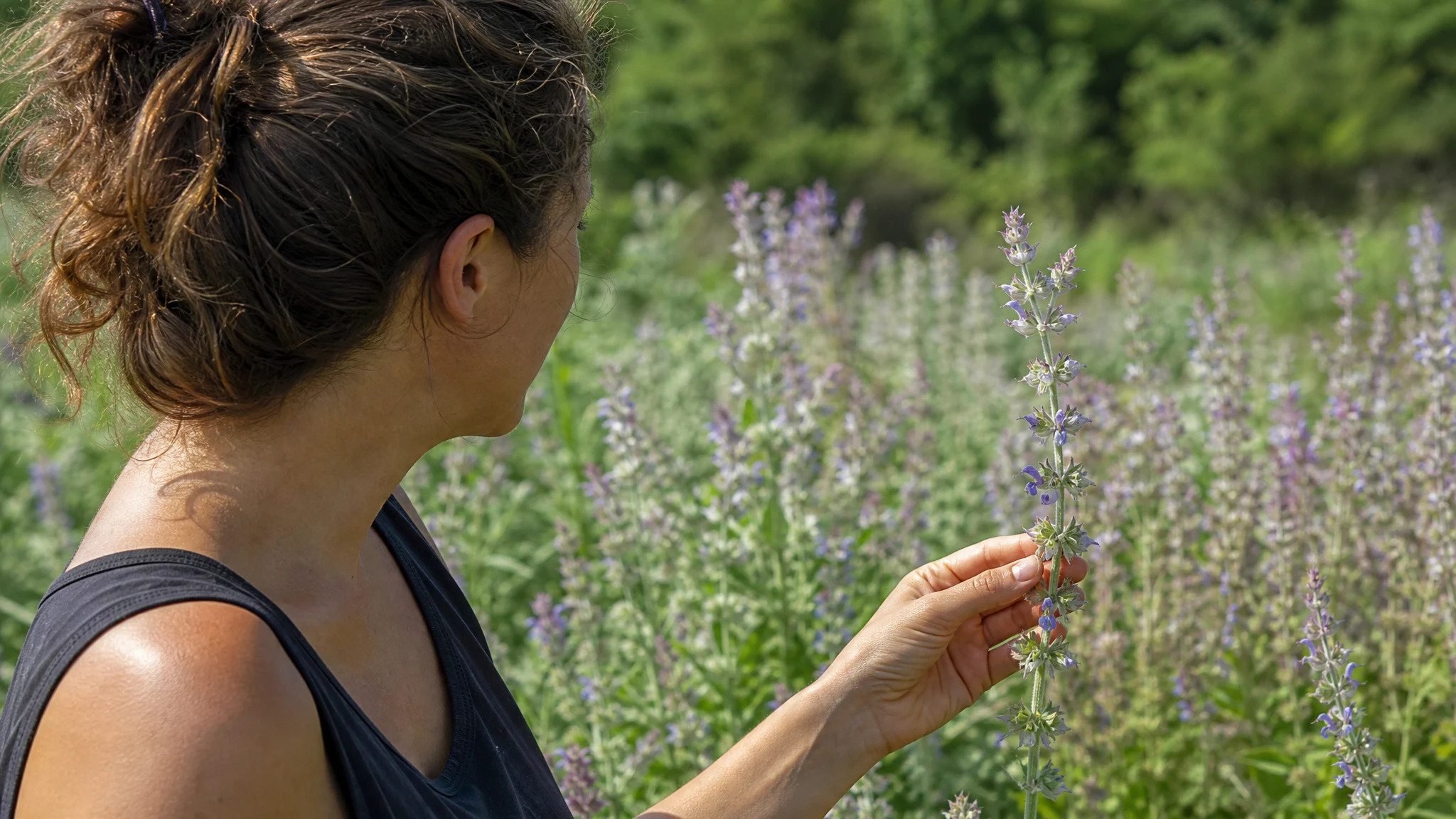
What Clary Sage Oil Smells Like
Smell clary sage oil and the words that come to mind are hay, tea, sweet herbs, a little nutty, a little musky. "Sharp" and "bright" are not on the list. It is a soft, dry, sweet-herbal oil that sits in the middle of a blend, and it rewards a slow sniff.

Clary Sage Essential Oil
Our own Clary Sage Essential Oil, in sizes from 0.5 oz to bulk.
From $19.99
Shop Now →How we describe it
Our clary sage oil is steam-distilled from the flowering tops and stems of Salvia sclarea. We describe the scent as sweet, dry and softly herbal, with nutty, tea-like undertones, a faint muskiness and a hay-like note. In perfume terms it is a middle note, the part of a blend that arrives after the first bright minutes and carries it along. The oil itself is typically a pale yellow to light olive liquid.
Perfumers have their own shorthand. A plant-biology paper on the clary sage flower notes the oil is used directly in perfume for a "tenacious, herbaceous, sweaty, and amber odor" (Chalvin et al., Horticulture Research, 2021). Different words, same neighbourhood: herbal, warm, a bit animalic at the edges.
What sits behind the scent
Most of the oil is linalyl acetate and linalool, the same pair that dominates lavender, which explains the sweet, floral-herbal core. In the three commercial batches analysed by the EFSA FEEDAP panel, 2024, linalyl acetate averaged about 68% and linalool about 15%. Where clary sage departs from lavender is the dry, hay-like edge. We would guess that comes from the smaller components, but no study we have read pins it on a particular compound, so we leave it as a guess.
Why two bottles can smell different
Clary sage oil is a natural product and it moves. Wild Greek plants hydrodistilled in a lab gave roughly 20 to 31% linalyl acetate (Pitarokili et al., 2002), against about 68% in the commercial French and Russian batches EFSA studied. Even within one plant, linalool and linalyl acetate are typical of the flowers while the leaves lean toward heavier sesquiterpenes (Schmiderer et al., Plant Biology, 2008). Distil more flower and you would expect a sweeter profile; distil more leaf and you would expect it to shift. Climate, soil and harvest timing add their own influence. If you buy clary sage from two sources, expect the same family and a different personality. The origin comparison goes through the papers.
A better way to smell it
Skip the bottle opening and your wrist. A paper blotter shows you the oil as it develops.
- Dip about a centimetre of a blotter, wave it for a moment, and smell from about 5 cm away.
- Come back at 5 minutes, 30 minutes and 2 hours, and write down the word you would use each time.
- Smell lavender and a common sage oil the same way on separate strips. Notice where clary sage lands between them. Clary sage vs sage explains why they are not the same plant.
- Reset your nose with a fresh blotter or your sleeve between samples.
Noses adapt within minutes and everyone's vocabulary is a little different, so treat your notes as a personal map. Smell the same oil again after a few weeks and compare; a bottle that has started to smell sharp or flat is a cue to check how long it has been open. Our storage guide covers keeping it fresh. Smell is not a safety test, though: oxidation products can form without an obvious change.
If you want the composition rather than the poetry, ask us in writing through the contact page for the report on your lot before you rely on it.
Before you sniff deeply
EFSA's panel treated the oil as an irritant to skin and eyes and a dermal and respiratory sensitiser, so people with fragrance allergy or scent-reactive asthma should ask a physician or allergist first. We advise avoiding the oil during pregnancy, and it is not the oil to reach for before driving. For skin we recommend 0.5% to 2% in a carrier oil such as jojoba or sweet almond, with a patch test first.
Start with the blotter, write down your three words, and see whether they match ours.
Clary Sage Essential Oil
Clary Sage Essential Oil from our own shop, in sizes from 0.5 oz to bulk.
From $19.99
Shop Now →Sources & Further Reading
- EFSA FEEDAP Panel, 2024. Safety and efficacy of a feed additive consisting of an essential oil derived from the flowering stems of Salvia sclarea L. (clary sage oil). PMC11561422
- Chalvin C, et al., 2021. Sclareol and linalyl acetate are produced by glandular trichomes through the MEP pathway. PMC8484277
- Pitarokili D, et al., 2002. Composition and antifungal activity on soil-borne pathogens of the essential oil of Salvia sclarea from Greece. PubMed 12405762
- Schmiderer C, et al., 2008. Diversity of essential oil glands of clary sage. PubMed 18557903