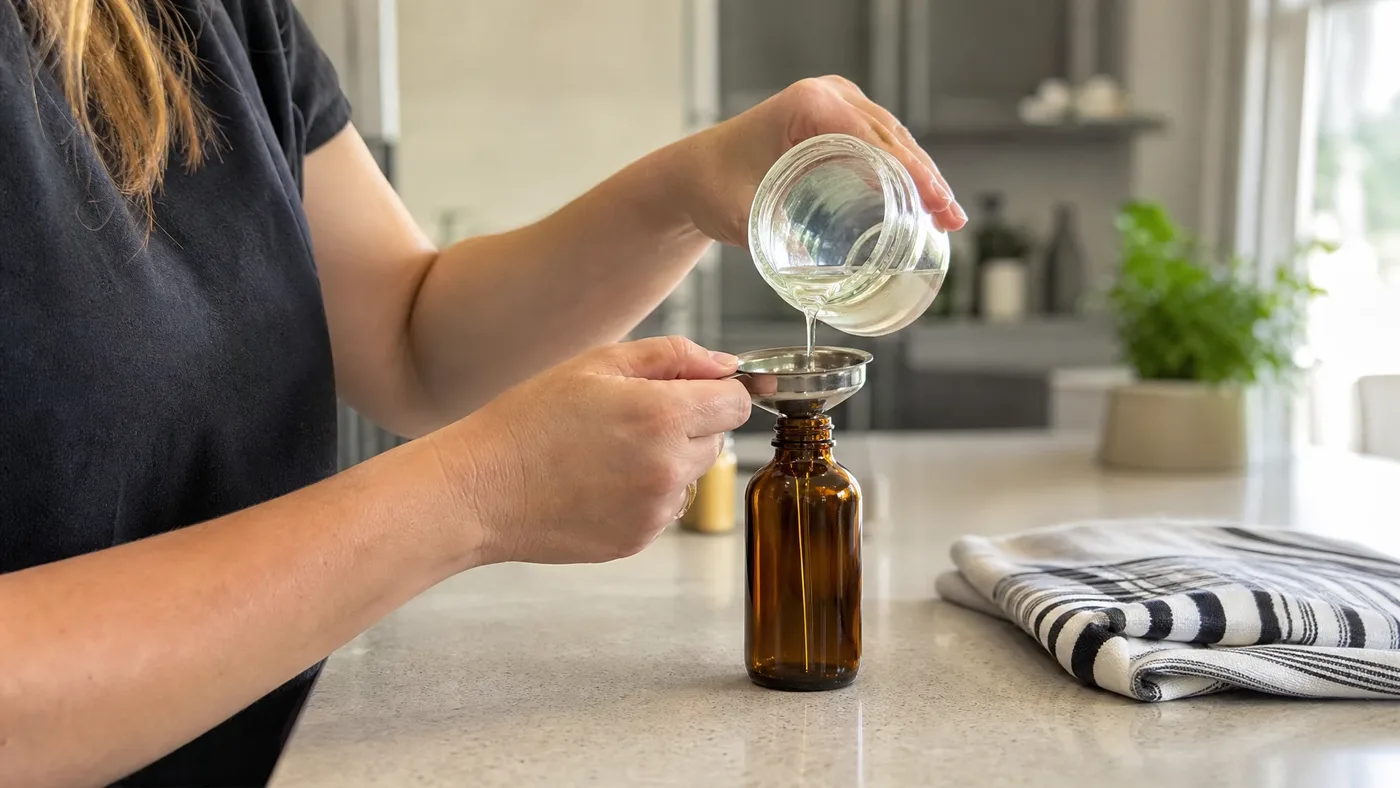
Measure, Don't Count: Making a Clary Sage Roller
A roller bottle looks harmless: it is tiny, and the amounts of oil it takes are tiny too. That is exactly why it is worth measuring. Ten milliliters of carrier and a single clary sage drop more or less than you meant can swing the percentage a long way, so the one habit we would borrow from the lab is to measure the oil by volume and not count drops.

Clary Sage Essential Oil
Our own Clary Sage Essential Oil, in sizes from 0.5 oz to bulk.
From $19.99
Shop Now →Where the numbers come from
The Tisserand Institute lists use-based ranges: 0.5% to 1.2% for facial cosmetics and deodorants, 1% to 3% for body oils and lotions, and 3% to 10% for rollerballs used on a small area of skin. It calls them guidelines and says to start low. Our own recommendation for clary sage oil on skin is 0.5% to 2% in a carrier, with a patch test first, and for a roller we would sit toward the low end and begin at 1%. The European Food Safety Authority's 2024 assessment of clary sage oil (written for animal feed, so not a skin limit) says it should be considered an irritant to skin and eyes and a dermal and respiratory sensitiser. That is our reason to prefer a modest roller over the top of a generic chart.
A 10 ml roller, worked out
A percentage is just a fraction of the bottle: 1% of 10 ml is 0.1 ml of oil. Drops are where the arithmetic wobbles, because droppers differ. Take six drops. If your dropper gives 20 drops to the millilitre, that is 0.3 ml, or 3% in a 10 ml roller. If it gives 40, six drops is 0.15 ml, or 1.5%. Same recipe, double the strength.
| Target | Oil in 10 ml | Drops at 20 per ml |
|---|---|---|
| 0.5% | 0.05 ml | 1 |
| 1% | 0.1 ml | 2 |
| 2% | 0.2 ml | 4 |
A graduated pipette or a small syringe from a craft or laboratory supplier reads in milliliters and removes the guesswork. We sell the oil only, so the roller bottle, carrier and pipette come from a craft or supply shop.
Three roller formulas
These come straight from the arithmetic above. Patch test any of them first (our patch test guide explains how) and adjust to taste.
- Clary sage alone, 1%: 0.1 ml of clary sage oil, topped up to 10 ml with carrier. Start here, because if your skin objects there is only one oil to blame.
- Clary sage and lavender, 1% total: 0.07 ml clary sage and 0.03 ml lavender, filled to 10 ml. Lavender is on our list of good partners; you would buy it elsewhere.
- Clary sage and vetiver, 1% total: 0.06 ml clary sage and 0.04 ml vetiver for a drier, deeper scent.
The percentage limit applies to all the oils together, not to each one. Our pairing guide has more partner ideas, and how to dilute clary sage oil covers carrier maths in more depth.
A note on bergamot
Bergamot is a popular roller partner, and it has a hard limit. Expressed (cold-pressed) bergamot oil is phototoxic. The Tisserand Institute says to keep it to 0.4% in the final product for skin exposed to sun, and describes bergapten-free (FCF) bergamot as considered non-phototoxic. In a 10 ml roller, 0.4% is 0.04 ml, which is less than one drop from a 20-per-ml dropper (one drop there is 0.05 ml, or 0.5%). With wrists and neck being places the sun reaches, a measured volume or a bergapten-free bergamot is the safer route.
When a roll-on is not the right idea
- Before driving or anything that needs alertness: clary sage is not the oil to reach for then, and a roller keeps the scent at your wrists all day.
- During pregnancy: we advise avoiding it, and an OB-GYN or midwife is the person to ask.
- Around children and pets: keep it away from both, and ask a pediatrician or veterinarian.
- On skin that is inflamed, broken or reactive. Tisserand's range for impaired skin is 0.2% to 1%, and a dermatologist is the right starting point.
Label the bottle with the oil, the percentage and the date, make small batches, and wear it as a fragrance, because that is what a clary sage roller does best.
Clary Sage Essential Oil
Clary Sage Essential Oil from our own shop, in sizes from 0.5 oz to bulk.
From $19.99
Shop Now →Sources & Further Reading
- Tisserand Institute. Dilution for essential oils. tisserandinstitute.org/dilution-essential-oils
- Tisserand Institute. Phototoxicity. tisserandinstitute.org/safety/phototoxicity
- EFSA FEEDAP Panel, 2024. Safety and efficacy of a feed additive consisting of an essential oil derived from the flowering stems of Salvia sclarea L. pmc.ncbi.nlm.nih.gov/articles/PMC11561422