Buying Clary Sage Oil in Bulk: From Sample to Drum
At bulk scale, a drum is judged less by its scent than by whether you can defend it to your own customers and formulator. A drum that smells right but comes with only a page of physical measurements leaves a gap, and the sensible way to close it is to decide what you need in writing before you order.

Clary Sage Essential Oil
Our own Clary Sage Essential Oil, in sizes from 0.5 oz to bulk.
From $19.99
Shop Now →Picture the size
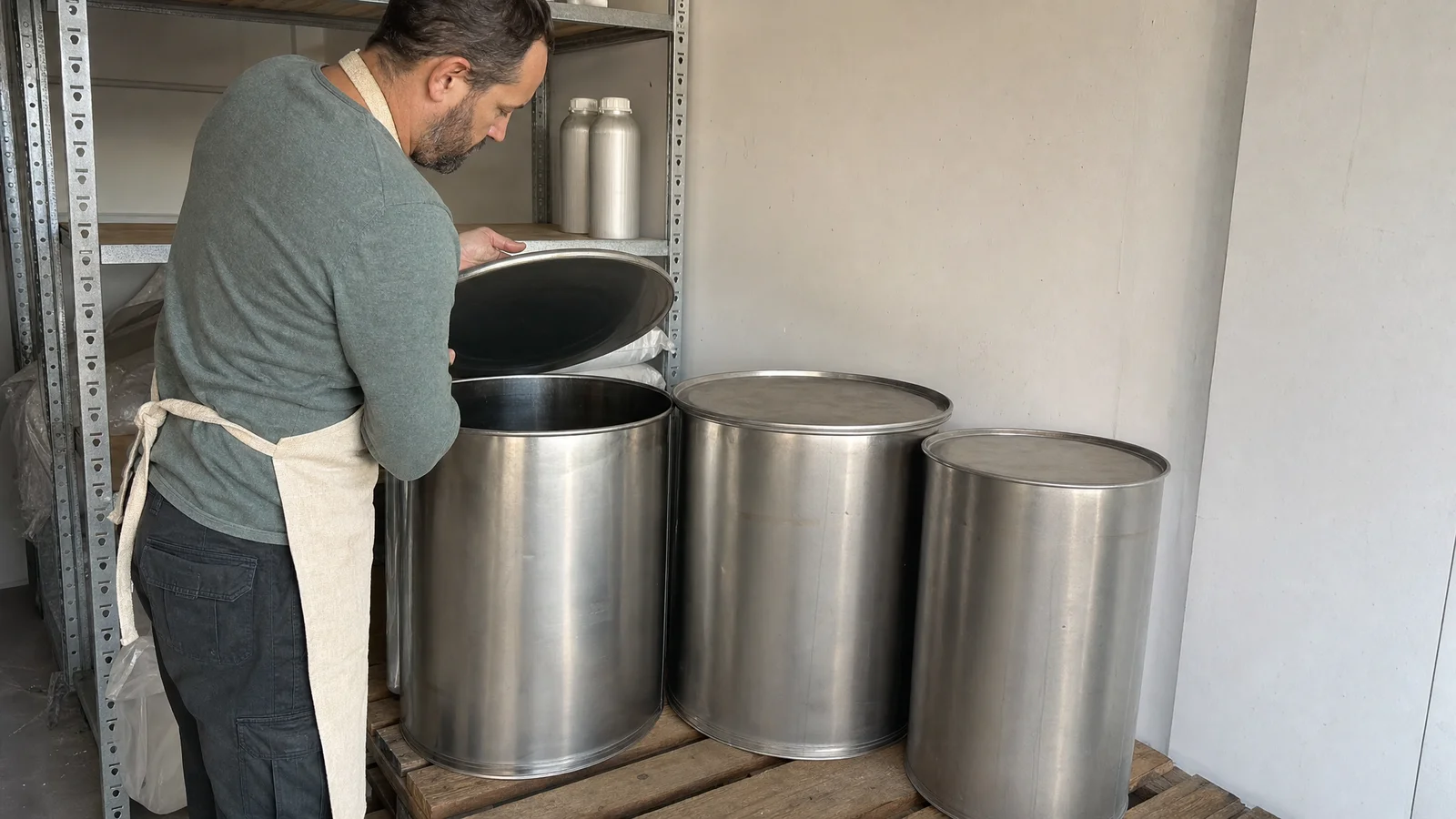
We sell clary sage oil in 5, 25, 100 and 400 lb sizes as well as bottles. The Certificate of Analysis we publish for one batch lists a relative density of 0.892 (its standard window is 0.879 to 0.910), so another batch will differ slightly, but it is a fair planning basis.
| Size | Grams | Litres, approx. | Finished product at 1% oil by weight |
|---|---|---|---|
| 5 lb | 2,268 g | 2.5 L | about 227 kg |
| 25 lb | 11,340 g | 12.7 L | about 1,134 kg |
| 100 lb | 45,359 g | 50.9 L | about 4,536 kg |
| 400 lb | 181,437 g | 203 L | about 18,144 kg |
The last column is the sanity check people skip. Work out how many months of production an order represents before you pick a size, because oil ages, and a 100 lb order used over three years is a different proposition from one used over three months.
Documents to request, in order
- A composition report for your lot. GC-MS lists the compounds. EFSA's specification for clary sage oil is 55% to 78% linalyl acetate and 6.5% to 25% linalool, and its three tested batches of one commercial oil ran roughly 62% to 75% linalyl acetate, while another steam-distilled sample came in at 49.1% (Kačániová et al., 2023). No single number defines good, so write your own specification and check the report against it.
- Physical constants. Density, refractive index and optical rotation are cheap and quick, and worth having alongside GC-MS, but they cannot show composition alone.
- Matching wording. Quote, label and report should agree on species, plant part and method. Sort out any difference in writing before you pay.
- Dates and lot numbers. Our bottles carry a lot, which is how a report is tied to your oil.
- Safety paperwork for your market. A safety data sheet, IFRA documents or allergen declarations are yours to request and verify. Ask us in writing and take the answer as the answer.
What we offer
The certificate we publish covers one batch and gives density, refractive index and optical rotation. For a composition report on your lot, ask through our wholesale page or the contact page and compare it with your own specification before committing to a large quantity. Our wholesale page also offers sample bottles, a free consultation and private label or custom formulation enquiries, and orders ship in one to two business days, though bulk sizes may need extra handling. Start with a sample. It is the cheapest way to learn whether the scent works in your base, whether it affects the colour of your product, and whether the documents you receive are the documents you asked for.
Handling a large quantity of an oil that ages
Linalyl acetate changes with air. In mice, a sample exposed to air for 10 weeks was a stronger sensitiser than the fresh compound (EC3 3.6% against 25%; Sköld et al., 2008), and the same group found linalool is not sensitising when fresh but becomes so on air exposure (Sköld et al., 2004). Those were isolated compounds in mice, so reading across to your drum is reasoning, but the practical advice is simple.
- Do not leave a large container half empty and open. Decant into smaller, full, tightly closed containers when you start.
- Keep it cool and out of light. Our guidance is that the oil typically stays vibrant for 3 to 4 years in a tightly capped bottle kept shaded, and a drum you open repeatedly deserves extra care.
- Write the opening date on every container and set your own re-test date with your lab.
Formulating responsibly
EFSA classes the oil as an irritant to skin and eyes and a dermal and respiratory sensitiser, and notes the applicant supplied no user-safety data. For a leave-on product, dilution, allergen labelling and claims are your regulatory responsibility, and a cosmetic chemist or regulatory consultant is the right person to set the usage rate. Our skin guidance, 0.5% to 2% in a carrier oil with a patch test, is for individual use, not a product-safety assessment. Keep health claims out of your marketing: the FDA says claims about treating disease or affecting body structure or function make a product a drug. We sell clary sage essential oil only, so hydrosol, absolute, blends and carrier oils come from a specialist supplier, with the same document checks.
A purchasing sequence that works
Order a sample, request the lot report and safety documents, check them against your written specification, place a small first order, run your stability test in your own base, then scale. For sampling and testing sizes see our size guide; for the report, how to read a GC/MS report; for the general checklist, buying online.
Put your specification in writing first and the rest of the process gets easier.
Clary Sage Essential Oil
Clary Sage Essential Oil from our own shop, in sizes from 0.5 oz to bulk.
From $19.99
Shop Now →Sources & Further Reading
- EFSA FEEDAP Panel, 2024. Safety and efficacy of a feed additive consisting of an essential oil derived from the flowering stems of Salvia sclarea L. (clary sage oil). EFSA Journal 22(11):e9016. doi.org/10.2903/j.efsa.2024.9016
- Kačániová M et al., 2023. Salvia sclarea essential oil chemical composition and biological activities. Int J Mol Sci. PMC10049179
- Sköld M et al., 2008. Autoxidation of linalyl acetate creates potent contact allergens. Contact Dermatitis. PubMed 18154552
- Sköld M et al., 2004. Contact allergens formed on air exposure of linalool. Chem Res Toxicol. PubMed 15606147
- US FDA. Cosmetics Labeling Claims. fda.gov