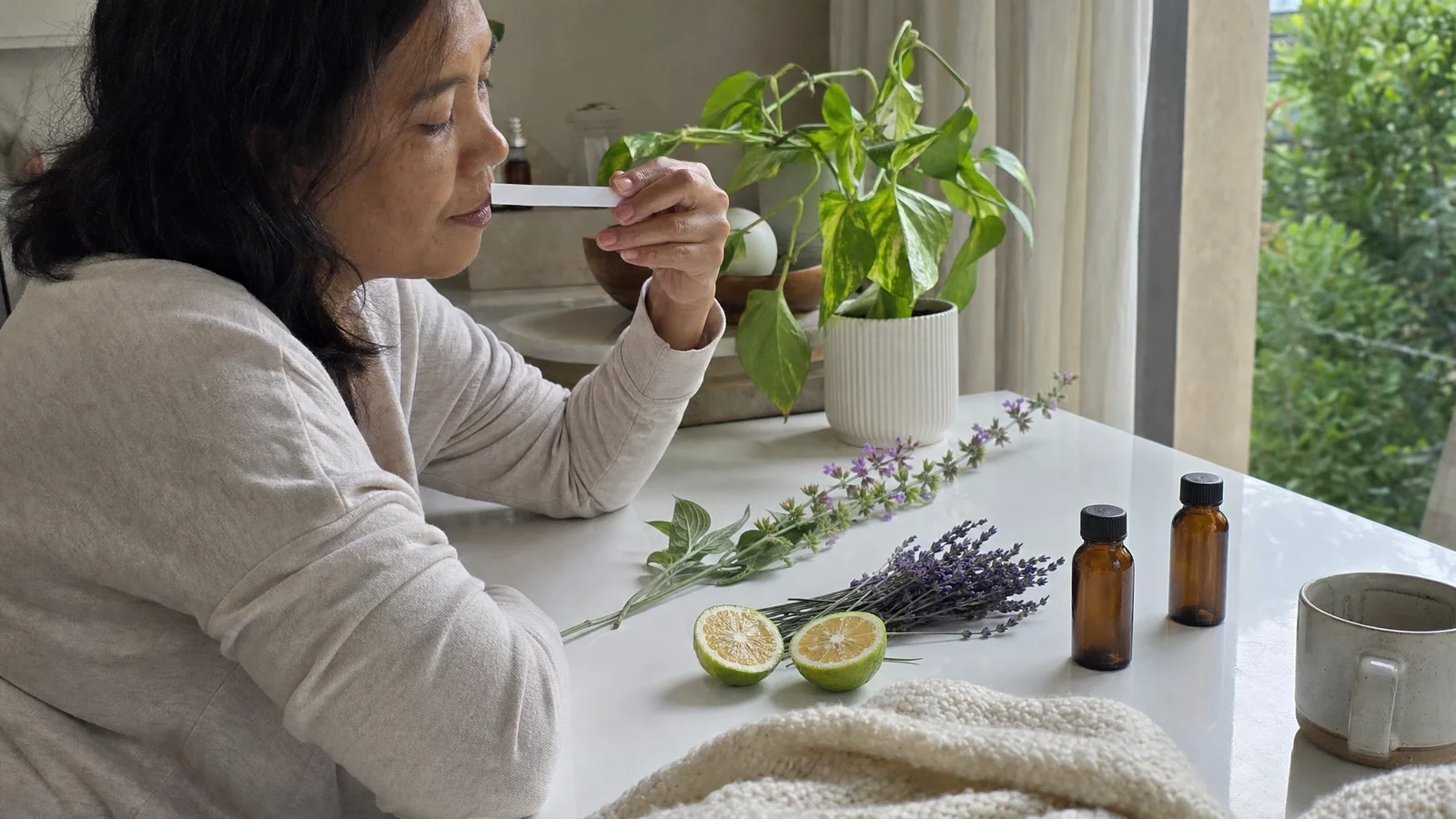
What Blends Well With Clary Sage
Clary sage blends beautifully, but it helps to know why. It pairs in one of two ways: with oils that share its chemistry, so the blend reads as one smooth sweet-herbal body, or with oils that supply what it lacks, a bright opening and a deeper base. Decide which you want and the partner picks itself.

Clary Sage Essential Oil
Our own Clary Sage Essential Oil, in sizes from 0.5 oz to bulk.
From $19.99
Shop Now →Overlap or contrast
Start with what the blend is missing. Clary sage is mostly linalyl acetate and linalool (about 68% and 15% across three batches in the EFSA FEEDAP panel, 2024), with only around half a percent of sclareol. That makes it soft and sweet, with little weight at the bottom, so the usual gaps are brightness and depth. Our own pairing list is lavender, bergamot, geranium, sandalwood and vetiver, and each one answers a different gap.
- Smoother and rounder: lavender. Linalyl acetate is also the main component of lavender oil (Sköld et al., Contact Dermatitis, 2008), so the two melt together. See clary sage vs lavender for the differences.
- A bright opening: bergamot. A perfumer's convention is to put a citrus on top of a middle note, and this one has the good manners to leave clary sage alone.
- A floral heart: geranium.
- Depth and staying power: sandalwood or vetiver. Clary sage will not supply base weight, which the base note article explains, so the woods do that job.
A first ten-drop vial
Write a blend as parts, then count drops. For a smooth, lavender-led heart with a little depth, try 4 parts clary sage, 3 lavender, 2 sandalwood and 1 bergamot. For a contrast build, try 3 clary sage, 4 vetiver, 2 bergamot and 1 geranium; it is deliberately base-heavy because vetiver is the part that lasts. These are starting arrangements to compare on a blotter, not fixed recipes. Change one part at a time and smell again at 10 minutes and at 2 hours. Add the heaviest oil first, clary sage next and the brightest last, so the part you will most want to nudge is the part you add at the end.
Drops are an imprecise unit. About 20 drops per millilitre is a rough convention and droppers differ, so weigh when you scale up. The batch on our published Certificate of Analysis has a relative density of 0.892, which means 1 ml weighs about 0.89 g; the other oils will differ.
From blend to skin, in arithmetic
Our guidance for skin is 0.5% to 2% in a carrier oil such as jojoba or sweet almond, with a patch test first. Treat 2% as the ceiling for the whole blend, not for each oil in it, and check IFRA guidance for your own formulation. One ounce of carrier is 29.57 ml. Ten drops of blend is about 0.5 ml, which is roughly 1.7% in an ounce of carrier. Twenty drops is about 3.4%, over the ceiling. Carrier oils come from a carrier-oil supplier, as we sell clary sage only. For worked quantities, see the massage oil batches and the roll-on maths.
Keeping a linalool-rich blend fresh
Lavender, bergamot and clary sage all carry linalool and linalyl acetate, which is why they sound so harmonious. Both molecules oxidise in air, and lavender oil that had been exposed to air produced positive patch tests in people already allergic to oxidised linalool (Hagvall et al., Contact Dermatitis, 2008). That work did not involve blends or clary sage, so what follows is reasoning: keep bottles capped, write the date opened on each, and do not hold a mixed vial for a year. A woody or resinous partner also spreads out the overlap.
Smell the vial again the next day against a blotter of clary sage alone. If clary sage has vanished into the others, raise it by one part; if it dominates, lower it by one. Write the change beside the ratio and you will have something you can reproduce.
When to leave it out
We advise avoiding clary sage oil during pregnancy, and our pregnancy article covers what sources say. Ask a veterinarian before diffusing around pets. EFSA's panel considered the oil a skin and eye irritant and a dermal and respiratory sensitiser, and it is not the oil to reach for before driving. If a partner oil is a sensitiser for you, the blend inherits that.
Choose the partner by the gap you want to fill, make a ten-drop vial before a big batch, and keep your notes.
Clary Sage Essential Oil
Clary Sage Essential Oil from our own shop, in sizes from 0.5 oz to bulk.
From $19.99
Shop Now →Sources & Further Reading
- EFSA FEEDAP Panel, 2024. Safety and efficacy of a feed additive consisting of an essential oil derived from the flowering stems of Salvia sclarea L. (clary sage oil). PMC11561422
- Sköld M, Hagvall L, Karlberg AT, 2008. Autoxidation of linalyl acetate, the main component of lavender oil, creates potent contact allergens. PubMed 18154552
- Hagvall L, et al., 2008. Lavender oil lacks natural protection against autoxidation, forming strong contact allergens on air exposure. PubMed 18759894