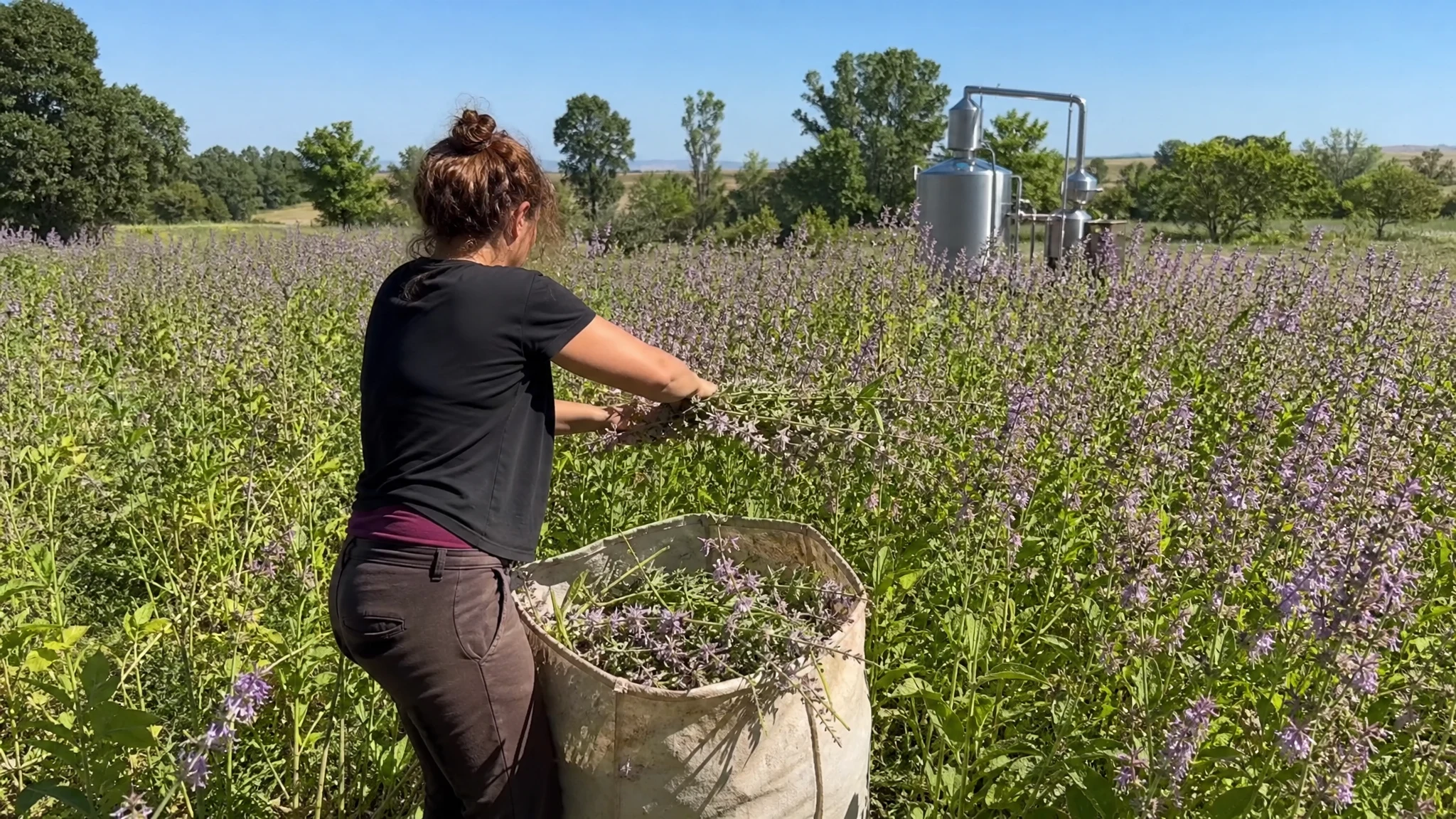
How Clary Sage Oil Is Made, from Flowering Stems to Bottle
Clary sage is a biennial: in its first year it is mostly a low rosette of leaves and roots, and in its second year it sends up tall flowering stems. That second-year stem is what ends up in the still, and the way it is cut, distilled and bottled explains a lot about why clary sage oil smells the way it does.

Clary Sage Essential Oil
Our own Clary Sage Essential Oil, in sizes from 0.5 oz to bulk.
From $19.99
Shop Now →One cut, then steam
We cut the flowering stems while the bracts, the colourful leaf-like parts around the flowers, are still bright. Our oil is steam-distilled from the flowering tops and stems of Salvia sclarea, and we distil it ourselves. In steam distillation, steam is passed through the cut plant material; the steam carries the aromatic compounds with it, cools back to water in a condenser, and the oil separates from the water and is collected. An EFSA panel describes the process the same way for clary sage: steam distillation of fresh or dried flowering stems, with the oil "separated from the aqueous phase by decantation" (EFSA FEEDAP Panel, 2024).
One detail we care about is the end of the run. We take the distillation to its end, because the sweeter fractions come later. Stop early and you lose some of the sweetness that makes clary sage worth wearing. Steam distillation is not the only method in the research; some studies use hydrodistillation, where the plant sits in boiling water instead, such as an Indian field trial that ran a Clevenger apparatus for six hours (Dhiman et al., Sci Rep, 2024). The two are often used loosely, and the papers we read do not compare them head to head, so we would be wary of anyone who says one is simply better.
Why a tiny amount of oil comes out
Essential oil is a small fraction of the plant. That same field trial reported oil content between about 0.16% and 0.19% in its plots, so most of what goes into the still is plant material that stays behind. It is a good reminder that distilled oils are concentrated, which is why we recommend diluting ours to 0.5% to 2% in a carrier oil for skin, with a patch test first.
Same species, different oils
If you read compositional studies, you will quickly notice that "clary sage oil" is not one fixed recipe. The EFSA panel's three batches ranged from 61.87% to 74.84% linalyl acetate, the ester behind much of the soft, sweet character. Six Greek oils in another study ran from 21.2% to 25.7% (Tomou et al., Molecules, 2024). The same compounds were present in all of them, just in different proportions, and the authors point to plant part, harvest time, origin and growing conditions as drivers. That is why we do not treat one component as a quality score; our linalyl acetate article goes deeper, and the origin comparison looks at regional differences.
Bottling and traceability
We stamp each bottle with the day it was distilled, the day it was filled and the lot behind both, and we use amber glass across our size range to keep light off the oil. If you need more than that for your own work, such as GC-MS for a particular lot, ask us in writing through our contact page before you order. The Certificate of Analysis we publish for one batch lists relative density, refractive index and optical rotation. Bulk and private-label buyers can start at our wholesale page.
Questions to ask any clary sage seller
- Which part of the plant went into the still?
- Was it distilled at all, or is it an absolute or CO2 extract? Our comparison explains the difference.
- Does the paperwork name the lot you are buying, and does it show composition or only physical constants?
Our buying checklist expands on these, and if the plant itself interests you, our growing guide follows it from seed to flower. A home still is not a good idea: hot steam, flammable vapour and a very small amount of oil make it a project for professionals.
Next time you open a bottle of clary sage, the sweet, dry, nutty scent is a second-year stem, a cut at the right moment and a distillation run to its end.
Clary Sage Essential Oil
Clary Sage Essential Oil from our own shop, in sizes from 0.5 oz to bulk.
From $19.99
Shop Now →Sources & Further Reading
- EFSA FEEDAP Panel, 2024. Clary sage (Salvia sclarea) essential oil as a feed additive. EFSA J 22(11):e9016. pmc.ncbi.nlm.nih.gov/articles/PMC11561422/
- Dhiman D et al., 2024. Mulch and nitrogen management on growth and essential oil yield of Salvia sclarea. Sci Rep. pmc.ncbi.nlm.nih.gov/articles/PMC11686162/
- Tomou EM et al., 2024. Variability in the composition of essential oils in 10 Salvia species. Molecules 29(7). pmc.ncbi.nlm.nih.gov/articles/PMC11013157/