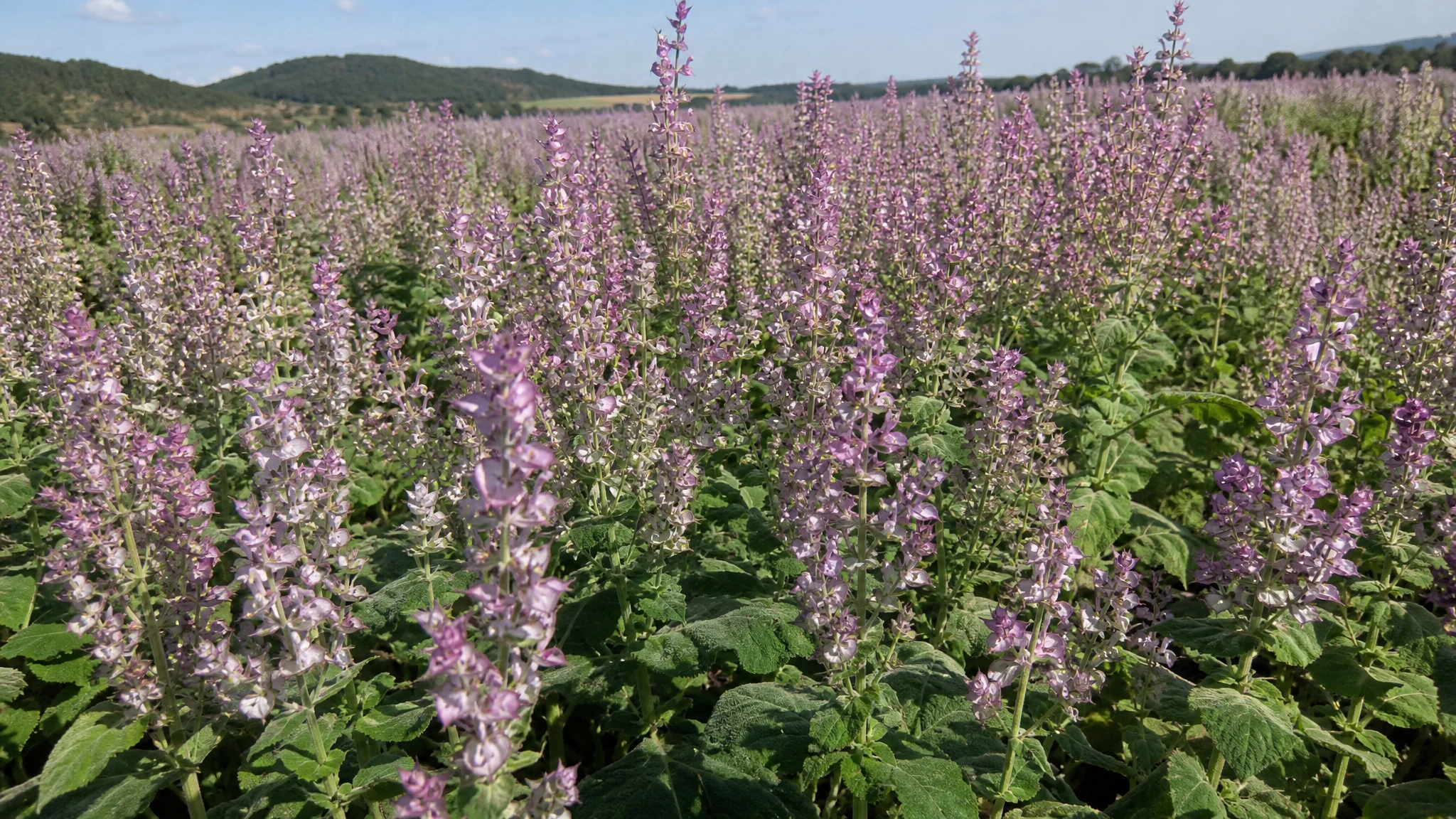
Meet Clary Sage Oil, the Muscatel Herb
The name "muscatel herb" comes from an old association between clary sage and muscat-style wine, and it is a lovely image: a tall, pink-bracted plant with a sweet, almost grapey haze around it in summer. What ends up in a bottle is more specific. This is what we would tell a curious customer about the plant, the oil and how to choose one.

Clary Sage Essential Oil
Our own Clary Sage Essential Oil, in sizes from 0.5 oz to bulk.
From $19.99
Shop Now →One plant, several products
Clary sage is Salvia sclarea, a member of the mint family, native to southern Europe and grown widely. A 2023 review describes plants up to 130 cm with flowering spikes up to 40 cm, and even calls it "biannual or perennial", so botanists do not entirely agree on its life cycle. The name covers more than one product. The essential oil is steam-distilled, and that is what we sell. An absolute or a CO2 extract is made with solvents or pressurised carbon dioxide (we do not sell either; see the comparison). Seed oil is a different material altogether (more here). None of them is culinary sage, as this piece explains.
What is in the bottle
The two big components are linalyl acetate and linalool, with a little sclareol. Published figures vary a lot. A 2024 EFSA assessment of three batches from France or Russia gave linalyl acetate at roughly 62 to 75%, while six Greek samples came in at about 21 to 26%, and a Slovak oil at about 49%. The authors put the spread down to genotype, geography, climate, harvest time and the plant part distilled. The takeaway is a comforting one: a bottle that smells a little different from last year's is not automatically adulterated, and a bottle that matches a textbook figure is not automatically better. We describe ours as sweet, dry and softly herbal, with nutty, tea-like undertones, a middle note that blends well with lavender, bergamot, geranium, sandalwood and vetiver.
What our paperwork gives you
We sell one clary sage oil, Salvia sclarea, undiluted and with no additives, in sizes from 0.5 oz up to 400 lb. The Certificate of Analysis we publish covers one batch and lists relative density, refractive index and optical rotation beside the standards it was checked against, concluding that the batch complies with pharmacopoeia standards for genuine clary sage oil. It does not include a composition breakdown. If you want one for a perfume you are developing, or a product you plan to sell, ask us in writing through the contact page and name your lot. When it arrives, our guide to reading a GC/MS report will help you read it.
The health question, answered plainly
Clary sage is first a perfumery material, used for generations in scents and cosmetics. People often ask about the health side. We make no health claims for our oil and the research is thin: one small 2014 study of 22 menopausal women measured blood chemistry after inhalation, but the abstract describes no placebo group, so it cannot show the oil caused the change (details here). For a health question, see a physician or pharmacist.
Handling it well
- Dilute for skin. We recommend 0.5% to 2% in a carrier oil such as jojoba or sweet almond, and a patch test first. The EFSA panel considers the oil an irritant to skin and eyes and a sensitiser (its assessment was for animal feed, so it is not a consumer dilution rule). See how to patch test.
- Pregnancy and driving. We recommend avoiding it during pregnancy (an obstetric clinician or midwife can advise; see our pregnancy piece), and it is not the oil to reach for before driving.
- Do not swallow it. Here is the arithmetic.
- Pets and children. Keep it out of reach. If an animal is exposed, call a veterinarian.
Treat it as the aromatic plant it is, and it will reward you with one of the most interesting scents in the cupboard.
Clary Sage Essential Oil
Clary Sage Essential Oil from our own shop, in sizes from 0.5 oz to bulk.
From $19.99
Shop Now →Sources & Further Reading
- Kacaniova M et al., 2023. Salvia sclarea Essential Oil Chemical Composition and Biological Activities. Int J Mol Sci. PMC10049179
- EFSA FEEDAP Panel, 2024. EFSA Journal 22(11):e9016. PMC11561422
- Tomou EM et al., 2024. Molecules 29(7):1547. PMC11013157
- Lee KB et al., 2014. Phytotherapy Research. pubmed.ncbi.nlm.nih.gov/24802524