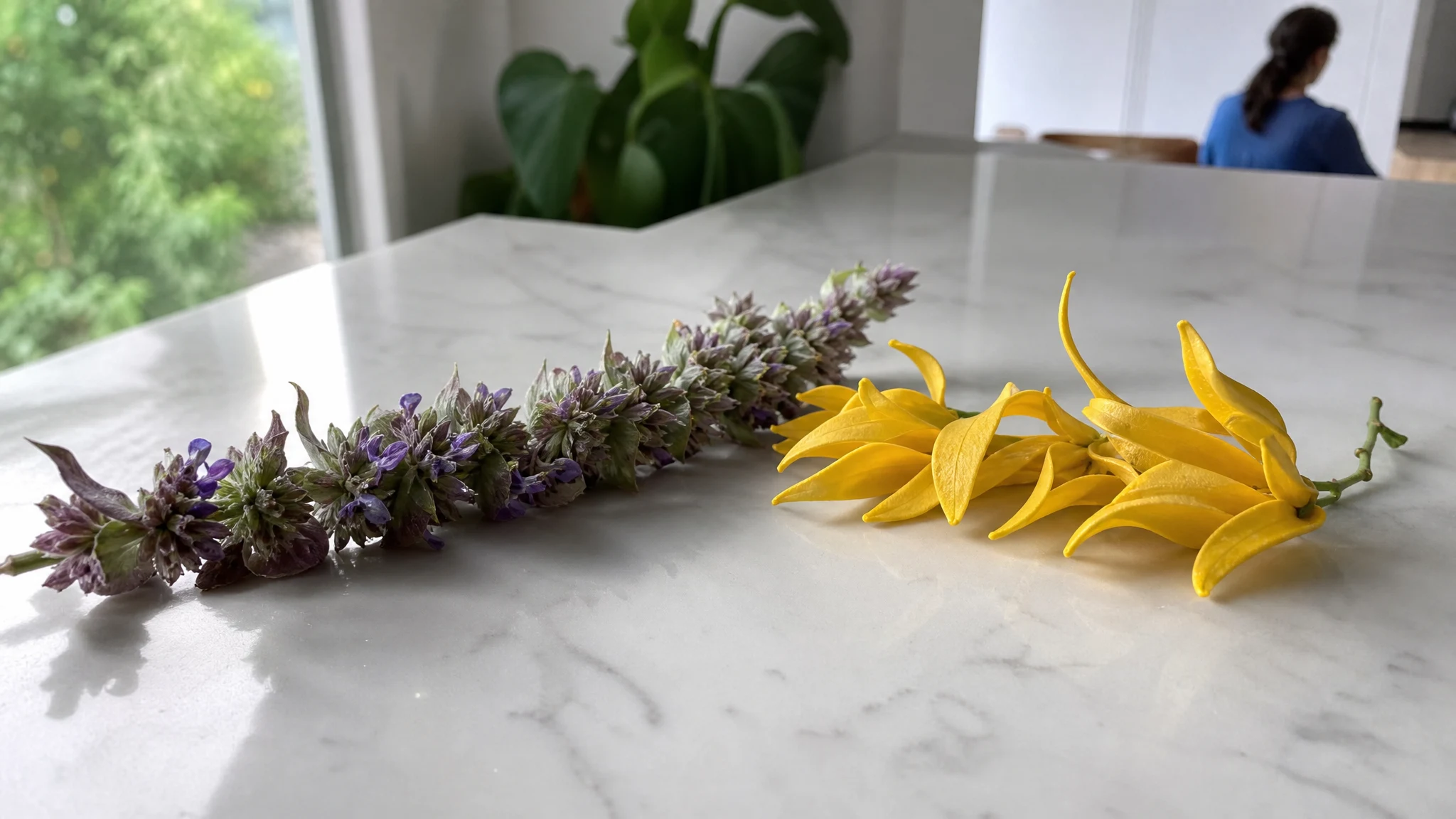
Clary Sage vs Ylang Ylang: Why They Are Not Twins
On a perfumer's shelf, clary sage and ylang ylang often sit side by side, and they get described in the same breath as rich, rounded oils. Look at what is actually in the bottles and they have very little in common. Clary sage is a story about two molecules. Ylang ylang is a story about grades.

Clary Sage Essential Oil
Our own Clary Sage Essential Oil, in sizes from 0.5 oz to bulk.
From $19.99
Shop Now →One oil versus five
Clary sage oil, as the European Food Safety Authority describes it, is steam-distilled from the flowering stems of Salvia sclarea and built mostly on linalyl acetate and linalool, with a specification of 55 to 78% and 6.5 to 25% respectively (EFSA FEEDAP Panel, 2024). Our oil is a single product, sweet, dry and softly herbal with nutty, tea-like undertones.
Ylang ylang, from the flowers of Cananga odorata, is collected in fractions as distillation runs on, and sold under five AFNOR grades: Extra-Sup, Extra, First, Second and Third. The composition shifts a long way between them. In the top grade, linalool runs 8 to 13% and benzyl acetate 14 to 20%. In the Third grade for Comoros oil, linalool falls to 0.1 to 2% while germacrene D rises to 20 to 35% (Chakira et al., Plants, 2025). Origin changes the picture too, since the same table lists different Madagascar ranges.
So "which smells better, clary sage or ylang ylang?" has no single answer. An Extra-Sup ylang is creamy and floral in its chemistry; a Third-grade one is mostly sesquiterpenes. The useful question for ylang is always which grade, from where.
Where they genuinely overlap
Linalool, mainly. Both oils contain it, and it is the reason both belong to the family of fragrance materials people are advised to patch test. A 2024 review of fragrance patch testing notes that ylang ylang oil is included in several baseline series at 2.0% in petrolatum and that it showed the highest rate of contact allergy among essential oils tested in the US and Europe in 2009 to 2014, up to about 2.5% (Sukakul et al., 2024). Those figures describe people referred to dermatitis clinics, not everyday users.
We read that as a general reminder, not a ranking. Clary sage oil is classed by EFSA as a dermal sensitiser, too. Our guidance for ours is 0.5% to 2% in a carrier oil, and always a patch test first; our patch test guide shows how.
How to choose
- You want a sweet, dry, herbal note with a tea-like edge. That is clary sage. Our scent profile and the muscatel story explain why.
- You want a creamy, floral effect. That is ylang ylang territory. We do not sell it, so ask the seller for the grade, the origin and a batch report.
- You are building a blend. The oils we know pair well with ours are lavender, bergamot, geranium, sandalwood and vetiver, and clary sage sits in the middle of a perfume's structure. Place anything else by smelling it on a blotter in your own formula.
If you are pregnant or breastfeeding, skip clary sage, and ask an obstetric clinician about any oil. For a close chemical cousin to ours, see clary sage and lavender. And whichever oil you are weighing, a name tells you less than a chromatogram: ask us in writing through the contact page for the GC-MS report for your lot if you need that detail from us.
Clary sage is one steady character with a soft, sweet-herbal voice. Ylang ylang is a whole cast, and you want to know which actor you hired.
Clary Sage Essential Oil
Clary Sage Essential Oil from our own shop, in sizes from 0.5 oz to bulk.
From $19.99
Shop Now →Sources & Further Reading
- EFSA FEEDAP Panel, 2024. Clary sage oil feed additive opinion. pmc.ncbi.nlm.nih.gov/articles/PMC11561422
- Chakira A et al., 2025. Improving the quality of ylang-ylang essential oils through microwave-assisted extraction. Plants 14(20):3217. pmc.ncbi.nlm.nih.gov/articles/PMC12567001
- Sukakul T, Bruze M, Svedman C, 2024. Fragrance contact allergy: a review focusing on patch testing. Acta Derm Venereol. pmc.ncbi.nlm.nih.gov/articles/PMC11334351