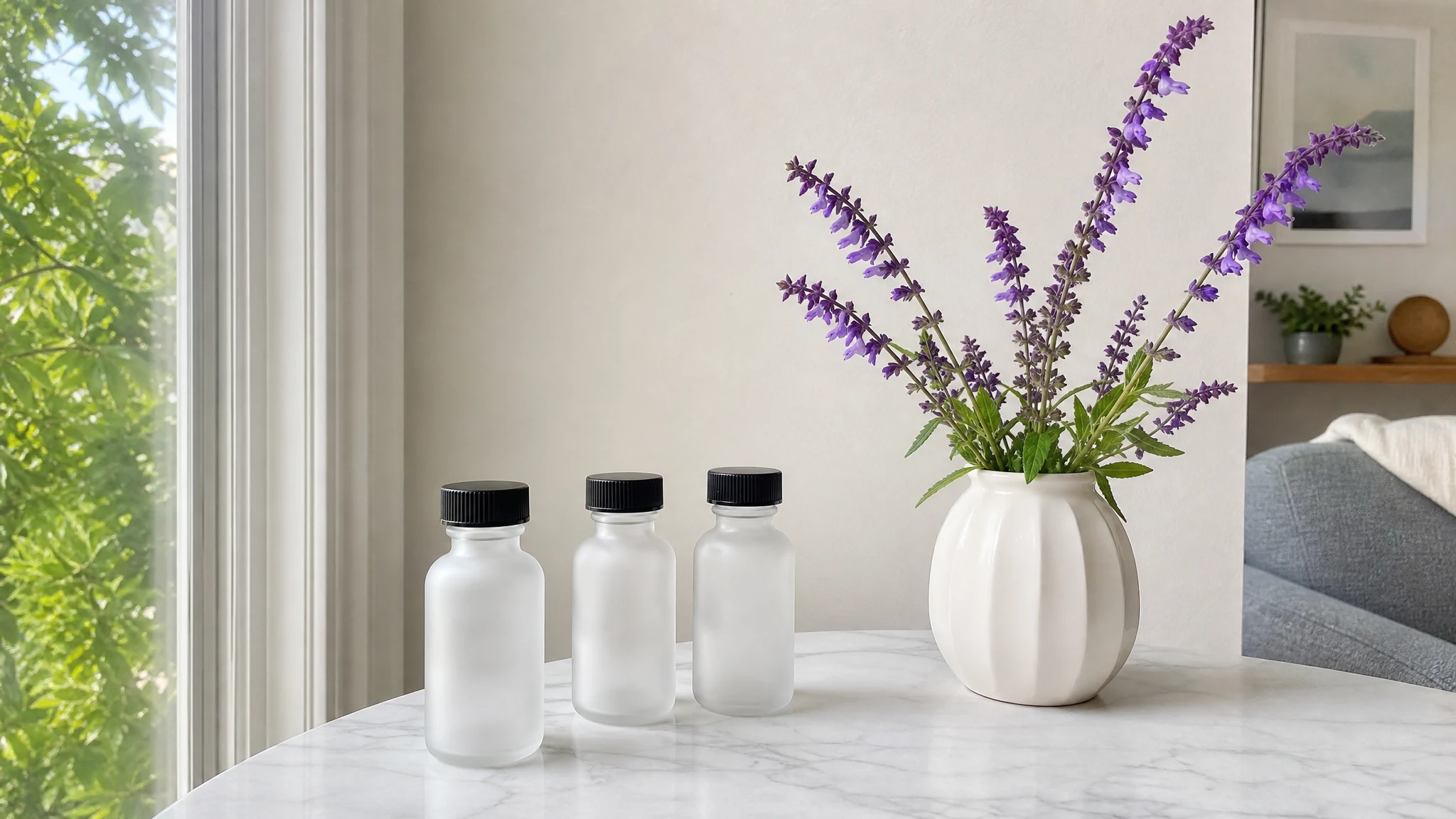
Why Clary Sage Is Called Muscatel
"Muscatel" is the word that follows clary sage around, and it makes people expect a glass of Muscat wine in the bottle. The truth is more interesting than the label. Clary sage oil and Muscat grapes do share aroma chemistry, but the family resemblance sits in one corner of the oil, not across the whole of it.

Clary Sage Essential Oil
Our own Clary Sage Essential Oil, in sizes from 0.5 oz to bulk.
From $19.99
Shop Now →What makes a Muscat a Muscat
Grape researchers tie the muscat character to a small group of monoterpene alcohols. A genetic study of Muscat flavour in grapevine links it to high levels of geraniol, linalool and nerol (Emanuelli et al., BMC Plant Biology, 2010). Those are the same sort of molecules that give lavender and bergamot their floral lift, which is a nice clue about where the name comes from.
Where the oil connects
Clary sage oil is rich in linalool, and it carries geranyl acetate too, the acetate form of geraniol. A study of wild Greek plants measured 18 to 30% linalool and about 4 to 12% geranyl acetate in the distilled oil (Pitarokili et al., J Agric Food Chem, 2002). So two of the three grape alcohols turn up in the oil, free or as an ester. That is the honest chemical basis for the word.
The bulk of the oil, though, is linalyl acetate, which averaged about 68% across three commercial batches in the EFSA FEEDAP panel, 2024. That sweet, lavender-like ester is the oil's body, and grapes do not owe their character to it. Think of muscatel as a facet. If you open a bottle hoping for wine, you will find something drier and more herbal. We describe our clary sage oil as sweet, dry and softly herbal, with nutty, tea-like undertones, a faint muskiness and a hay-like edge, and that is a pleasure in its own right.
Where the amber comes from
Perfumers describe the oil as "tenacious, herbaceous, sweaty, and amber" in character, and a plant-biology paper on the clary sage flower makes the same point: the oil is used directly in perfume, and the plant's sclareol is the starting material for ambroxide, a modern amber ingredient (Chalvin et al., Horticulture Research, 2021). The oil itself holds only a little sclareol, around half a percent in the batches EFSA analysed. We would not credit the amber facet to any one molecule; it is better read as the character of the whole oil.
Putting the family resemblance to work
Because clary sage shares linalool with lavender and bergamot, those pairings tend to read as one smooth idea instead of two competing ones. That is reasoning from composition rather than a studied result, but it matches our blending list of lavender, bergamot, geranium, sandalwood and vetiver. For the comparison in detail see clary sage vs lavender, and for ratios and partners head to the pairing guide. If it is the sweet ester that interests you, this article takes it further.
A blotter makes the whole idea concrete. Put clary sage on one strip and a linalool-rich oil you already own, lavender for instance, on another, and smell them a minute apart. You should find a shared sweet-floral core, and then the dry, hay-like edge where clary sage goes its own way. A fragrance oil sold as "clary sage muscatel" is a different product, which our fragrance oil comparison explains.
A note on handling
Linalool and its relatives oxidise in air, and air-exposed lavender oil has produced positive patch tests in people already allergic to oxidised linalool (Hagvall et al., Contact Dermatitis, 2008). That work used lavender, so for clary sage it is a sensible precaution drawn from shared components. We recommend diluting to 0.5% to 2% in a carrier oil for skin, patch testing first, keeping the cap tight, and avoiding the oil during pregnancy.
Read "muscatel" as a nod to shared aroma alcohols and a bit of romance, then let your nose decide.
Clary Sage Essential Oil
Clary Sage Essential Oil from our own shop, in sizes from 0.5 oz to bulk.
From $19.99
Shop Now →Sources & Further Reading
- Emanuelli F, et al., 2010. A candidate gene association study on muscat flavor in grapevine. PubMed 21062440
- Pitarokili D, et al., 2002. Composition and antifungal activity on soil-borne pathogens of the essential oil of Salvia sclarea from Greece. PubMed 12405762
- EFSA FEEDAP Panel, 2024. Safety and efficacy of a feed additive consisting of an essential oil derived from the flowering stems of Salvia sclarea L. (clary sage oil). PMC11561422
- Chalvin C, et al., 2021. Sclareol and linalyl acetate are produced by glandular trichomes through the MEP pathway. PMC8484277
- Hagvall L, et al., 2008. Lavender oil lacks natural protection against autoxidation, forming strong contact allergens on air exposure. PubMed 18759894