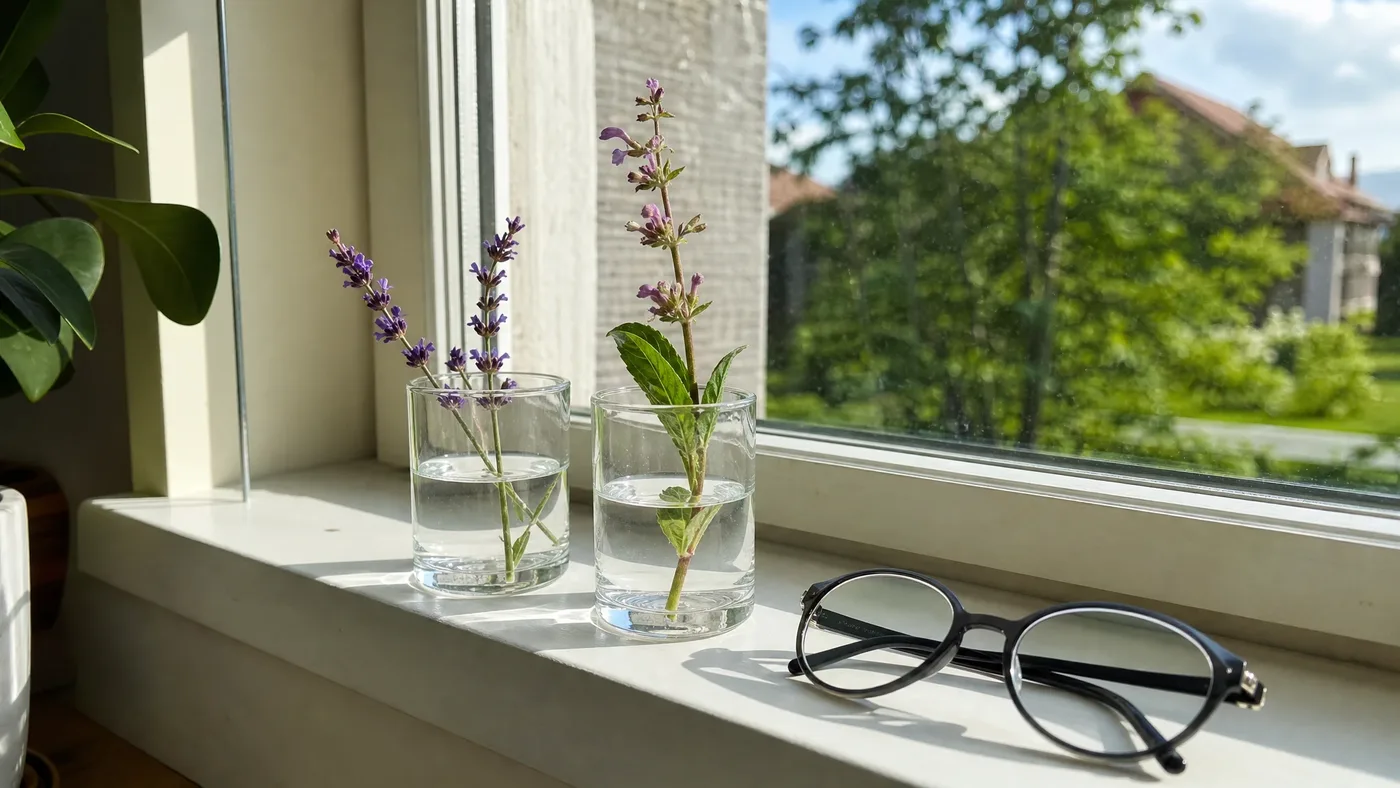
Clary Sage or Lavender: Close Cousins in the Bottle
Hold a bottle of lavender and a bottle of clary sage side by side and you could be forgiven for thinking they are close relatives. Chemically, they are. Both are built around the same two molecules, and what separates the scents is the supporting cast. That makes this one of the more satisfying comparisons in the oil world.

Clary Sage Essential Oil
Our own Clary Sage Essential Oil, in sizes from 0.5 oz to bulk.
From $19.99
Shop Now →Shared molecules, different accents
Linalyl acetate and linalool are the stars of clary sage oil. The European Food Safety Authority's specification runs 55 to 78% linalyl acetate and 6.5 to 25% linalool (EFSA FEEDAP Panel, 2024). Researchers studying lavender oil describe linalyl acetate, linalool and beta-caryophyllene as its main constituents (Hagvall et al., 2008). Same headline molecules, different proportions, and different minor notes around them.
That fits what the nose says. Lavender is bright and floral. Ours is sweet, dry and softly herbal, with nutty, tea-like undertones, and it sits in the middle of a blend. They are cousins that dress differently, which is why lavender is one of the oils we suggest pairing with clary sage, along with bergamot, geranium, sandalwood and vetiver. Our pairing guide shows how to play them off each other, and the linalyl acetate post explains the shared chemistry.
One more thing they share: air
Because both are rich in linalool and linalyl acetate, both change when exposed to air. In a mouse study, pure linalyl acetate was a weak sensitizer, but a sample oxidized in air for ten weeks was far more potent (Skold et al., 2008). And lavender oil itself oxidizes at about the same rate as its pure components, with air-exposed oil triggering reactions in people already allergic to oxidized linalool (Hagvall et al., above). The practical lesson applies to both bottles: keep the cap tight, store them in a cool, dark place, and do not keep an oil forever. Our storage guide has the details.
What the research looks like
Here the two are not on equal footing. Lavender has a large body of human research. A 2019 systematic review pooled 37 randomized trials with 3,964 participants and reported that lavender inhalation lowered scores on anxiety questionnaires, while noting that most included trials carried a high risk of bias (Donelli et al., 2019). Clary sage has far less. We sell a cosmetic oil and make no claims about mood or stress, but the two small trials that include both oils are interesting to know about.
In one, 34 women having a urodynamic exam inhaled clary sage, lavender or almond oil at 5% for 60 minutes. Systolic blood pressure was significantly lower in the clary sage group than in the almond oil or lavender groups (Seol et al., 2013). With about eleven people per group, in one clinical setting, that is a hint worth a larger study, not a verdict. In the other, 132 working women compared lavender with a 1:1:1 blend of lavender, clary sage and marjoram over four weeks, and sleep scores improved more in the blend group (Kao et al., 2017). Since the blend contained lavender and marjoram too, clary sage cannot be credited with the gap. If sleep or worry is behind your question, a physician is the right first stop.
Choosing between them
- You want the brighter, florally familiar one: lavender. We do not sell it, so look for a seller who prints the Latin name and a batch number.
- You want something drier and more herbal, with a tea-like edge: clary sage. We recommend diluting ours to 0.5% to 2% in a carrier oil, patch testing first, and avoiding it during pregnancy. It is also not the oil to reach for before driving.
- You want both: they blend beautifully. Pairing them keeps the lavender lift and adds clary's dry sweetness.
If a composition matters to you, ask us in writing through the contact page for the GC-MS report on your lot.
The nicest way to think of them is as two members of one family, each with a distinct voice and a place in your kit.
Clary Sage Essential Oil
Clary Sage Essential Oil from our own shop, in sizes from 0.5 oz to bulk.
From $19.99
Shop Now →Sources & Further Reading
- EFSA FEEDAP Panel, 2024. Clary sage oil feed additive opinion. pmc.ncbi.nlm.nih.gov/articles/PMC11561422
- Hagvall L et al., 2008. Lavender oil lacks natural protection against autoxidation, forming strong contact allergens on air exposure. Contact Dermatitis. pubmed.ncbi.nlm.nih.gov/18759894
- Skold M, Hagvall L, Karlberg AT, 2008. Mouse local lymph node assay of linalyl acetate and its air oxidation products. Contact Dermatitis. pubmed.ncbi.nlm.nih.gov/18154552
- Donelli D et al., 2019. Effects of lavender on anxiety: a systematic review and meta-analysis. Phytomedicine. pubmed.ncbi.nlm.nih.gov/31655395
- Seol GH et al., 2013. Randomized controlled trial for Salvia sclarea or Lavandula angustifolia. J Altern Complement Med. pubmed.ncbi.nlm.nih.gov/23360656
- Kao YH et al., 2017. Comparisons for effectiveness of aromatherapy and acupressure massage on quality of life in career women. J Altern Complement Med. pubmed.ncbi.nlm.nih.gov/28504569