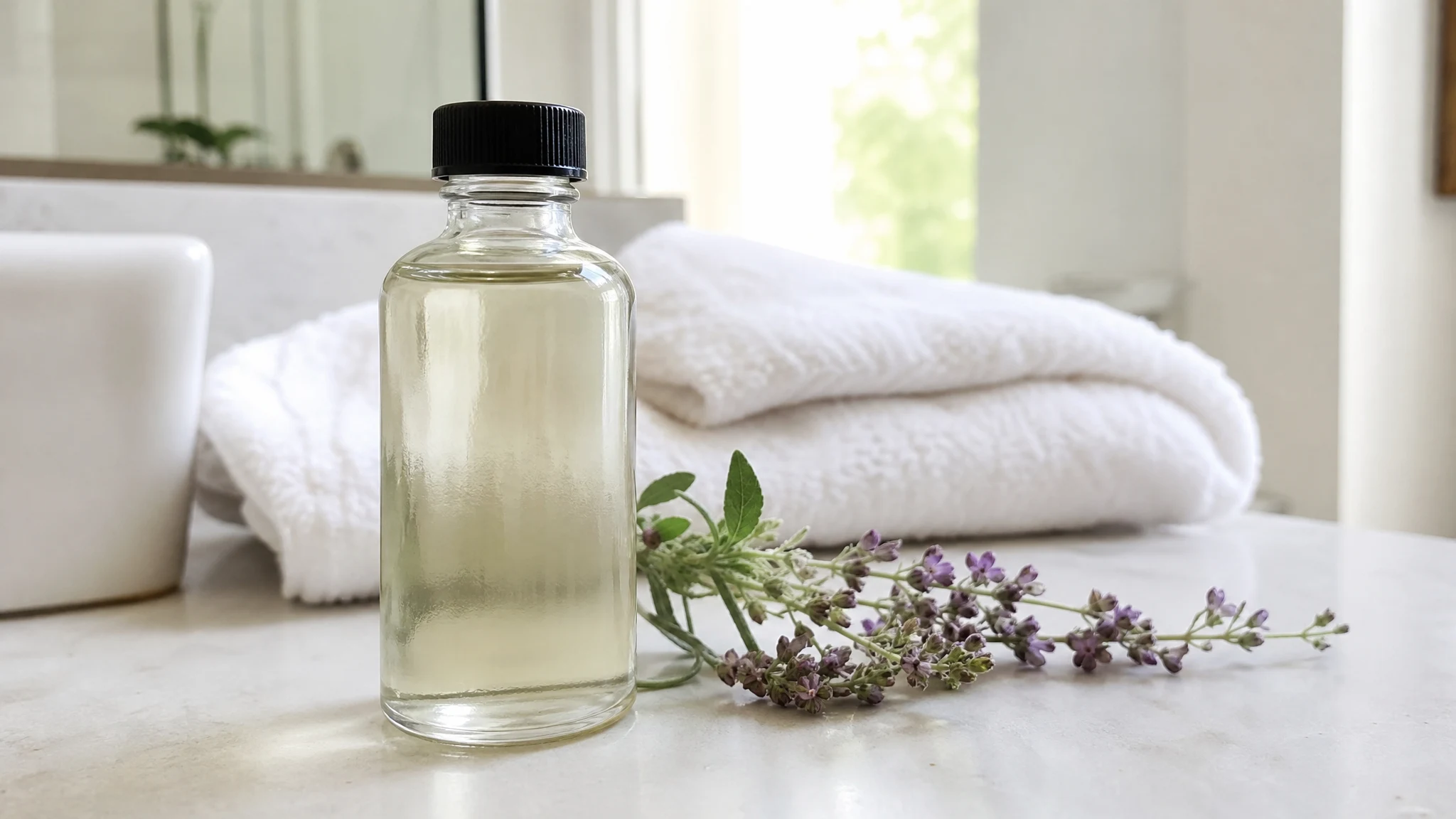
Making a Lightly Scented Clary Sage Scalp Oil
With a scalp oil, less is the whole idea. It sits on skin close to your forehead, ears and eyes and may be reapplied often, so the interesting question is how little clary sage oil you need to scent it nicely. The answer for a 60 ml bottle is about 6 to 12 drops, and the arithmetic is below.

Clary Sage Essential Oil
Our own Clary Sage Essential Oil, in sizes from 0.5 oz to bulk.
From $19.99
Shop Now →Scent and slip, not hair claims
Clary sage turns up on plenty of hair-growth lists, and we make no such claim. The FDA names restoring hair growth among the claims that make a product a drug, whatever else it is called, and it looks at labels and websites to decide a product's intended use. So a scalp oil is described by its scent and its feel, which is also how we think about it. When we searched Europe PMC for clary sage together with hair or scalp (2026-11-03), none of the first 15 of 77 records was a human study of clary sage on hair. If you are curious how clary sage compares with other oils people talk about for hair, our clary sage versus rosemary post is the place to look.
Why 0.5% to 1%
Our recommendation for skin is 0.5% to 2% in a carrier with a patch test first. The Tisserand retail page for clary sage gives 2 drops per 10 ml of blending oil for the face and up to 5 drops per 10 ml for the body, roughly 1% and 2.5% at 20 drops to the millilitre. A scalp is neither, and we are not aware of a scalp-specific limit, so we work at the facial figure or lower. The European Food Safety Authority's 2024 opinion on clary sage oil (written for animal feed) says it should be considered an irritant to skin and eyes and a dermal and respiratory sensitiser, which is another reason to keep the dose light.
The recipe, with the arithmetic shown
| Component | 0.5% version | 1% version |
|---|---|---|
| Carrier oil, 60 ml (2 fl oz) | 60 ml | 60 ml |
| Clary sage oil | 0.3 ml, about 6 drops | 0.6 ml, about 12 drops |
| Weight of oil added | about 0.27 g | about 0.54 g |
The weights use the relative density on our certificate (0.892, so 1 ml is about 0.892 g). The 20 drops per ml is a rough convention, and if you have a scale that reads to 0.01 g, weighing beats counting.
- Choose a carrier oil from a carrier-oil supplier; we do not sell carriers. Avoid nut oils if anyone touching the finished product has a tree-nut allergy.
- Add the clary sage oil to the carrier in an amber glass bottle, cap it and invert ten times.
- Label it with the date and the percentage, and make only what you will use in a few weeks, because carrier oils can go rancid.
This blend keeps to one essential oil on purpose. Lavender, bergamot, geranium, sandalwood and vetiver are all good partners (our pairing guide goes through them), but each adds to the total amount of oil on your skin, so keep the combined total inside the same ceiling.
Applying it
- Patch test first: a few drops of the finished blend on inner forearm, then wait a day. Our patch test guide explains how.
- Use it before washing, not after. A pre-shampoo oil gets rinsed away, so skin contact is shorter. That is our reasoning, not a studied protocol.
- Keep it off the hairline and away from eyes. If some gets in, rinse with water and see a clinician if irritation lasts.
- Stop if the scalp itches, burns or reddens. A flaky or inflamed scalp, or sudden or patchy hair loss, calls for a dermatologist and not an oil.
Who should skip it
We advise avoiding clary sage oil during pregnancy, and it is not the oil to reach for before driving. The Tisserand page adds sensitive or allergy-prone skin and children under 3. If you have a hormone-sensitive condition or take medication, ask your physician or pharmacist. For a rinse-off alternative, see our shampoo post.
A few drops of clary sage in a light carrier give you a dry, herbal scent and a bit of glide, and the first bottle is best made small so you can see how you like it.
Clary Sage Essential Oil
Clary Sage Essential Oil from our own shop, in sizes from 0.5 oz to bulk.
From $19.99
Shop Now →Sources & Further Reading
- US FDA. Is It a Cosmetic, a Drug, or Both? (Or Is It a Soap?). fda.gov
- Tisserand Essential Oils. Clary Sage Essential Oil, safety information. tisserand.com
- EFSA FEEDAP Panel, 2024. Safety and efficacy of a feed additive consisting of an essential oil derived from the flowering stems of Salvia sclarea L. pmc.ncbi.nlm.nih.gov/articles/PMC11561422