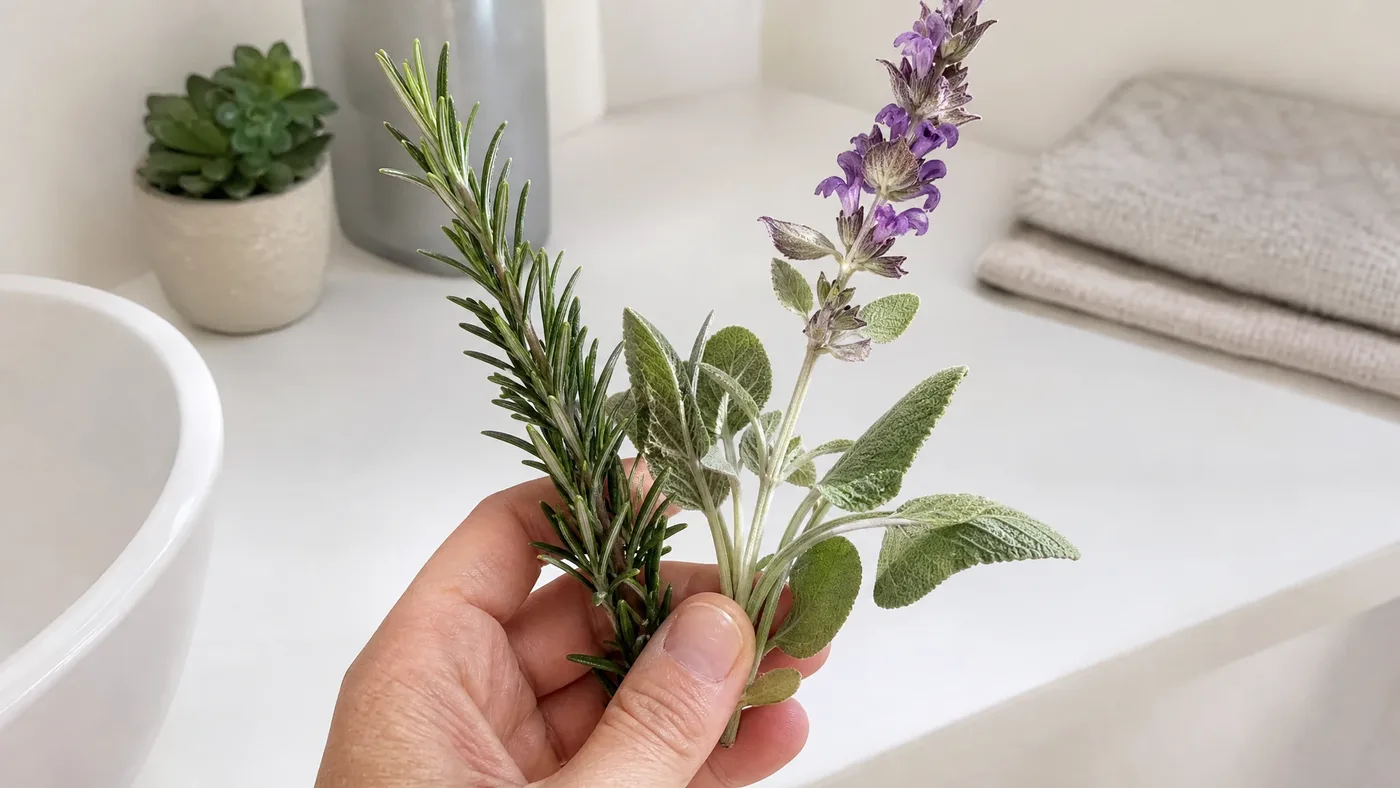
Clary Sage or Rosemary Oil for Hair? What Studies Exist
Search for oils and hair and rosemary shows up everywhere, while clary sage mostly appears as a fragrant afterthought. That is not just marketing. Of the two, only rosemary has a human trial behind it, and that trial is worth reading closely before it shapes anyone's routine.

Clary Sage Essential Oil
Our own Clary Sage Essential Oil, in sizes from 0.5 oz to bulk.
From $19.99
Shop Now →First, which hair question do you have?
"Hair oil" covers several different situations, and studies of one say little about another. Gradual thinning at the crown is one. Sudden round patches are another. Heavy shedding after illness or childbirth is a third. And simply dry, dull hair is a fourth, where an oil is a cosmetic choice and no trial is involved.
The American Academy of Dermatology puts it plainly: effective treatment for hair loss begins with finding the cause, and a board-certified dermatologist can examine the scalp and, if needed, order tests (AAD). No oil can do that. If you are losing hair and do not know why, that appointment comes before any bottle.
What the rosemary trial did
In 2015, 100 people with androgenetic alopecia were randomly assigned to rosemary oil or 2% minoxidil for six months. At three months neither group showed a significant change in hair count. At six months both groups showed a significant increase over baseline, and the two did not differ from each other. Scalp itching rose in both groups, and more often with minoxidil (Panahi et al., 2015).
It is a reasonable result to be curious about, with limits worth knowing. There was no carrier-only comparison group, so the trial cannot separate rosemary from time or from the routine of daily scalp care. The abstract gives no rosemary concentration, so there is no recipe to take from it. It is one trial.
The other study people cite involved 86 people with alopecia areata, a different condition. The active group massaged a blend of thyme, rosemary, lavender and cedarwood oils in jojoba and grapeseed carriers into the scalp daily, and the control group massaged with the carriers alone. Nineteen of 43 (44%) in the active group improved, compared with 6 of 41 (15%) in the control group (Hay et al., 1998). Because four oils were in the blend, nothing can be credited to rosemary alone.
And clary sage?
We searched Europe PMC in November 2026 for Salvia sclarea alongside hair, scalp and alopecia, and read through the first 15 of 77 records. None was a human study of clary sage on hair. We sell a cosmetic oil and make no claims about hair outcomes. What clary sage brings to a hair routine is aroma: sweet, dry and softly herbal with nutty, tea-like undertones.
Scalp skin is skin, so the same care applies as anywhere else. EFSA's 2024 opinion treats the oil as a skin and eye irritant and a dermal sensitiser (EFSA FEEDAP Panel, 2024). Our guidance is 0.5% to 2% in a carrier oil, patch test first, no use on broken or irritated skin, and no use during pregnancy. The Tisserand Institute gives broader ranges, 0.2 to 1% for sensitive skin and 1 to 3% for body oils (Tisserand Institute), and notes these are guidelines, not rules. Start low.
A fair way to choose
- Thinning or shedding you cannot explain: see a dermatologist first, and tell them about any oil you are using.
- Curious about the rosemary result: rosemary is something we do not sell, so buy it from a seller who prints the Latin name and a batch number, and keep the trial's limits in mind.
- A scalp or hair oil you enjoy smelling: clary sage, diluted to our guidance and patch tested. Our scalp oil post and shampoo post work through the arithmetic, and our hair care post covers the cosmetic side.
You will need your own carrier oil for any of these, since we sell the oil only; a craft or supply shop is the place to look.
So: rosemary has a small trial, clary sage has a lovely scent, and the best investigator of a hair concern is still a dermatologist.
Clary Sage Essential Oil
Clary Sage Essential Oil from our own shop, in sizes from 0.5 oz to bulk.
From $19.99
Shop Now →Sources & Further Reading
- Panahi Y et al., 2015. Rosemary oil vs minoxidil 2% for the treatment of androgenetic alopecia: a randomized comparative trial. Skinmed. pubmed.ncbi.nlm.nih.gov/25842469
- Hay IC, Jamieson M, Ormerod AD, 1998. Randomized trial of aromatherapy: successful treatment for alopecia areata. Arch Dermatol. pubmed.ncbi.nlm.nih.gov/9828867
- American Academy of Dermatology. Hair loss: diagnosis and treatment. aad.org
- EFSA FEEDAP Panel, 2024. Clary sage oil feed additive opinion. pmc.ncbi.nlm.nih.gov/articles/PMC11561422
- Tisserand Institute. Dilution for essential oils. tisserandinstitute.org/dilution-essential-oils