Clary Sage Oil Side Effects and How to Avoid Them
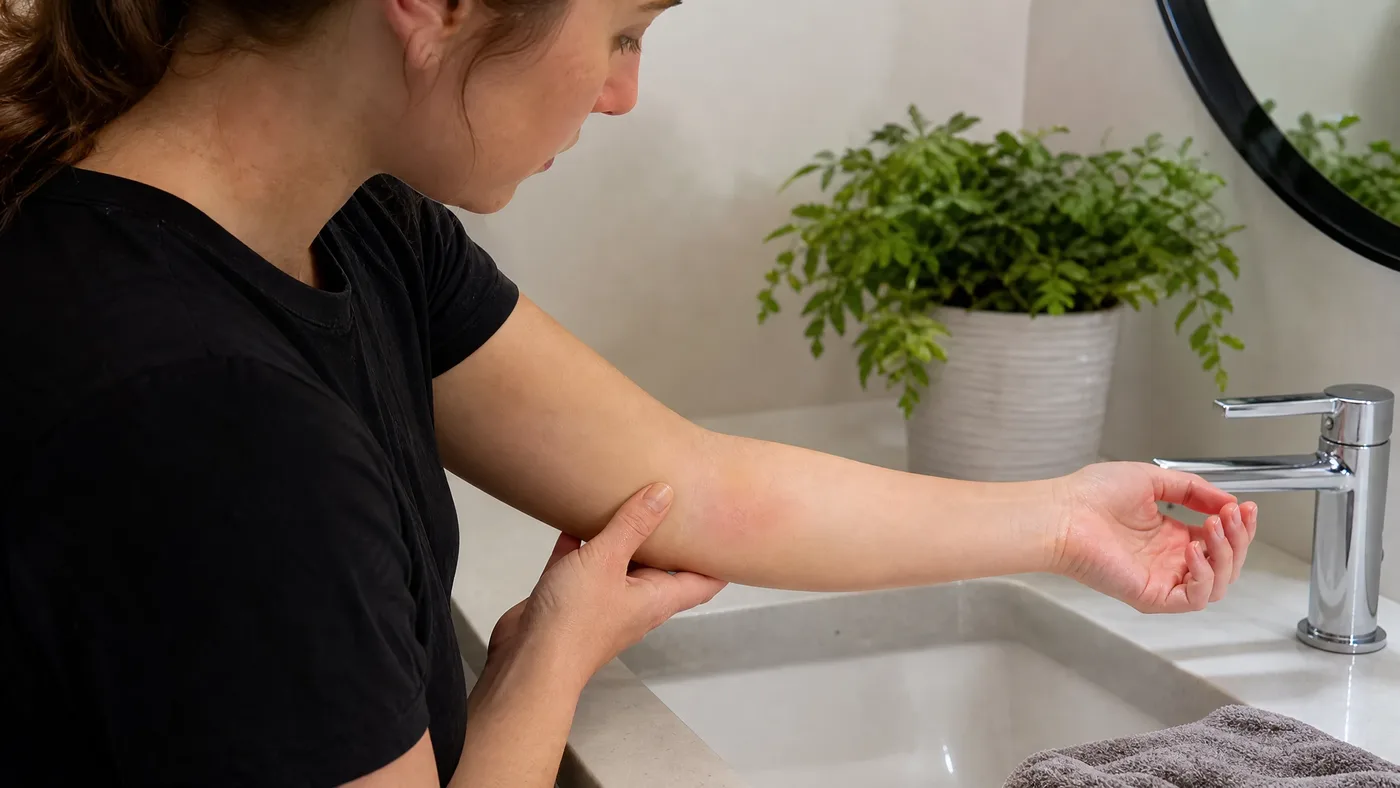
Clary sage oil smells soft and herbal, which can make it easy to forget that it is a concentrated plant extract. Its best-documented side effect is not exotic: it is skin irritation or allergy, and almost all of the advice that follows comes down to dilution, freshness and patch testing.

Clary Sage Essential Oil
Our own Clary Sage Essential Oil, in sizes from 0.5 oz to bulk.
From $19.99
Shop Now →Why skin is the main story
In 2024 Europe's feed-additive panel assessed clary sage oil (Salvia sclarea) and concluded it should be considered an irritant to skin and eyes and a dermal and respiratory sensitiser. That was a hazard classification for people handling the concentrated oil, not a measure of how often diluted use causes trouble, and the assessment was for animal feed (EFSA FEEDAP Panel, 2024). It is still a useful reminder: handle it diluted and keep it away from eyes.
Fresh oil matters
Linalool, one of the main components of clary sage oil, reacts with air over time, and the products it forms are common fragrance allergens. In a Danish hospital registry of 6,719 consecutively patch-tested patients, 3.1% reacted to linalool hydroperoxides, mostly weakly (Botvid et al., 2026). Those were dermatology patients tested with a prepared compound, so the figure overstates what a typical shopper would see. The practical lesson is simple, though. Keep the cap tight, store the bottle away from heat and light, and Tisserand suggests using an opened bottle within 12 months (Tisserand clary sage page). Our storage guide has the details.
Our dilution guidance
We recommend 0.5% to 2% in a carrier oil such as jojoba or sweet almond for skin, with a patch test first. For context, the Tisserand Institute's bands run from 0.2% to 1% for sensitive or impaired skin, 0.5% to 1.2% for facial products and 1% to 3% for body oils, with the advice to start low (Tisserand Institute). Our range lines up with the face and body bands, and if you are unsure, the low end is the place to begin. About 1 ml of oil in 99 ml of carrier makes 1%. Our dilution guide walks through the math, and our patch test guide shows how to do the first trial.
Drowsiness and driving
We tell readers clary sage is not the oil to reach for before driving. The nearest research is a mouse study in which linalool at 1% or 3% in a saturated chamber lengthened sleep after a sedative (Linck et al., 2009). That is one component in mice at saturation, so it does not tell us what a diffuser does for a person. It is reason enough for a bit of common sense: if you take sedating medicines or need to stay alert, ask your pharmacist.
Who should check first
- Pregnant or breastfeeding: we avoid recommending it during pregnancy. See our pregnancy article.
- Fragrance allergy or eczema: ask a dermatologist or allergist before using it on skin.
- Children: keep it out of reach, and see children and safety.
- Cats, dogs and birds in the home: see our pages on cats and dogs.
If something goes wrong
Stop using it and wash it off. For swallowing, a splash in the eye, or a child or pet reaching the bottle, call poison control (US: 1-800-222-1222) (National Capital Poison Center). We cover ingestion in our ingestion article.
Most people who treat clary sage as a diluted, fresh, well-stored aroma oil never meet any of this. It is simply the short list worth reading once.
Clary Sage Essential Oil
Clary Sage Essential Oil from our own shop, in sizes from 0.5 oz to bulk.
From $19.99
Shop Now →Sources & Further Reading
- EFSA FEEDAP Panel, 2024. Safety and efficacy of clary sage oil (Salvia sclarea) as a feed additive. EFSA J.
- Botvid S et al., 2026. Ten years of patch testing to hydroperoxides of limonene and linalool. Contact Dermatitis.
- Tisserand Institute. Dilution for essential oils.
- Tisserand Aromatherapy. Clary Sage Essential Oil, safety information.
- Linck VM et al., 2009. Inhaled linalool-induced sedation in mice. Phytomedicine.
- National Capital Poison Center. Essential oils.