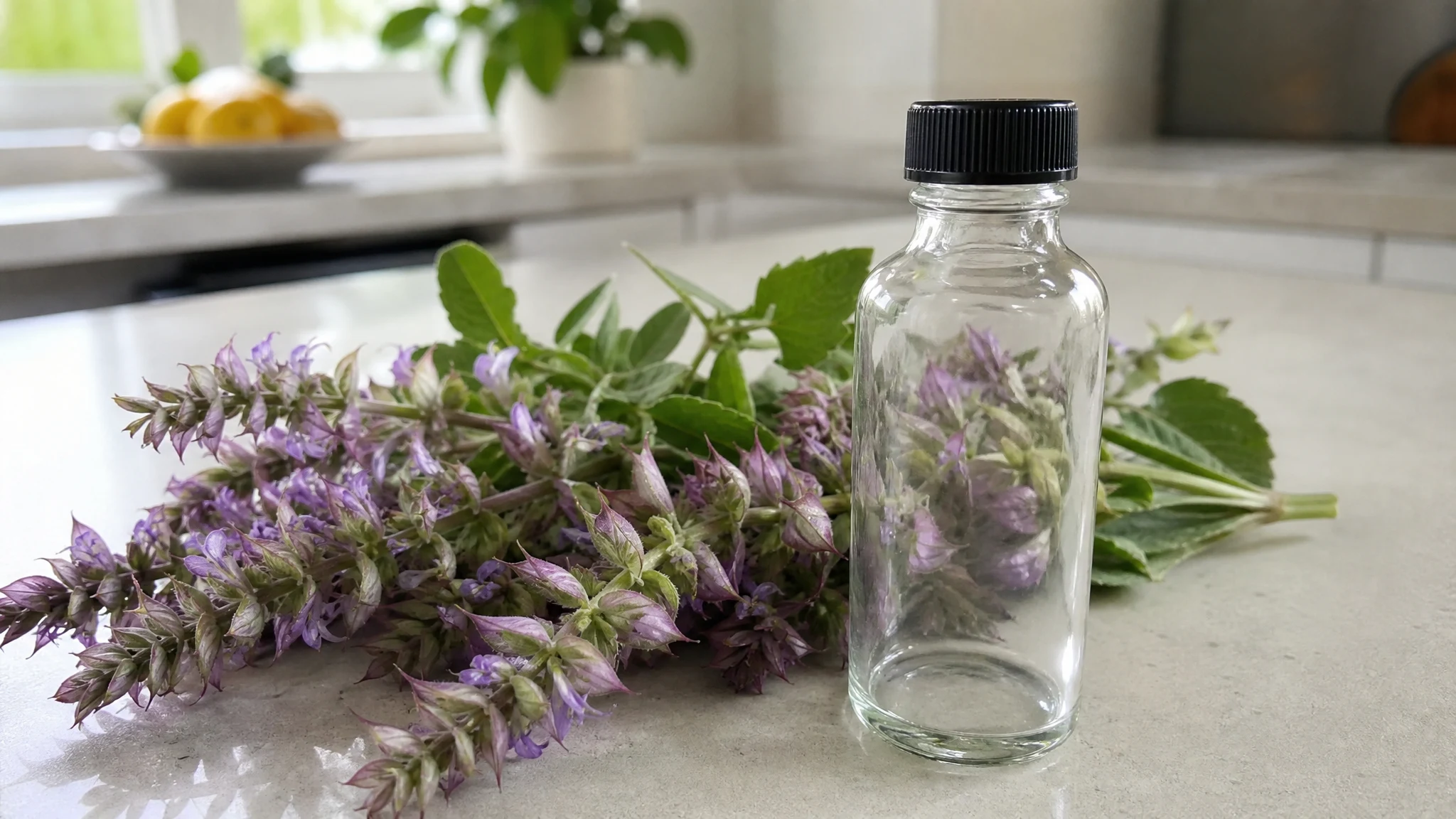
Clary Sage Fragrance Oil or Essential Oil? How to Choose
Search for clary sage and you will find "fragrance oil" and "essential oil" side by side, often at different prices and with similar photos. They are different things. An essential oil is a material distilled from a plant. A fragrance oil is a formulated scent, and its label usually does not tell you what is in it. We sell the first, Salvia sclarea essential oil, so this is a guide to choosing, and to knowing which bottle you are holding.

Clary Sage Essential Oil
Our own Clary Sage Essential Oil, in sizes from 0.5 oz to bulk.
From $19.99
Shop Now →Neither phrase is a grade
"Fragrance oil" is not a promise of synthetic content, and "essential oil" is not a promise of anything beyond what the plant and the producer deliver. What helps is the ingredient line and the paperwork. On cosmetics, the FDA says fragrance and flavor ingredients can be listed simply as "Fragrance" or "Flavor", and that labeling law cannot force a company to reveal trade secrets. In practice a fragrance oil is allowed to be a closed box, while an essential oil is a named botanical, so "what is in it?" has an answer you can check.
What clary sage oil looks like on paper
The European Food Safety Authority's 2024 opinion gives a good public description of clary sage oil: steam distillation of fresh or dried flowering stems of Salvia sclarea, grown in France or Russia, specified at 55% to 78% linalyl acetate and 6.5% to 25% linalool. In six batches by GC-MS, up to 84 peaks appeared, linalyl acetate averaged 59% and linalool 18%, and thujones were not detected. That fingerprint is what lets a lab say whether a sample looks like clary sage. A fragrance oil that merely smells like it is under no obligation to resemble the plant's chemistry.
Natural is not the same as gentler
Many people choose an essential oil to avoid "chemicals", but the compounds in clary sage oil are ordinary fragrance materials. EFSA's panel said the oil should be considered an irritant to skin and eyes and a dermal and respiratory sensitiser. Linalool is among the fragrance allergens EU cosmetic rules require to be declared above set limits, a list that grew from 26 to 80 materials in June 2023 (Sukakul et al., 2024). Linalool is a "prehapten", meaning it becomes allergenic once air oxidises it, and linalyl acetate behaves similarly in mouse data: a sample oxidised for 10 weeks was a stronger sensitiser than the fresh compound (EC3 3.6% against 25%; Sköld et al., 2008). Reasoning from that, an old bottle of either product can be tougher on skin than a fresh one, and neither label settles it. See how to patch test and documented side effects.
Look-alikes and partial substitutions
With essential oils, the usual issue is partial substitution, not a fragrance oil sold under another name. In one study of neroli, mandarin and bergamot oils bought online, only one sample of each (one of nine, one of eleven, one of eleven) met every ISO chromatographic specification, and findings included dilution and added linalool and linalyl acetate that were possibly synthetic (Pierson et al., 2021). Different oils, so not a clary sage failure rate, but it shows why a bare purity claim is weak evidence. For clary sage itself, a Turkish study found that two products sold as clary sage resembled another sage, Salvia fruticosa, with 1,8-cineole and camphor prominent, while a pharmacy oil showed 52% linalyl acetate and 20% linalool (Gülen et al., 2018). It was a small, one-country sample, but it makes the point that linalyl acetate should lead a clary sage chromatogram. Our GC/MS reading guide shows how to check.
Choosing for your project
- You want a named botanical, or need to say plant-derived: choose essential oil and ask the supplier for the botanical name and a batch report.
- You must disclose composition to a regulator, customer or allergic user: an essential oil has a nameable composition. For a fragrance oil, request the supplier's allergen declaration in writing first.
- You want a clary-like scent at large scale with identical results every batch: a fragrance oil from a perfumery-supplies seller is a fair choice, because plant oils vary with origin and distillation. We do not sell fragrance oils.
- You are swapping one for the other in a skin product: do not assume the dilution carries over. Each material has its own limit, so ask the fragrance oil's seller for the usage limit for your product type.
About our bottle
Our clary sage essential oil is Salvia sclarea, in ten sizes from 0.5 oz to 400 lb. We describe the scent as sweet, dry and softly herbal with nutty, tea-like undertones. The Certificate of Analysis we publish for one batch gives density, refractive index and optical rotation. If you need a linalyl acetate or linalool breakdown, ask us in writing through the contact page for the report on your lot. Our skin guidance is 0.5% to 2% in a carrier oil with a patch test first, and we recommend avoiding the oil in pregnancy; our pregnancy article covers the sources.
They are not rivals on a quality ladder. One is a plant material you can question, the other a scent you take on the maker's word, so pick the one whose paperwork you can actually get.
Clary Sage Essential Oil
Clary Sage Essential Oil from our own shop, in sizes from 0.5 oz to bulk.
From $19.99
Shop Now →Sources & Further Reading
- U.S. FDA, 2022. Fragrances in Cosmetics. fda.gov/cosmetics
- EFSA FEEDAP Panel, 2024. Safety and efficacy of a feed additive consisting of an essential oil derived from the flowering stems of Salvia sclarea L. (clary sage oil). EFSA Journal 22(11):e9016. PMC11561422
- Sukakul T, Bruze M, Svedman C, 2024. Fragrance contact allergy: a review focusing on patch testing. Acta Derm Venereol. PMC11334351
- Sköld M, Hagvall L, Karlberg AT, 2008. Autoxidation of linalyl acetate creates potent contact allergens. Contact Dermatitis. PMID 18154552
- Pierson M, Fernandez X, Antoniotti S, 2021. Non-compliance and adulteration in neroli, mandarin and bergamot oils purchased online. Sci Rep 11:11096. PMC8160360
- Gülen HT, Yücel YY, Polatoğlu K, 2018. Salvia sclarea L. aromatherapy oils from Turkish markets. Facta Universitatis 16(1). casopisi.junis.ni.ac.rs