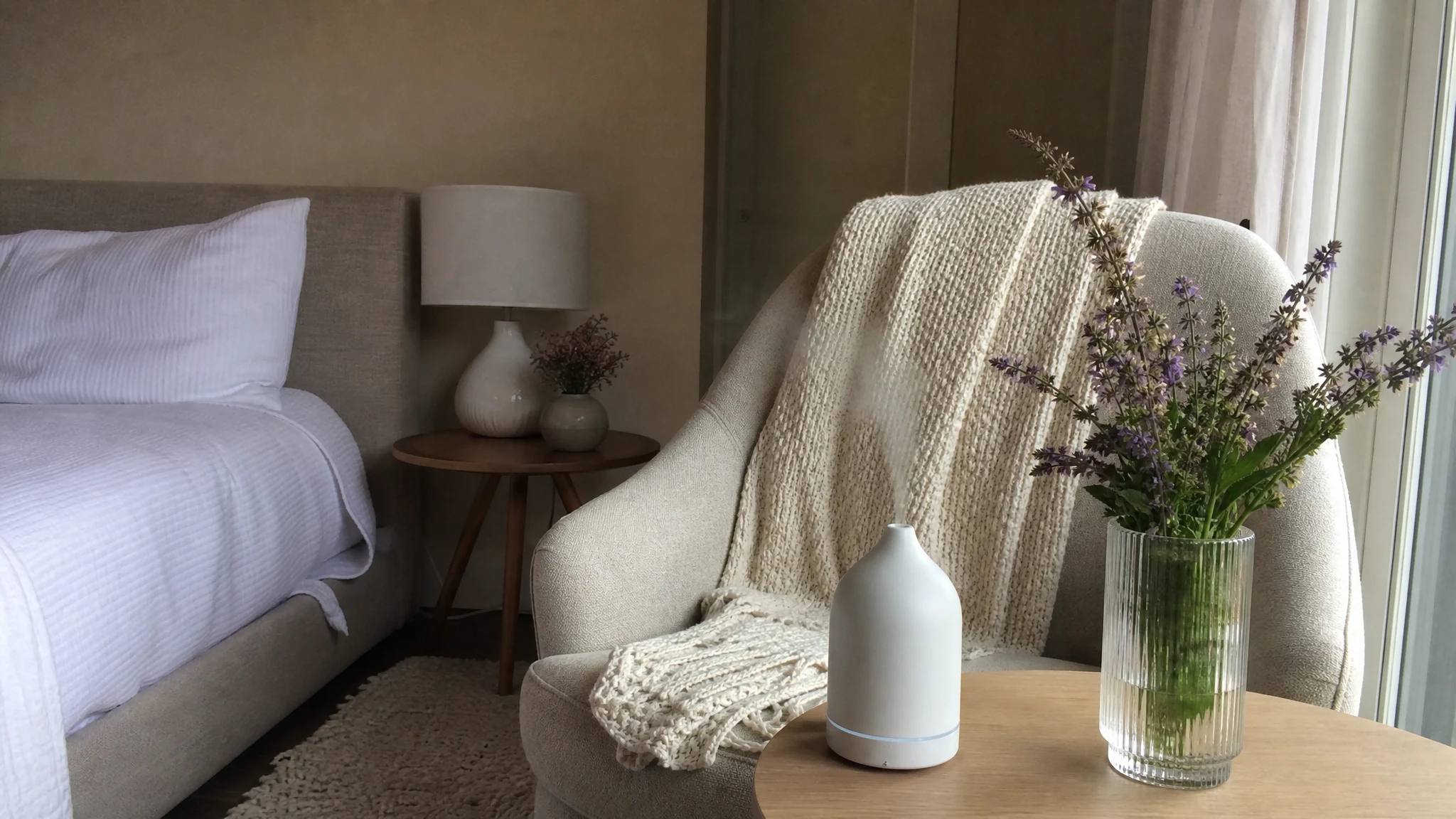
Clary Sage Diffuser Blends That Smell Balanced
A good diffuser blend is a small scent-design project: a few drops, a clear idea of which oil does what, and a bit of attention to the room. Clary sage makes it easy, because it is a sweet, dry, softly herbal middle note that gets along with almost everything on our pairing list of lavender, bergamot, geranium, sandalwood and vetiver.

Clary Sage Essential Oil
Our own Clary Sage Essential Oil, in sizes from 0.5 oz to bulk.
From $19.99
Shop Now →Three blends and the thinking behind them
These are drop counts for a unit with about a 100 ml water tank, worked out from how the oils sit together. Keep the total small and judge by nose after ten minutes. About 20 drops to a millilitre is a rough convention, and droppers vary.
- Soft herbal, lavender-led: 3 drops clary sage, 2 drops lavender. The two share linalyl acetate, so they read as one smooth note. For what sets them apart, see clary sage vs lavender.
- Bright top over a dry middle: 3 drops clary sage, 1 drop bergamot. Bergamot opens the blend and clary sage carries it on.
- Woody and dry: 2 drops clary sage, 1 drop sandalwood or vetiver. Woods are heavy, so add them one drop at a time.
Lavender, bergamot, sandalwood and vetiver come from another supplier, since our shelf holds clary sage alone. The reasoning behind more partners is in the pairing guide.
Judge it in the room
A blend that smells balanced on a blotter can shift once it becomes mist, because water volume, room size and the unit itself all change what reaches your nose. So test where you will use it.
- Run the unit for 10 minutes with the smallest blend, leave the room for 5, then come back. Your nose has reset and you can tell if the scent is readable.
- If you can smell it from the doorway, it is already stronger than you need. Lower the drops before you lower the water.
- Jot down the drops, tank size and minutes run so you can repeat a blend you like.
What a diffuser puts into the air
An ultrasonic diffuser releases more than scent. A chamber study of four oils (lemon, lavender, eucalyptus and grapeseed) measured volatile compounds and fine particles from the units, found each oil had its own profile, and suggested diffusers can add substantially to indoor particulate matter. Filling the tank with tap water instead of deionized water raised fine particle emissions about fivefold in the eucalyptus run (Schwartz-Narbonne, Du and Siegel, Indoor Air, 2021). Clary sage was not among the oils, so the practical lesson is general: use the least oil that gives a readable scent, run in intervals instead of all evening, keep the room ventilated, and use the water your unit's manual recommends.
Set the diffuser on a stable, water-resistant surface a little away from where you sit, not beside your face and not at the head of a bed. Wipe the surface after a session, and empty and rinse the tank so old water does not linger. In a larger open space, move the unit toward the middle instead of adding more drops.
Who should sit this one out
EFSA's panel that characterised clary sage oil advised treating it as an irritant to skin and eyes and a dermal and respiratory sensitiser (EFSA FEEDAP, 2024). That assessment concerned handling the oil, but it is a fair reason to be careful about breathing it. We advise keeping the oil away from children and pets, and avoiding it during pregnancy; it is also not the oil to reach for before driving. So nurseries, rooms shared with pets and the minutes before a drive are out. If you have asthma or scent-triggered breathing trouble, ask a physician first, and ask a veterinarian about pets (our cat and dog articles cover what sources exist). Other ways to enjoy the scent are ranked in how to inhale clary sage oil.
We are selling a scent oil, so we leave sleep and stress claims to the clinical literature, which looks thin for diffused clary sage specifically. Choose a blend because you enjoy how it smells, run it briefly, and open a window. Keep the cap on between sessions, since the sweet ester at the heart of the oil changes with air exposure (Sköld et al., 2008), and our storage guide shows how.
Start with the three-drop lavender blend, take notes, and change one drop at a time.
Clary Sage Essential Oil
Clary Sage Essential Oil from our own shop, in sizes from 0.5 oz to bulk.
From $19.99
Shop Now →Sources & Further Reading
- Schwartz-Narbonne H, Du B, Siegel JA, 2021. Volatile organic compound and particulate matter emissions from an ultrasonic essential oil diffuser. Indoor Air. PubMed 33905580
- EFSA FEEDAP Panel, 2024. Safety and efficacy of a feed additive consisting of an essential oil derived from the flowering stems of Salvia sclarea L. (clary sage oil). PMC11561422
- Sköld M, Hagvall L, Karlberg AT, 2008. Autoxidation of linalyl acetate, the main component of lavender oil, creates potent contact allergens. PubMed 18154552