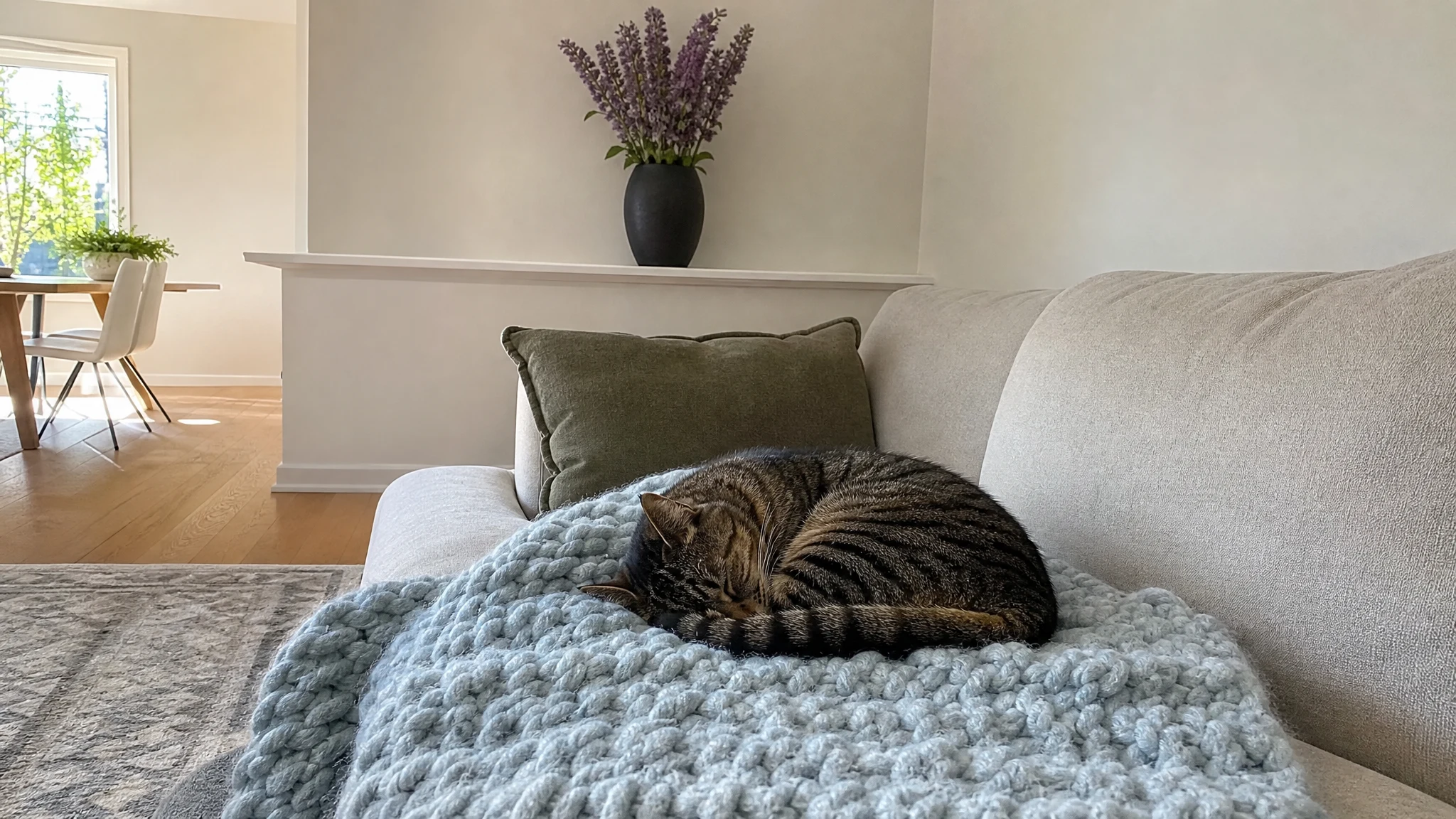
Clary Sage Oil and Cats: Keeping the Household Safe
Cat owners ask the right question before they buy: will this oil be a problem for the animal that sleeps on the sofa? We cannot call any essential oil safe around a cat, and the sources we read do not either, so here is what the veterinary guidance says and how we would arrange a home that includes both a cat and a bottle of clary sage.

Clary Sage Essential Oil
Our own Clary Sage Essential Oil, in sizes from 0.5 oz to bulk.
From $19.99
Shop Now →Why cats get extra attention
The Merck Veterinary Manual says cats are especially at risk from essential oils because they are deficient in an enzyme called glucuronyl transferase, and that oils are absorbed quickly through the gut, skin, lungs and mucous membranes (Merck Veterinary Manual). Pet Poison Helpline names cats and birds as the species at greatest risk (Pet Poison Helpline).
The one clary-sage-specific data point comes from Europe's feed regulator, which reviewed clary sage oil as an animal feed additive in 2024. For cats it set a safe level of 4 mg per kg of complete feed, versus 20 mg/kg for dogs, citing cats' reduced ability to clear these compounds (EFSA FEEDAP Panel, 2024). That is a daily-diet allowance, not a statement about diffusers or skin, so it cannot be turned into a number of drops. It does tell us that regulators treat cats as the more sensitive household animal.
Think about the route
Pet Poison Helpline ranks exposure from highest to lowest risk as oral, then dermal, then respiratory. That ordering helps because the common household accidents are not the ones people worry about.
| Situation | What the sources say | What we would do |
|---|---|---|
| Oil on the cat | ASPCA: best to avoid applying oils to pets at all | Never |
| Ultrasonic or nebulizing diffuser | Merck: emits microdroplets that can settle on fur and be groomed off | The setup to avoid most with a cat |
| Reed or candle diffuser | Merck: no droplets of oil unless tipped | Lower exposure, still out of reach |
| Open or spilled bottle | Absorbed through skin and gut | Cap it and shelve it high |
A cat that walks through a spill and then grooms can turn a skin exposure into an oral one in minutes. That is reasoning from the two sources above, and it is why a spilled bottle is a bigger concern than a faint scent in a room.
If you diffuse anyway
ASPCA says a diffuser used briefly in a secured area is not likely to be an issue, and that pets with breathing problems may do better without one (ASPCA). Putting that together, a sensible setup is a short session, a door the cat can walk through, and no diffuser at all for a kitten, a senior cat, or a cat with asthma. Those details are our extrapolation, so check with your veterinarian. Our guidance on the bottle itself is to keep clary sage away from children and pets.
What to watch for
Pet Poison Helpline lists drooling, vomiting, lethargy and loss of appetite, usually within 6 to 8 hours. If you suspect exposure, move the cat to fresh air, call your veterinarian, the ASPCA Animal Poison Control Center at (888) 426-4435 or Pet Poison Helpline at (855) 764-7661, and do not induce vomiting. Have the bottle handy so you can describe what and how much.
For the other half of the household, see our page on dogs. Humans in the house have their own pages too: children and side effects. To enjoy the aroma with fewer moving parts, see how to inhale clary sage oil.
We would not offer a "safe number of drops" for a cat, and neither should anyone else. A capped bottle, a high shelf and a call to your vet when in doubt is the whole plan.
Clary Sage Essential Oil
Clary Sage Essential Oil from our own shop, in sizes from 0.5 oz to bulk.
From $19.99
Shop Now →