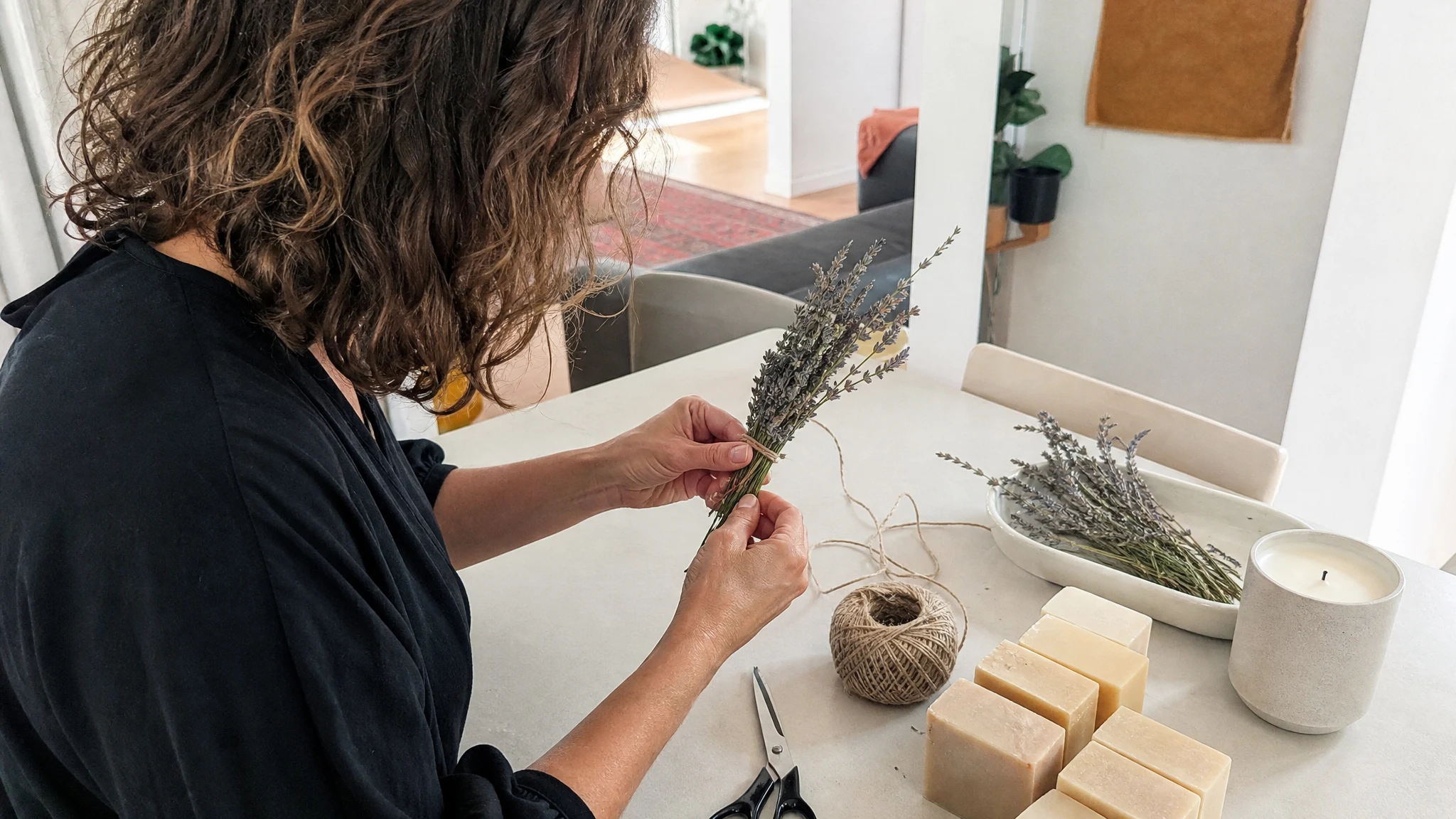
Craft Projects That Suit Clary Sage Oil
Craft projects feel like the gentle way to use clary sage oil, since nothing is going on skin. That is mostly true, and the sorting question that makes it fully true is simple: what will touch this, and for how long? A drawer sachet and a bracelet are very different jobs for the same few drops.

Clary Sage Essential Oil
Our own Clary Sage Essential Oil, in sizes from 0.5 oz to bulk.
From $19.99
Shop Now →Why time in the open air matters
Clary sage oil is built from a few large components. In the 2024 EFSA opinion on the oil, linalyl acetate averaged about 59 to 68% and linalool about 15 to 18%, depending on the analytical method (EFSA FEEDAP Panel, 2024). Linalool is the one to keep in mind for crafts, because air changes it. In a study of 2,900 dermatitis patients across six countries, linalool itself was weak or non-allergenic, but its air-oxidised form produced positive reactions in 6.9% of those tested (Bråred Christensson et al., Contact Dermatitis, 2012). That was a clinic population, not a rate for everyone, so reading it for craft use is reasoning rather than a measured result: a few drops spread across a big open surface for weeks have the most air, so keep skin away from those projects.
Projects that suit it well
These keep the oil contained, away from skin, and easy to replace.
- Sealed-jar scent cures. Drops on wood chips or a ceramic bead, kept in a closed jar until needed. Sachets and simmer pots are among the uses we list for the oil, and this is the same family of idea.
- Unglazed ceramic or plain wood shelf diffusers. The oil sits on a material you never handle, and you can swap it when the scent fades.
- Sachets for storage boxes. A closed box of linens or paper keeps the scent in and your skin out.
Projects that need more thought
- Anything worn or slept on. Pillow sprays, scarves, bracelets and scented fabric end up as skin-contact products in practice. Our skin guidance is 0.5% to 2% in a carrier oil with a patch test first, while the Tisserand retail page suggests 2 drops per 10 ml of blending oil for the face and up to 5 drops per 10 ml for the body (Tisserand, clary sage product page). Neat oil on cloth has no dilution at all.
- Wax melts, soap and candles. These come with their own rules and documents; our soap and candle guide is the place to start.
- Anything a child might mouth. We advise keeping the oil away from children and pets, and Tisserand says not to use it on children under 3, so scented teethers and bead bracelets are not for clary sage.
Small rooms and animals
EFSA's panel considered the oil an irritant to skin and eyes and a dermal and respiratory sensitiser, so a closed drawer is lovely, while a heated pot in a small room with an asthmatic or an animal is not a good experiment. If a dog or cat shares your home, please ask a veterinarian first. Our cat and dog articles summarise what exists. We also advise avoiding the oil during pregnancy.
Small habits that pay off
- Spot-test for staining. Undiluted oil can mark paper, raw wood and fabric. Try a scrap first.
- Weigh instead of counting drops when you scale up. The batch on our published Certificate of Analysis has a relative density of 0.892, so 1 ml is about 0.89 g, and about 20 drops per ml is only a rough convention.
- Use a small bottle for occasional projects, because every opening lets in air. We describe typical shelf life as 3 to 4 years in a tightly capped, shaded cupboard; our storage guide has more.
- Replace, do not top up. When a sachet fades, change the filler instead of adding oil over the old.
- Sell it carefully. The FDA treats a fragrance marketed with aromatherapy claims, such as helping someone sleep, as a drug, while one marketed to promote attractiveness is a cosmetic, and labels and websites both count (FDA, Is It a Cosmetic, a Drug, or Both?).
We sell the oil itself, so sachet fabric, beads, wax and containers come from a craft-supply seller. If the plan is to scent a room, the diffuser is easier to control than most crafts, because you can simply switch it off; see how to inhale clary sage oil, what it smells like and the pairing guide.
Before any project, ask who or what will be in contact with it next month, whether you can replace the scented part cheaply, and whether you are scenting an object or a whole room. Those three answers sort most ideas on their own.
Clary Sage Essential Oil
Clary Sage Essential Oil from our own shop, in sizes from 0.5 oz to bulk.
From $19.99
Shop Now →Sources & Further Reading
- EFSA FEEDAP Panel, 2024. Safety and efficacy of a feed additive consisting of an essential oil derived from the flowering stems of Salvia sclarea L. (clary sage oil). PMC11561422
- Bråred Christensson J, et al., 2012. Air-oxidized linalool: a frequent cause of fragrance contact allergy. Contact Dermatitis 67(5). PubMed 22906042
- Tisserand Essential Oils. Clary Sage Essential Oil, product page. tisserand.com
- FDA. Is It a Cosmetic, a Drug, or Both? (Or Is It a Soap?). fda.gov