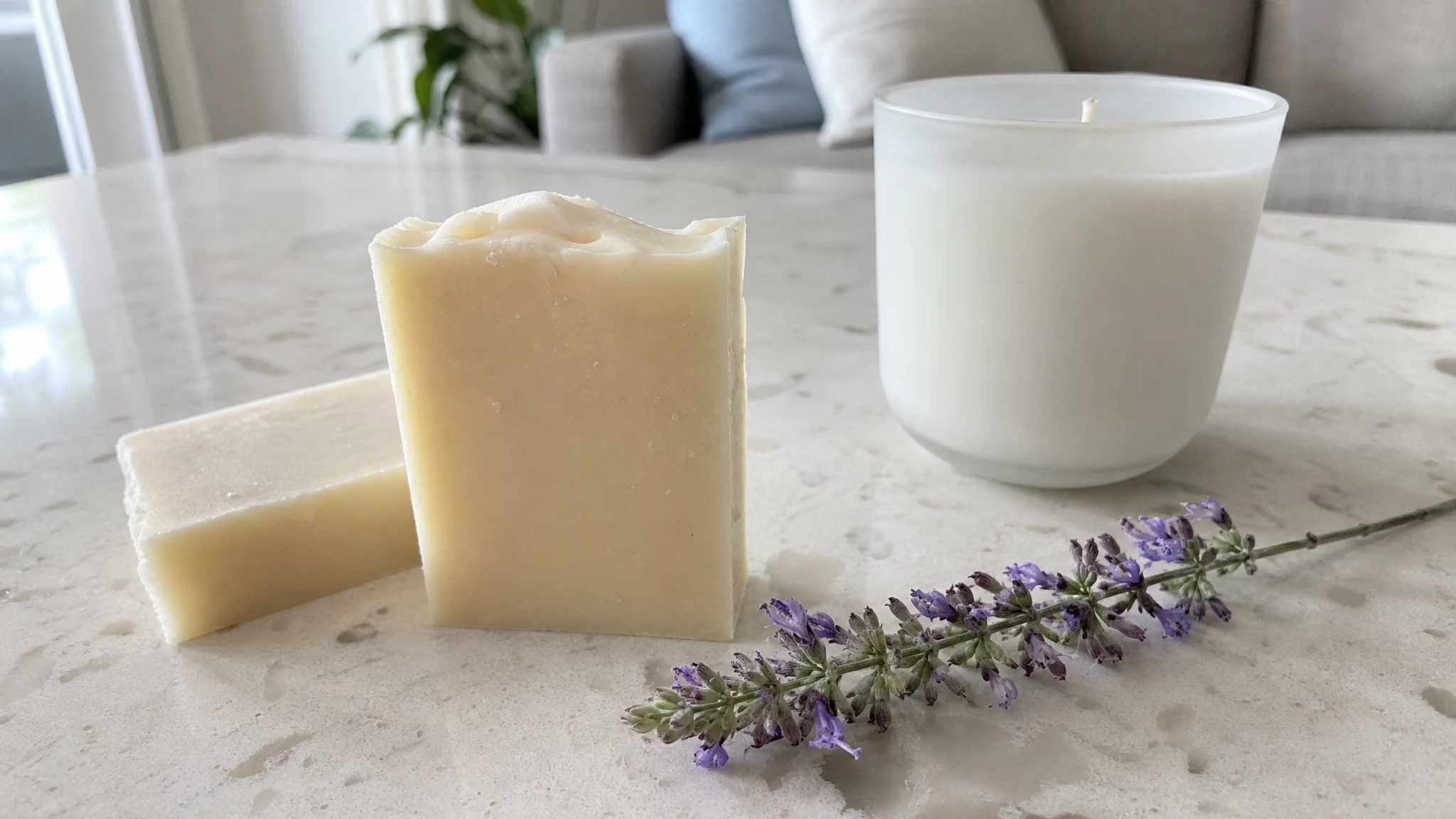
Clary Sage Oil for Soap and Candle Makers: Before You Pour
Clary sage oil smells soft, dry and herbal with a nutty, tea-like edge, which is exactly why soap and candle makers keep reaching for it. The oil itself is the easy part. What takes a little planning is everything around it: how the bottle converts to your recipe weights, which documents you want on file, and how you word the label.

Clary Sage Essential Oil
Our own Clary Sage Essential Oil, in sizes from 0.5 oz to bulk.
From $19.99
Shop Now →Start with the weights
Recipes are written in grams, oil is sold in fluid ounces and pounds. The Certificate of Analysis we publish for one batch lists a relative density of 0.892, so 1 ml of that batch weighs about 0.892 g. Another lot will differ a little, but it is a sound basis for planning.
- 1 fl oz (29.57 ml) weighs about 26.4 g.
- 1 lb (453.6 g) is about 508 ml.
- In a 500 g batch, 1% oil is 5 g (about 5.6 ml) and 2% is 10 g (about 11.2 ml).
A 0.5 oz bottle holds about 13 g, which is plenty for a handful of test batches. When you know your real monthly use, our larger sizes, up to bulk, make more sense; our size guide walks through choosing.
Know your ceiling before you choose a rate
How much oil a soap or candle can carry is set by the IFRA standard for your product category, applied to the fragrance as a whole, and by what you find acceptable for scent and performance. The skin guidance we give on our shop pages, 0.5% to 2% in a carrier oil, is for diluted skin use. It is not a soap or candle rate. Ask any supplier, us included, for the IFRA and safety documents your category needs, in writing, and file them with your batch records. If you need an IFRA certificate or a safety data sheet for your records, ask us through the contact page before you build a product around the oil.
What the oil is made of, and why it matters in a bar
Clary sage oil is ester-rich. In a 2024 safety opinion on clary sage oil from France or Russia, the European Food Safety Authority described linalyl acetate at roughly 60% to 70% of the oil and linalool at roughly 15% to 18%, depending on the method (EFSA FEEDAP Panel, 2024). Those are one applicant's samples, not a promise about any particular bottle, but they tell you what a composition report should look like.
Linalool is the compound worth a maker's attention. Fresh, it is a weak allergen; exposed to air, it forms oxidation products that do cause contact allergy. In a patch-test study of 2,900 dermatitis patients, 6.9% reacted to oxidised linalool (Bråred Christensson et al., 2012). Those were clinic patients, not the general public, so read it as a reason to keep bottles tightly capped, buy sizes you will use within a year, and mind the date, not as a rate. Our guidance is that the oil typically stays vibrant for 3 to 4 years in a tightly capped bottle kept somewhere shaded.
Soap versus cosmetic, decided by your words
The FDA treats a cleansing product as a soap only when most of its non-volatile matter is an alkali salt of fatty acids, the cleansing comes from those salts, and it is labelled and sold solely as soap. Soap in that sense falls under the Consumer Product Safety Commission instead. The same FDA page says a fragrance marketed to promote attractiveness is a cosmetic, while the same fragrance marketed with an aromatherapy claim such as helping someone sleep is a drug. In practice, a bar listed as "clary sage for calm nights" changes category on wording alone. Describe the scent, not an effect. We describe ours as sweet, dry and softly herbal with nutty, tea-like undertones, and that is a good register to borrow.
Cold process, candles and a test-first habit
For cold-process soap, we could not find published measurements of how clary sage oil's scent holds up in lye, so a small test bar judged after the cure, not at the pour, is the sensible first step. For candles, the CPSC's business guidance points to the ASTM standards, including F2417 on fire safety and F2058 on labelling, and caps lead in metal-cored wicks at 0.06%. A scented candle has its own testing path, and the essential oil is only one ingredient in it. We do not sell wax, wicks, soap base or carrier oils; a craft or soap-supply shop is the place for those.
One more line for the label file: our guidance is to avoid the oil during pregnancy, and Tisserand's retail page for clary sage says the same, so it is not the oil to build a product for pregnant buyers around.
A sensible order of operations
Buy a small bottle, ask us for the report on your lot if you need composition data (the Certificate of Analysis we publish for one batch gives density, refractive index and optical rotation), make one test bar and one test candle, and keep notes. Then scale. For what a composition report tells you, see how to read a GC/MS report; for the buying checks, our quality-check article; and for the label caution on grade words, what that label means. The skin-safety side is covered in the side effects article.
Make the first batch small and write down what you did. It is the quickest way to learn this oil.
Clary Sage Essential Oil
Clary Sage Essential Oil from our own shop, in sizes from 0.5 oz to bulk.
From $19.99
Shop Now →Sources & Further Reading
- EFSA FEEDAP Panel, 2024. Safety and efficacy of a feed additive consisting of an essential oil derived from the flowering stems of Salvia sclarea L. (clary sage oil). pmc.ncbi.nlm.nih.gov/articles/PMC11561422
- FDA. Is It a Cosmetic, a Drug, or Both? (Or Is It a Soap?). fda.gov
- Bråred Christensson J et al., 2012. Air-oxidized linalool: a frequent cause of fragrance contact allergy. Contact Dermatitis 67(5). pubmed.ncbi.nlm.nih.gov/22906042
- U.S. Consumer Product Safety Commission. Candles: business guidance. cpsc.gov
- Tisserand. Clary Sage Essential Oil, product safety information. tisserand.com