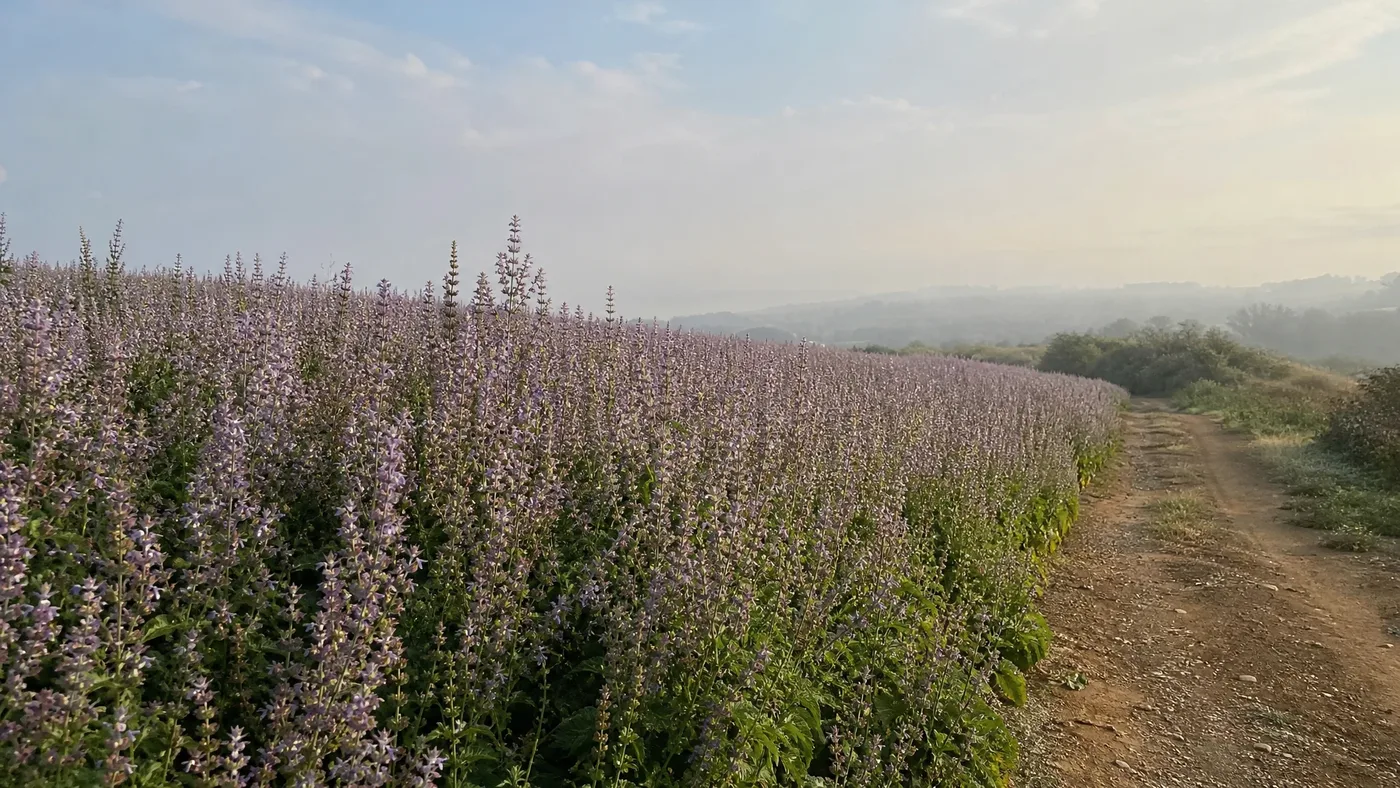
Does Where Clary Sage Grows Change the Oil?
It is tempting to rank clary sage oils by country, as though a French flag on the label or a Bulgarian one told you what is in the bottle. The published analyses tell a more interesting story: the spread inside one country can be as wide as the gap between two countries, and how an oil was distilled changes the numbers as much as where the plant stood.

Clary Sage Essential Oil
Our own Clary Sage Essential Oil, in sizes from 0.5 oz to bulk.
From $19.99
Shop Now →What the analyses actually show
The one standard-setting document is the European Food Safety Authority's 2024 opinion on clary sage oil. It describes oil made by steam distillation of the flowering stems, from plant material sourced in France or Russia. Its specification allows 55 to 78% linalyl acetate and 6.5 to 25% linalool, and three batches analyzed by GC-FID landed at 61.87 to 74.84% linalyl acetate and 10.88 to 17.91% linalool (EFSA FEEDAP Panel, 2024).
Other published samples sit well away from that range:
- Two wild Greek populations, hydrodistilled in a lab, gave 19.75 to 31.05% linalyl acetate and 18.46 to 30.43% linalool (Pitarokili et al., 2002). Six Greek samples in 2024 gave 21.2 to 25.7% linalyl acetate (Tomou et al., 2024).
- A Slovak oil bought from a producer, steam distilled from young branches and leaves, came in at 49.1% linalyl acetate and 20.6% linalool (Kacaniova et al., 2023).
- A field trial in the Indian Himalayan foothills reported 25.30 to 29.41% linalyl acetate (Dhiman et al., 2024).
Read those as a spread, not a league table. Each study used a different plant part, a different distillation setup and a different lab, so the numbers are not directly comparable. That is exactly the lesson.
Why the flag explains so little
Three things move the figures at least as much as geography. The plant part matters: one study notes that linalool and linalyl acetate are typical of the flowers while leaves carry more sesquiterpenes, and that composition even varies within a single plant (Schmiderer et al., 2008). The method matters: the Slovak authors attribute variation to climate, soil and extraction method. And lots are blended: EFSA's own product is defined by a pair of countries, not one.
There is a neat illustration of the method point in the 2021 Tuscan study. The same oil was measured twice. Analyzed as a liquid it was 62.6% linalyl acetate and 11.1% linalool; analyzed by headspace, which samples the vapor above the oil, those became 30.1% and 28.9% (Ovidi et al., 2021). One bottle, two honest answers. Lighter linalool simply escapes into the air more readily, so what you smell in the room is not a readout of what is in the bottle.
What we would look at instead
If you are choosing a bottle, we would put these ahead of the country name:
- The botanical name. Ours is Salvia sclarea, steam-distilled, the species the standards describe.
- A lot-specific report. The Certificate of Analysis we publish for one batch lists relative density, refractive index and optical rotation. If you need GC-MS, ask us in writing through the contact page before ordering, naming the size you want.
- The scent you actually want. Ours is sweet, dry and softly herbal with nutty, tea-like undertones, a middle note in perfume terms. That is a linalyl acetate-forward character, and our linalyl acetate post explains why.
To make sense of a chromatogram when one arrives, our GC/MS walkthrough goes peak by peak, and the process post covers plant part and still.
Clary sage is a plant that expresses itself differently from field to field and still to still. The most useful travel guide to a bottle is a report on that bottle.
Clary Sage Essential Oil
Clary Sage Essential Oil from our own shop, in sizes from 0.5 oz to bulk.
From $19.99
Shop Now →Sources & Further Reading
- EFSA FEEDAP Panel, 2024. Clary sage oil feed additive opinion. pmc.ncbi.nlm.nih.gov/articles/PMC11561422
- Pitarokili D et al., 2002. Composition of Salvia sclarea oils from two Greek populations. J Agric Food Chem. pubmed.ncbi.nlm.nih.gov/12405762
- Tomou EM et al., 2024. Salvia sclarea from Greece. Molecules. pmc.ncbi.nlm.nih.gov/articles/PMC11013157
- Kacaniova M et al., 2023. Salvia sclarea essential oil chemical composition and biological activities. Int J Mol Sci. pmc.ncbi.nlm.nih.gov/articles/PMC10049179
- Dhiman et al., 2024. Salvia sclarea field trial. Sci Rep. pmc.ncbi.nlm.nih.gov/articles/PMC11686162
- Schmiderer C et al., 2008. Plant Biol. pubmed.ncbi.nlm.nih.gov/18557903
- Ovidi E et al., 2021. Plants. pmc.ncbi.nlm.nih.gov/articles/PMC8067454