Clary Sage Seed Oil or Essential Oil? Read the Label
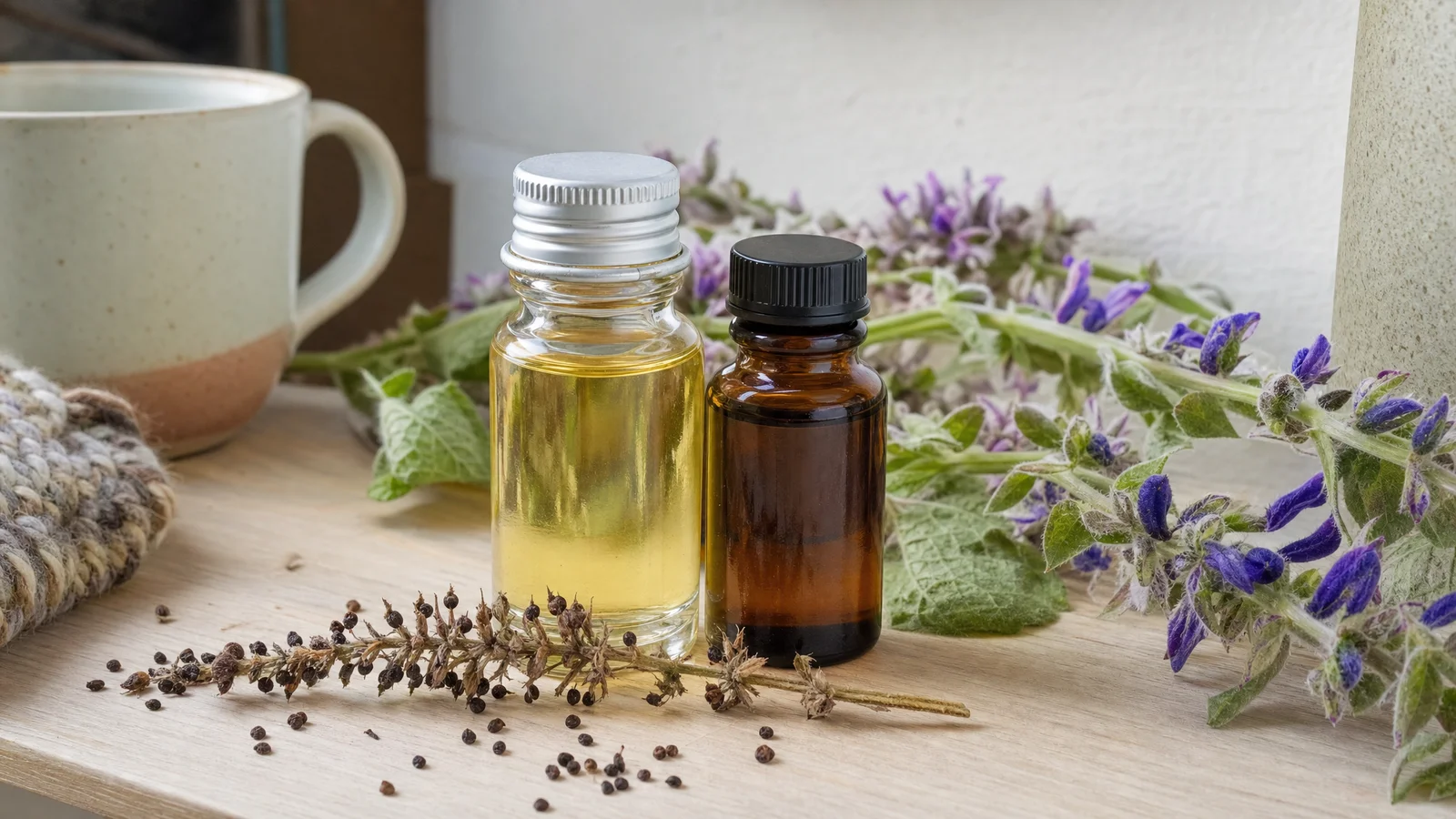
Two bottles can both say Salvia sclarea and have almost nothing in common. One is the essential oil, a volatile, aromatic liquid distilled from the flowering stems. The other is seed oil, a fixed oil pressed from the seeds that behaves much like a carrier oil. They sit next to each other in online listings, and the thumbnails look alike, which is exactly how people end up with the wrong one.

Clary Sage Essential Oil
Our own Clary Sage Essential Oil, in sizes from 0.5 oz to bulk.
From $19.99
Shop Now →Two different families
The essential oil is a story of aroma. The European Food Safety Authority describes it as steam-distilled from the fresh or dried flowering stems, with a specification of 55 to 78% linalyl acetate and 6.5 to 25% linalool (EFSA FEEDAP Panel, 2024). That is where the sweet, herbal, tea-like scent comes from.
Seed oil is a story of fat. A 2017 study of Salvia sclarea seeds found around 20% oil, rich in polyunsaturated fatty acids, with alpha-linolenic acid the main one at around 54% (Zivkovic et al., 2017). That is one analysis of one set of seeds, so read it as a typical picture and not a spec sheet.
The two will not stand in for each other. The seed oil's chemistry is built from fatty acids, not volatile aroma compounds, so it should not carry the scent we describe for ours. And the essential oil is a concentrated material, not a base oil.
Mix-ups to avoid
- Buying seed oil for fragrance. If you want that sweet, dry, softly herbal scent, which is a middle note in perfume terms, the essential oil is the one.
- Using the essential oil as a carrier. Ours is meant to be diluted: 0.5% to 2% in a carrier oil such as jojoba or sweet almond, with a patch test first. Our patch test guide walks through it, and the massage oil recipe shows the percentages in practice.
- Treating a recipe as interchangeable. When a recipe says "clary sage oil", check which one it means. One percent of essential oil in a carrier is a scent decision; a seed oil is a whole ingredient.
- Storing them alike. A fat that is mostly polyunsaturated is more prone to going off than one rich in oleic acid. That is general chemistry, not something that study measured, so ask a seed oil seller for a best-by date and keep the bottle cool and dark. For the essential oil, see our storage guide.
Five questions for any seller
Whichever bottle you are after, these sort listings quickly. What is the botanical name, written out? Which plant part? Is it distilled or pressed? Is there a batch report, and what does it measure? And what is the best-by date?
The Certificate of Analysis we publish for one batch of our oil gives relative density, refractive index and optical rotation. If you want a composition, such as linalyl acetate and linalool, ask us in writing through the contact page for the report on your lot before ordering.
Which one for what
- Scent for a diffuser, candle, soap or diluted massage oil: the essential oil, which is what we sell.
- A base oil or carrier: seed oil, or any carrier you like. We sell only the essential oil, so a carrier-oil supplier is the place to look. Ask for botanical name, plant part and best-by date.
- Scent in a carrier base: the seed oil as base and the essential oil as scent at a low percentage. That is simply reasoning from the above, so check the percentage against a safety source and patch test.
Our essential oil should never be swallowed; our ingestion post explains why. For other things that share the name, see oil versus absolute versus CO2 extract and oil versus hydrosol.
A little label-reading goes a long way: the words "seed" and "flowering tops" are the whole difference between a pantry-style oil and a fragrant one.
Clary Sage Essential Oil
Clary Sage Essential Oil from our own shop, in sizes from 0.5 oz to bulk.
From $19.99
Shop Now →Sources & Further Reading
- EFSA FEEDAP Panel, 2024. Clary sage oil feed additive opinion. EFSA Journal 22(11):e9016. pmc.ncbi.nlm.nih.gov/articles/PMC11561422
- Zivkovic J et al., 2017. Comparison of chemical profile and antioxidant capacity of seeds and oils from Salvia sclarea and Salvia officinalis. Chem Biodivers. pubmed.ncbi.nlm.nih.gov/28865183