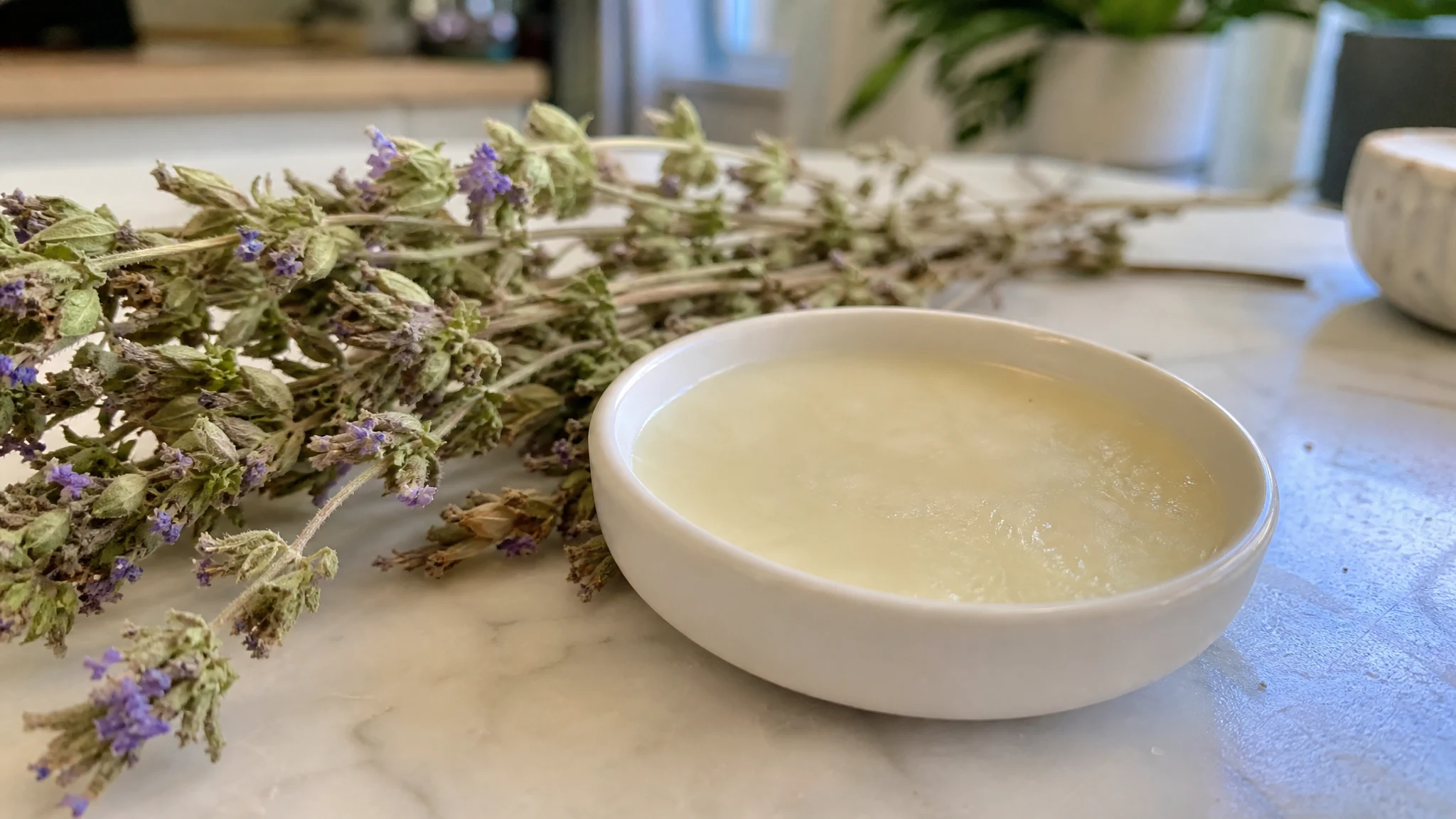
Three Clary Sage Solid Perfume Balms, Worked by Weight
A solid perfume is a small tin of wax and oil, and clary sage is a natural fit for it: sweet, dry and softly herbal, with nutty, tea-like undertones, and a middle note that gives a scent body in the first hour on skin. Below are three clary sage balms worked out by weight for a 20 g batch, starting with a single-oil version that tells you how your skin feels about the oil before you add anything else.

Clary Sage Essential Oil
Our own Clary Sage Essential Oil, in sizes from 0.5 oz to bulk.
From $19.99
Shop Now →The ceiling and the base
All three stay at or under 2% total essential oil, with clary sage never above 1%. The Tisserand Institute gives 1% to 3% for body oils and lotions, 0.5% to 1.2% for facial cosmetics and underarm products, and 0.2% to 1% for reaction-prone skin. It has no solid perfume line, so a pulse-point balm is a judgment inside the body range, below its top. Keep these off the face and underarms. Our own recommendation for clary sage on skin is 0.5% to 2% in a carrier with a patch test first, and the Tisserand retail page for clary sage lists 5 drops per 10 ml for body use and 2 drops per 10 ml for the face, with a caution for pregnancy and for sensitive or allergy-prone skin.
The base is the same for all three: 5.0 g beeswax to about 14.6 g jojoba oil, roughly one part wax to three of oil. That ratio is a starting point, not a standard. More wax gives a firmer balm that releases scent more slowly, less gives a softer one. Beeswax, jojoba and tins come from a craft or soap-making supplier, and any partner oils from a perfumery-supplies seller, since we sell clary sage oil only.
Weigh rather than count drops. The batch on our certificate has a relative density of 0.892, so 1 ml weighs about 0.892 g, and a scale reading to 0.01 g is enough. At 20 drops to the millilitre, 0.20 g of clary sage is around four or five drops.
Formula 1: the single-oil balm
5.0 g beeswax, 14.9 g jojoba, 0.10 g clary sage oil (0.5%). Make this first. If your skin reacts there is only one oil to blame, and 0.5% sits at the low edge of both our range and Tisserand's range for reactive skin. Follow our patch test method with this balm before making anything more elaborate.
Formula 2: clary-led, dry and herbal
5.0 g beeswax, 14.6 g jojoba, 0.20 g clary sage (1.0%), 0.12 g vetiver (0.6%), 0.08 g geranium (0.4%). This is the one for people who love the oil itself. Clary sage supplies half the scent, vetiver gives the weight and staying power a middle note lacks (our base-note article explains why), and geranium adds a floral edge so the dry herbal character is not flat. Expect a nutty, dry result rather than a sweet one.
Formula 3: a citrus opening and a dry finish
5.0 g beeswax, 14.6 g jojoba, 0.14 g clary sage (0.7%), 0.12 g geranium (0.6%), 0.06 g bergamot (0.3%), 0.08 g vetiver (0.4%). Bergamot supplies the opening, geranium the middle and vetiver the base. Expressed bergamot oil is phototoxic, and the Tisserand Institute says to keep it to 0.4% in the final product for sun-exposed skin; 0.3% leaves a margin for weighing error. Bergapten-free (FCF) bergamot is described as non-phototoxic, so check which one your supplier sells. If in doubt, wear this balm on covered skin.
Making a batch
- Weigh the beeswax and jojoba into a small heatproof jar and melt in a warm water bath until clear.
- Take it off the heat and let it cool until just warm to the touch. Volatile oils escape from hot wax faster, so add them late.
- Weigh in the essential oils, heaviest first and brightest last, and stir for a full minute.
- Pour into a clean tin, let it set undisturbed, then cap. Label it with the formula, percentages and date.
Smell it again after a day, because a balm settles. Compare it with a blotter of clary sage alone and change one number at a time. For a roll-on version, drop the wax and use 19.6 g of jojoba with the same weights.
Who should skip these
We advise avoiding clary sage oil during pregnancy and while nursing, and an obstetric clinician is the right person to ask. Anyone with a known fragrance allergy or reactive skin should check with a dermatologist or allergist, since the European Food Safety Authority's 2024 opinion (written for animal feed) says clary sage oil should be considered an irritant to skin and eyes and a dermal and respiratory sensitiser. Keep balms away from children under 3, and ask a veterinarian about pets. If you plan to sell a balm, labelling and safety-assessment requirements apply that go beyond this article, and a cosmetic chemist can help; for composition details on our oil, you can ask us in writing through the contact page.
Our pairing guide has more partner ideas to swap into Formula 2 or 3, one change at a time.
A tin of solid perfume lasts a long while at these amounts, and the first small batch will tell you which of the three you reach for.
Clary Sage Essential Oil
Clary Sage Essential Oil from our own shop, in sizes from 0.5 oz to bulk.
From $19.99
Shop Now →Sources & Further Reading
- Tisserand Institute. Essential oil dilution. tisserandinstitute.org/dilution-essential-oils
- Tisserand Institute. Phototoxicity. tisserandinstitute.org/safety/phototoxicity
- Tisserand Essential Oils. Clary Sage Essential Oil, safety information. tisserand.com
- EFSA FEEDAP Panel, 2024. Safety and efficacy of a feed additive consisting of an essential oil derived from the flowering stems of Salvia sclarea L. pmc.ncbi.nlm.nih.gov/articles/PMC11561422