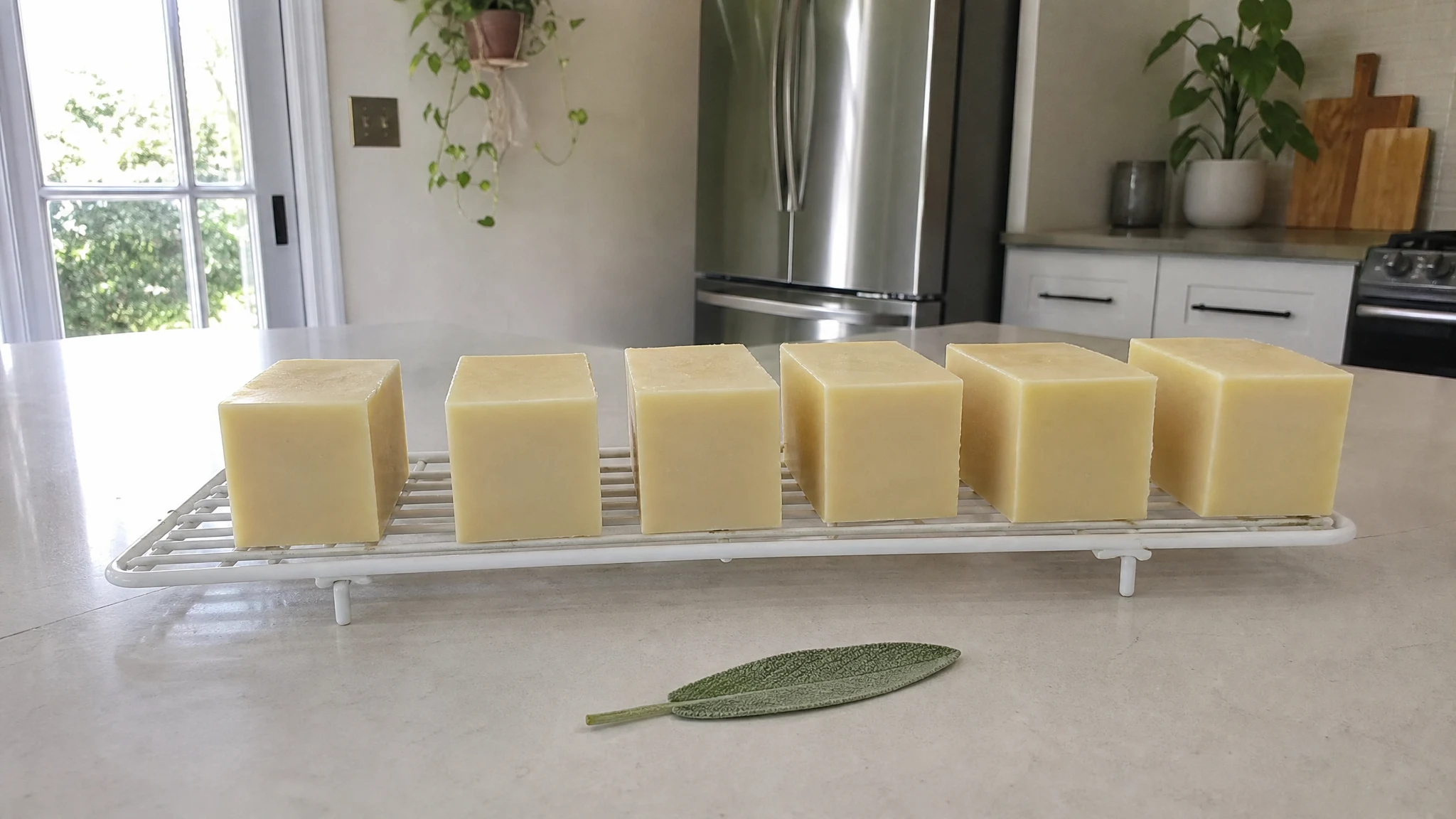
Scenting Cold Process Soap With Clary Sage Oil
Soapmakers tend to measure fragrance in grams, not drops, and clary sage oil rewards that habit. It is a soft, herbal, slightly nutty oil, and the number that matters is how much of it sits in the finished bar. That is a simple sum once you know which percentage your guideline is talking about.

Clary Sage Essential Oil
Our own Clary Sage Essential Oil, in sizes from 0.5 oz to bulk.
From $19.99
Shop Now →Is your product soap, legally?
The word "soap" carries regulatory weight. The FDA applies it only when most of the nonvolatile matter is an alkali salt of fatty acids, those salts provide the cleansing, and the product is labelled and sold solely as soap; products that meet it are overseen by the Consumer Product Safety Commission rather than the FDA (FDA, Is It a Cosmetic, a Drug, or Both? (Or Is It a Soap?)). The same page notes that intended use is read from labels, ads and online claims. So for a clary sage bar, describe the scent and leave the rest out. Our buyer's guide for soap and candle makers covers supplier paperwork, which leaves this post free for the making.
From a percentage to grams on the scale
Tisserand's dilution guidance puts wash-off products such as soap and body wash in a 2 to 4% range of the total product, describing its ranges as guidelines rather than rules and advising you to start low (Tisserand Institute, dilution). It gives no figure specific to clary sage. Our own dilution guidance for leave-on skin use is 0.5% to 2% in a carrier oil, and since soap rinses off, a first batch somewhere around 1% to 2% of the batter is a comfortable starting place, with 4% as the category ceiling rather than a target. Check IFRA standards for the category your finished product falls into before you settle on a number.
Recipes are usually written as a percentage of oil weight, while that guideline is a percentage of the whole product, so convert before you pour. As an illustration, take 1,000 g of oils plus 450 g of lye solution, or 1,450 g of batter. Your lye calculator will give your real total.
| Share of batter | Oil needed | As volume | Share of oil weight |
|---|---|---|---|
| 1% | 14.5 g | 16.3 ml | 1.45% |
| 2% | 29 g | 32.5 ml | 2.9% |
| 4% | 58 g | 65 ml | 5.8% |
The volume column uses the 0.892 relative density on the certificate of analysis we publish for one batch, so 1 ml of that batch weighs about 0.892 g; other lots will differ slightly. By the rough 20-drops-per-ml convention, 2% would be around 650 drops, which is a good argument for weighing instead of counting.
One more adjustment: bars lose water as they cure, so the oil's share of a finished bar creeps up. If a bar lost 15% of its weight, a 2% batter would finish near 2.35%. That figure is illustrative, but it is worth leaving yourself that headroom.
What lye does to the scent
This is where we would rather be candid than confident. Clary sage oil is mostly linalyl acetate and linalool; in the oils analysed in the European Food Safety Authority's 2024 opinion, the ester averaged about 68% and the alcohol about 15% of peak area across three batches (EFSA FEEDAP Panel, 2024). Those figures describe the species typically, not our lot. Esters are the kind of molecule that strong alkali can split, so it is reasonable to expect the scent of a finished bar to drift from the scent in the bottle. We could not find a measurement that sizes that effect for clary sage in soap; the nearest paper analysed a lavender oil only before it went into hot process soap (Dirahoui et al., 2026). So the honest answer to "does it hold?" is that your bench will tell you.
A small bench plan
- Change one thing at a time. Same base recipe, different oil share, or a different moment of adding it.
- Weigh and write everything down, including the lot and the date the bottle was opened.
- Smell on a schedule: at pour, after a day, and at several points through the cure, beside an unscented control bar.
- Pick the lowest rate you can still smell at the end of cure and keep it under the ceiling you chose.
Sample bottles from our wholesale page suit this sort of bench work better than a bulk order, and for production runs you can ask us in writing through the contact page for the report on your lot, which our GC/MS reading guide will help you decode.
Handling and skin
EFSA's panel advised treating the oil as a skin and eye irritant and a dermal and respiratory sensitiser, and linalool is the usual suspect once it oxidises. In a six-country study of 2,900 dermatitis patients, 6.9% reacted to oxidised linalool at 6% in petrolatum (Bråred Christensson et al., 2012). That is a clinic population and overstates what an ordinary bar user sees, but it is a fair reason to use fresh oil, stored as in our storage guide, and to patch test a finished bar before gifting or selling it. We advise avoiding clary sage oil during pregnancy, which applies to the maker as well as the customer. Lye, base oils, moulds and scales come from soap-supply shops, and the lye supplier's safety data sheet governs how you handle it.
Work out the grams first, smell your way to the rate, and let a bar that has cured be your final judge.
Clary Sage Essential Oil
Clary Sage Essential Oil from our own shop, in sizes from 0.5 oz to bulk.
From $19.99
Shop Now →