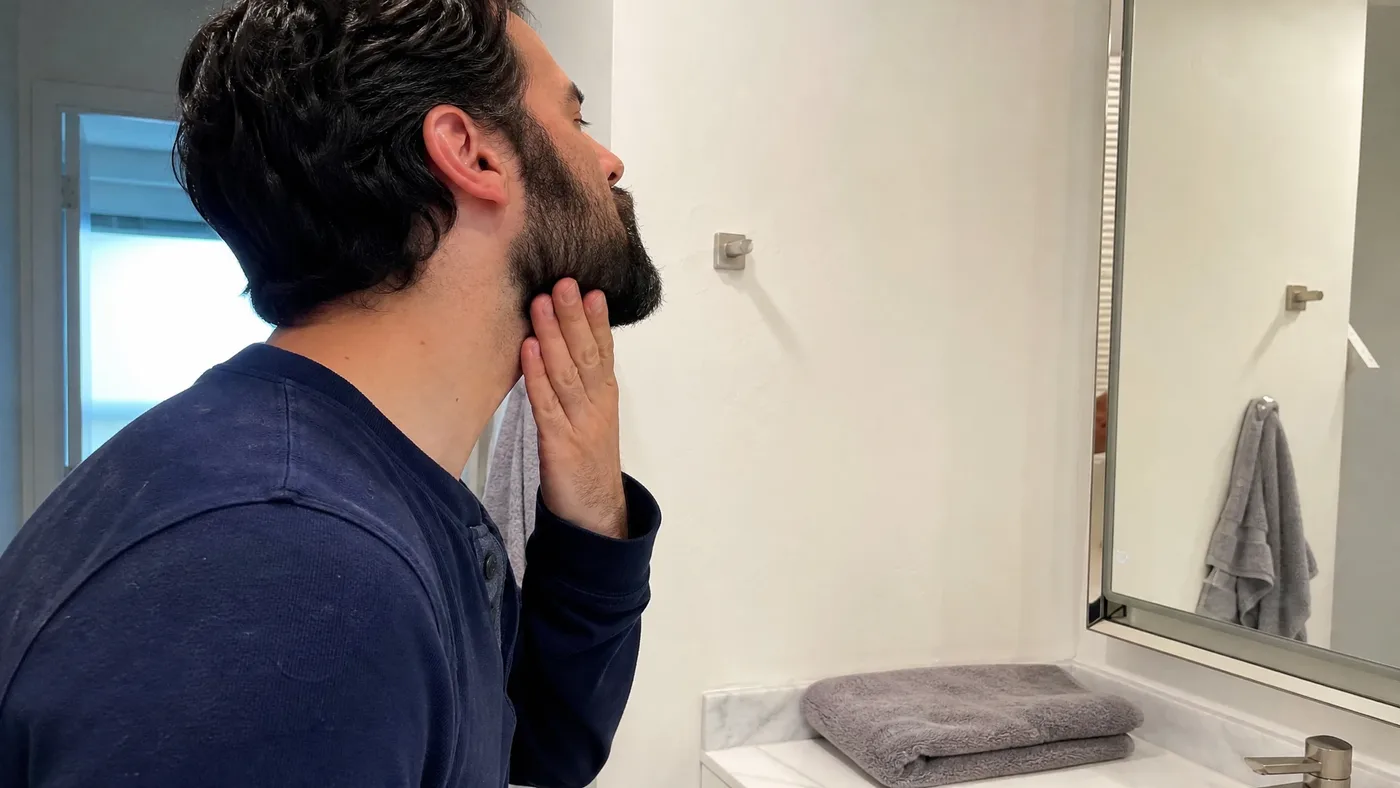
A Clary Sage Beard Oil for Evenings, Worked in ml
A beard oil sits a few centimetres below your nose from breakfast to bedtime, so the scent is not a minor detail. Clary sage is sweet, dry and softly herbal with nutty, tea-like undertones, which makes it an interesting choice for a beard oil: more tea-and-hay than the usual cedar and citrus. Here is how to build a 30 ml bottle with the numbers worked out.

Clary Sage Essential Oil
Our own Clary Sage Essential Oil, in sizes from 0.5 oz to bulk.
From $19.99
Shop Now →Start with the face number, not the body number
Skin on the face and neck is more reactive than skin on a forearm, and dilution guidance reflects that. The Tisserand Institute gives 0.5% to 1.2% for facial cosmetics and deodorants, against 1% to 3% for body oils, and 0.2% to 1% for skin that is already reaction-prone. Our own guidance for general skin use is 0.5% to 2%. For a beard oil, work from the overlap: 0.5% to 1.2%, and stay near the bottom if your skin is sensitive. Clary sage oil is mostly linalyl acetate and linalool, and the EFSA panel that reviewed it in 2024 considers it an irritant to skin and eyes and a sensitiser. That assessment was written for animal feed and gives no facial dose, but it is a good reason to treat the top of any range as a ceiling, not a target.
The 30 ml batch
The oil volume is the percentage times 30 ml. Drop counts use the Institute's chart assumption of 30 drops per ml.
| Target | Clary sage oil in 30 ml | Drops at 30/ml |
|---|---|---|
| 0.5% | 0.15 ml | 4.5 |
| 0.75% | 0.225 ml | 6.75 |
| 1% | 0.3 ml | 9 |
| 1.2% (top of the facial range) | 0.36 ml | 10.8 |
Real droppers vary a lot: the Institute reports roughly 20 to 40 drops per ml across the ones it looked at. Nine drops from a 20-per-ml dropper is 0.45 ml, which in 30 ml is 1.5%, already past the facial ceiling. So measure 0.3 ml with a small syringe or graduated pipette instead of counting. For a first bottle we would suggest 0.5%, since you can add oil to a second batch but cannot take it out of a finished one. Patch test the finished blend first; here is how.
Choosing the carrier
We sell clary sage oil only, so the carrier comes from a supplier of your choosing. Jojoba is a popular pick because it is a liquid wax ester rather than a triglyceride oil, and in a 2022 heat test comparing jojoba, olive oil and squalene it showed the lowest oxidation of the three. That was a lab test of three materials, not a shelf-life promise for any finished beard oil, but it is a sensible reason to put jojoba on your shortlist. Our carrier and ratio guide covers other options.
Keeping the bottle fresh
Linalool and linalyl acetate react with air over time, and lavender oil studies show that oxidised versions are more likely to cause skin reactions. Clary sage shares those two main compounds, so the sensible habits carry over: keep the oil bottle tightly capped in a cool, dark place, mix small batches, and retire any blend that smells different from the day you made it. We say our oil typically stays vibrant for 3 to 4 years in a tightly capped, shaded cupboard, but a beard oil you open daily does not get that protection, so label it with the date.
Why we would keep this one for evenings
We say clary sage is not the oil to reach for before driving, so if you make this beard oil, we would keep it for the evening bottle and use something else on the way to work. If you want a woody frame, lavender, bergamot, geranium, sandalwood and vetiver are the partners we list; any second oil counts toward the same total percentage, not on top of it. Our pairing guide has ideas.
A few cautions
- Skin under the beard. A scented oil is not an answer to itching, flaking or redness. See a dermatologist, and tell them about any fragranced product you were using.
- Eyes and mouth. Keep the oil away from eyes and do not take it by mouth. Apply below the lip line and wash your hands afterwards.
- Pregnancy, children and pets. We recommend avoiding it during pregnancy, so if you live with someone who is pregnant, ask an OB-GYN or midwife, and keep the bottle away from children and pets.
Start low, give it a week, and adjust. A beard oil that smells like a quiet herb garden is worth the arithmetic.
Clary Sage Essential Oil
Clary Sage Essential Oil from our own shop, in sizes from 0.5 oz to bulk.
From $19.99
Shop Now →Sources & Further Reading
- Tisserand Institute. Dilution of essential oils. tisserandinstitute.org/dilution-essential-oils
- Tisserand Institute. Drop size. tisserandinstitute.org/learn-more/drop-size
- EFSA FEEDAP Panel, 2024. EFSA Journal 22(11):e9016. PMC11561422
- Tsuchimoto, Sakai, Fukui, 2022. BPB Reports 5(6). jstage.jst.go.jp
- Hagvall L, Christensson JB, 2016. Acta Derm Venereol. pubmed.ncbi.nlm.nih.gov/26671837