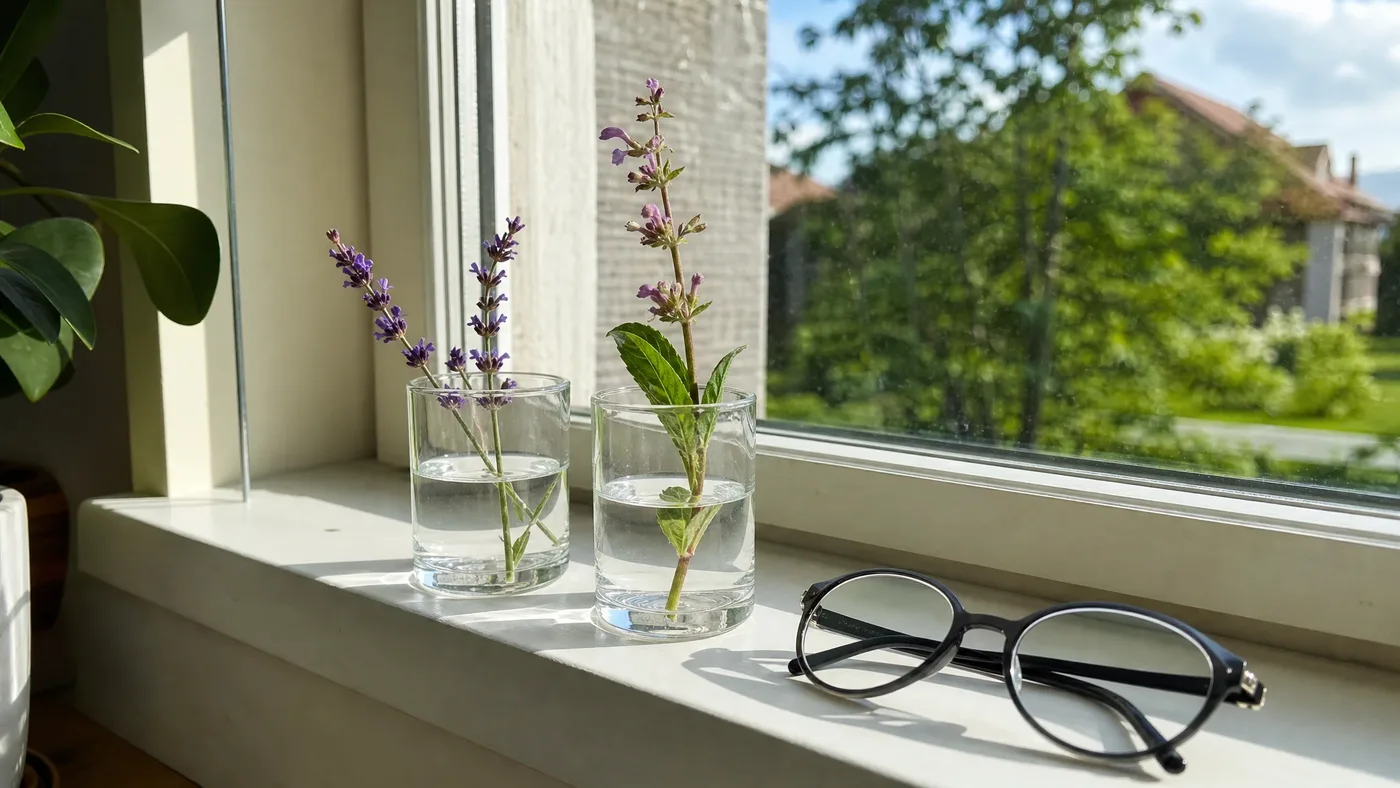
Clary Sage vs Lavender Oil: What the Evidence Shows
If you are choosing between clary sage oil and lavender oil for an evening routine, the honest ranking is this: lavender has far more human research behind it, clary sage has one small head-to-head trial that went its way, and the two oils are chemically closer than their scents suggest. We sell only clary sage, so weigh what follows with that in mind. We have not run a scent panel or any side-by-side test of the two, and nothing below comes from customer outcomes.

Clary Sage Essential Oil
Our own Clary Sage Essential Oil, in sizes from 0.5 oz to bulk.
From $19.99
Shop Now →Where the chemistry overlaps, and where it does not
Both oils are built mostly from the same two molecules, linalyl acetate and linalool. The numbers differ by sample. A 2020 pilot paper from the University of Vienna (Mitic et al., Planta Medica, 2020) analysed one clary sage oil and found 61.3% linalyl acetate and 22.1% linalool. A 2023 analysis of a different clary sage sample (Kačániová et al., Int J Mol Sci, 2023) reported 49.1% and 20.6%. The 2024 European Food Safety Authority opinion on clary sage oil as a feed additive lists a specification of 55 to 78% linalyl acetate and 6.5 to 25% linalool (EFSA FEEDAP Panel, 2024). One Moroccan lavender oil analysed in 2025 came in at 31.78% linalyl acetate and 16.58% linalool (Aguerd et al., AMB Express, 2025).
Reasoning from those four figures: a single lavender sample and a single clary sage sample cannot be compared as if each were the species average, because oils vary by harvest and distillation. What the figures do show is that "clary sage is the lavender-like one" is chemically fair, and that the difference you smell comes from the minor components, not from a different main ingredient. Our linalyl acetate article goes deeper on that molecule.
What the evidence actually looks like
| Question | Lavender | Clary sage |
|---|---|---|
| Meta-analysis of human trials | Yes: 37 randomised trials, 3,964 participants in the quantitative synthesis (Donelli 2019) | None found in PubMed |
| Single-oil randomised trials | Many | A handful, all small (Seol 2013 had 34 participants) |
| Head-to-head against the other | One trial each way (Seol 2013, Kao 2017) | Same two trials |
| Topical safety signal in the literature | Henley 2007 case reports (products with lavender and tea tree oils) | Sensitiser classification on supplier safety sheets (EFSA 2024) |
The lavender side is deep. A 2019 systematic review of 65 randomised trials and 25 non-randomised studies (Donelli et al., Phytomedicine, 2019) pooled 37 of them (3,964 participants) and reported that lavender inhalation lowered anxiety scores (Hedges' g of -0.73, 95% CI -1.00 to -0.46). The same authors flagged a high overall risk of bias in most included trials and found no significant effect of inhaled lavender on systolic blood pressure. So even the strong side is "a medium effect on questionnaires, in studies of mixed quality".
The clary sage side is thin. When we searched PubMed on 23 October 2026 for Salvia sclarea essential oil, the human trials we could find were small, several came from Korea and Taiwan, and several tested blends. We found no meta-analysis.
The one trial that put them head to head
In a double-blind randomised trial of 34 women with urinary incontinence undergoing a urodynamic examination, participants inhaled clary sage, lavender or almond oil (the control), each at 5% vol/vol, for 60 minutes (Seol et al., J Altern Complement Med, 2013). The clary sage group had a significantly lower systolic blood pressure than the control (p=0.048) and the lavender group (p=0.026), and the lavender group tended to drift upward. The authors wrote that lavender "may be inappropriate" for lowering stress in that setting.
Read that narrowly. The setting was a stressful clinical procedure, the outcome was blood pressure and respiratory rate rather than sleep or mood, and 34 people split three ways is about eleven per arm. It does not show that clary sage beats lavender at bedtime. Meanwhile a 4-week trial of 132 working women (Kao et al., J Altern Complement Med, 2017) compared lavender alone with a 1:1:1 blend of lavender, clary sage and marjoram, and sleep scores improved more with the blend than with lavender alone. Because the blend contains lavender and marjoram, you cannot credit clary sage for that gap. Two trials, two framings, and our reading is that the honest conclusion is "no verdict".
Safety flags that differ
For lavender, the well-known item is a 2007 report in the New England Journal of Medicine of three prepubertal boys whose breast enlargement coincided with topical products containing lavender and tea tree oils and resolved after stopping them; the authors also found estrogen-like and anti-androgen-like activity for both oils in cell lines (Henley et al., NEJM, 2007). Three children and two oils together cannot isolate lavender, and the report drew several published letters in the same journal. It is a signal to discuss with a pediatrician before using any scented product on a child, not a settled finding.
For clary sage, EFSA's feed-additive panel stated that the oil should be treated as irritant to skin and eyes and as a dermal and respiratory sensitiser, a conclusion based on the applicant's safety data sheet because no user-safety data were supplied (EFSA FEEDAP Panel, 2024, above). That is a regulatory classification for an animal-feed opinion, not a cosmetic review, but it fits our own instructions: dilute to 0.5% to 2% in a carrier oil, patch test, keep away from eyes. At 0.5% a 10 ml bottle of carrier takes 0.05 ml of oil; at 2% it takes 0.2 ml. With the rough assumption of 20 drops per ml, that is about one and four drops, and drop counts are only approximate. Our oils are sold undiluted, so that maths is yours. For pregnancy, our own page says to avoid clary sage, and we cannot compare how lavender is regarded there: ask an OB-GYN or midwife about either oil.
How we would choose
- You want the option with the larger body of human research and a scent you probably already know: lavender. We do not sell it. Buy from a seller that prints the Latin name (Lavandula angustifolia) and a batch number.
- You like a drier, more herbal scent with a nutty, tea-like edge (how our Purity page describes ours) and are happy to accept thin evidence: clary sage. See our pairing guide; lavender is among the oils our own pages name as blending partners.
- You want sleep help: neither oil has a trial in insomnia that we could verify. See our sleep article and, for worry, our anxiety article. Persistent trouble sleeping or anxiety is a matter for a physician, not an oil.
- Our own page also warns that clary sage is unusually relaxing to sit with and not the oil to reach for before driving.
You also do not have to pick one for good: both are used in blends, and the lavender-and-clary pairing is one our own pages list. The blend trials above are the reason to keep expectations modest, since nobody has separated the oils inside them.
Clary Sage Essential Oil
Clary Sage Essential Oil from our own shop, in sizes from 0.5 oz to bulk.
From $19.99
Shop Now →Sources & Further Reading
- Mitic et al., 2020. Clary Sage Essential Oil and Its Effect on Human Mood and Pulse Rate. pubmed.ncbi.nlm.nih.gov/32688401
- Kačániová et al., 2023. Salvia sclarea Essential Oil Chemical Composition and Biological Activities. pubmed.ncbi.nlm.nih.gov/36982252
- EFSA FEEDAP Panel, 2024. Safety and efficacy of a feed additive consisting of an essential oil derived from the flowering stems of Salvia sclarea L. pmc.ncbi.nlm.nih.gov/PMC11561422
- Aguerd et al., 2025. Chemical composition and biological effects of Lavandula angustifolia essential oils. pubmed.ncbi.nlm.nih.gov/41191233
- Donelli et al., 2019. Effects of lavender on anxiety: a systematic review and meta-analysis. pubmed.ncbi.nlm.nih.gov/31655395
- Seol et al., 2013. Randomized controlled trial for Salvia sclarea or Lavandula angustifolia. pubmed.ncbi.nlm.nih.gov/23360656
- Kao et al., 2017. Comparisons for Effectiveness of Aromatherapy and Acupressure Massage on Quality of Life in Career Women. pubmed.ncbi.nlm.nih.gov/28504569
- Henley et al., 2007. Prepubertal gynecomastia linked to lavender and tea tree oils. pubmed.ncbi.nlm.nih.gov/17267908