Clary Sage in the Period Cramp Trials, Decoded
Two clinical trials put clary sage in a blend and rubbed it on the lower abdomen of women with painful periods, and both are quoted all over the internet. Neither tested clary sage oil on its own, and the recipes are more interesting than the headlines. Here is what went into them and what that means for anyone curious about a massage oil.

Clary Sage Essential Oil
Our own Clary Sage Essential Oil, in sizes from 0.5 oz to bulk.
From $19.99
Shop Now →Recipe one: the Korean college students
In 2006, researchers enrolled 67 college students who rated their cramps above 6 out of 10 and had no systemic or reproductive disease and no contraceptive pills (Han et al., 2006). The aromatherapy group (25 women) had their abdomens massaged with two drops of lavender, one drop of clary sage and one drop of rose in 5 cc of almond oil. A placebo group (20) was massaged with almond oil alone and a control group (22) received nothing. Cramps were lower in the aromatherapy group than in both other groups on the first and second day of menstruation.
The arithmetic is simple. Taking 5 cc as 5 ml and the common rough convention of 20 drops to the millilitre, four drops is about 0.2 ml, so the whole blend was about 4%. Clary sage was one of those four drops, about 1% of the mixture. That sits inside our 0.5% to 2% guidance for clary sage, though the blend as a whole was double the top of it.
Recipe two: the Taiwanese outpatients
The second trial involved 48 outpatients whose primary dysmenorrhea was confirmed by a gynecologist (Ou et al., 2012). Lavender, clary sage and marjoram in a 2:1:1 ratio were diluted to 3% in unscented cream, and the comparison group used a cream with synthetic fragrance. Everyone massaged the lower abdomen daily from the end of one period to the start of the next. The authors report pain relief and a shorter duration of menstrual pain in the essential oil group.
If clary sage is one quarter of a 3% blend, it works out to about 0.75%. Another low figure, and again a mix, not a single oil.
What this does and does not tell you
Both trials used a blend plus a massage, so neither can say how much came from the clary sage, how much from the other oils, and how much from the simple act of a warm, scented abdominal rub. Han's placebo group was also massaged, which helps, though almond oil has little scent, so participants may have known which group they were in. That is our reasoning, not the authors'. The honest summary is that a daily, scented abdominal massage has been studied, with lavender, rose or marjoram alongside clary sage, and that nobody has isolated clary sage.
What ACOG puts first
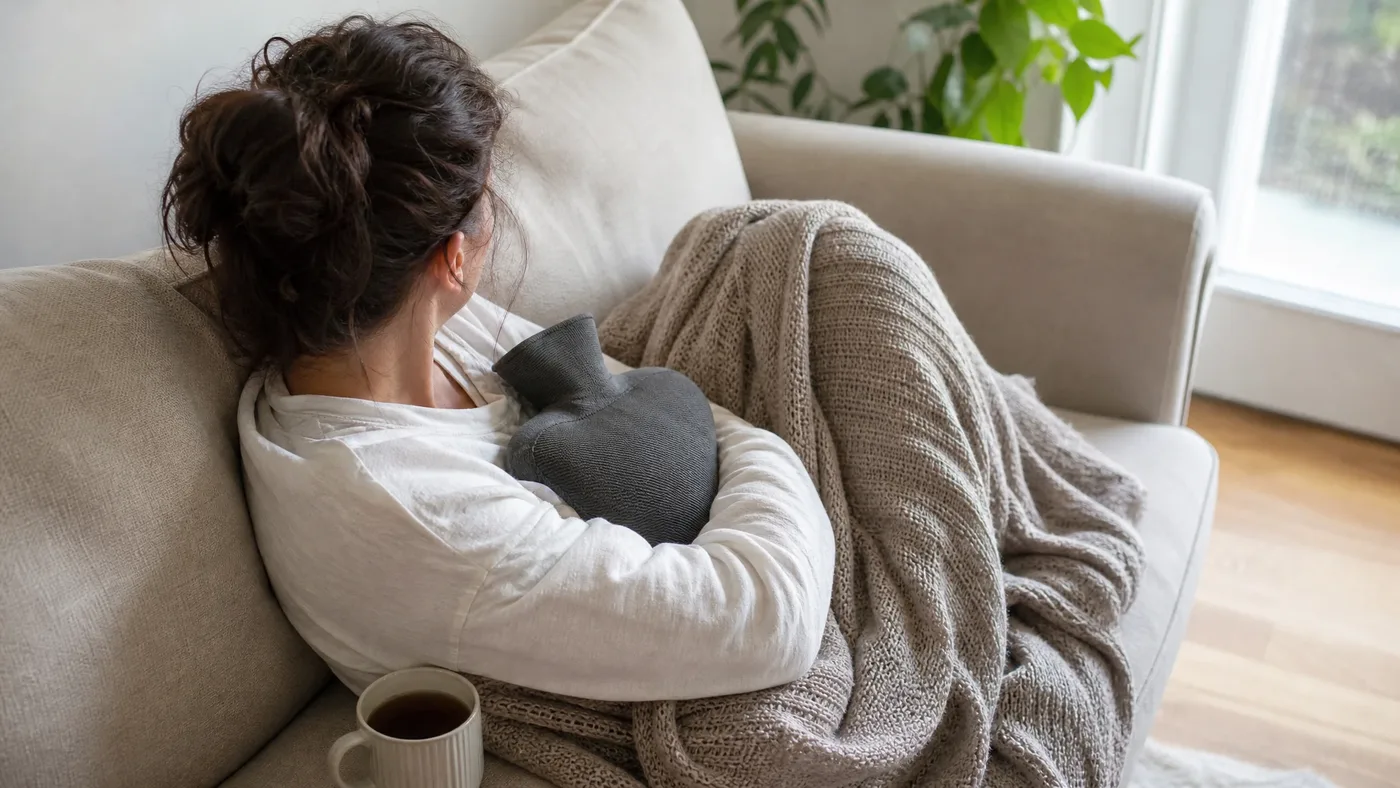
The American College of Obstetricians and Gynecologists describes primary dysmenorrhea as cramping pain caused by prostaglandins, the chemicals that make the uterine muscle contract, which is why pain usually eases after the first days of a period (ACOG, Dysmenorrhea). Its first-line treatment is NSAIDs such as ibuprofen taken at the first sign of pain, and hormonal birth control is another route. At home, it suggests exercise, enough sleep, relaxation such as meditation or yoga, and "a warm bath or placing a heating pad or hot water bottle on your abdomen".
Heat has been tested head to head. In a trial of 344 evaluable women, a wearable heat wrap beat 1,000 mg of acetaminophen for pain relief over 8 hours (means of 2.48 and 2.17, p = 0.015) (Akin et al., 2004). We put heat first in any cramp routine for that reason, and the oil, if you want it, comes after.
ACOG also describes secondary dysmenorrhea, caused by conditions such as endometriosis, fibroids or adenomyosis, where pain tends to worsen over time. Pain that is getting worse, that lasts for days, or that medication does not touch deserves an OB-GYN visit, not a massage oil.
If you want a scented massage oil anyway
Our oil is sold undiluted, so you will need a carrier such as a plain vegetable oil or unscented lotion from a craft shop or grocery store. At 20 drops to the millilitre, 10 ml of carrier needs about 1 drop of clary sage for 0.5%, about 2 drops for 1%, and about 4 drops for 2%. That covers the clary sage share of both recipes above, though not the lavender, rose or marjoram, which we do not sell. Patch test on your forearm first and keep it off broken skin and away from your eyes; our dilution guide has the method, and our massage oil and roll-on posts go further.
We avoid clary sage in pregnancy, so a late period is a reason for a test before an oil (see our irregular periods article). Our pages say to keep it from children and not to use it before driving. For the wider research map, see our women's health overview, and for the mood side of the cycle, our PMS article.
A warm heating pad and a good-smelling oil can sit side by side on a hard day, as long as the heating pad comes first.
Clary Sage Essential Oil
Clary Sage Essential Oil from our own shop, in sizes from 0.5 oz to bulk.
From $19.99
Shop Now →Sources & Further Reading
- Han SH et al., 2006. Effect of aromatherapy on symptoms of dysmenorrhea in college students. J Altern Complement Med. pubmed.ncbi.nlm.nih.gov/16884344/
- Ou MC et al., 2012. Pain relief assessment by aromatic essential oil massage on outpatients with primary dysmenorrhea. J Obstet Gynaecol Res. pubmed.ncbi.nlm.nih.gov/22435409/
- Akin MD et al., 2004. Continuous, low-level, topical heat wrap therapy as compared to acetaminophen for primary dysmenorrhea. J Reprod Med. pubmed.ncbi.nlm.nih.gov/15493566/
- ACOG. Dysmenorrhea: painful periods. www.acog.org/womens-health/faqs/dysmenorrhea-painful-periods