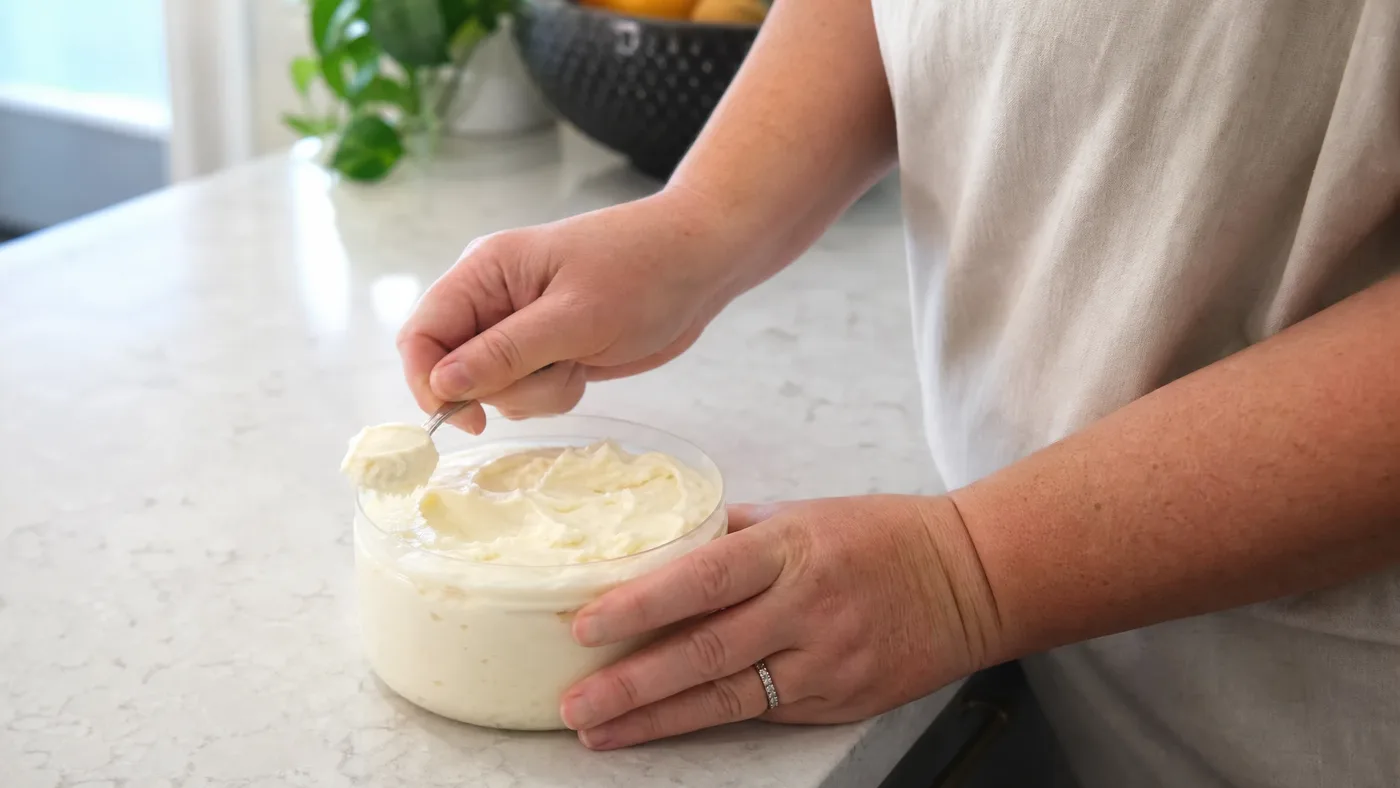
Making a Clary Sage Body Butter, Gram by Gram
If you want to scent a body product with clary sage, here is our advice: make a butter, not a lotion. A whipped butter is built from fats and oils alone, so it stays simple. A lotion contains water, which brings a whole preservation question that is really a cosmetic chemist's job. The butter is also the better home for clary sage's sweet, dry, softly herbal aroma, because the scent sits in the fat and stays put on skin.

Clary Sage Essential Oil
Our own Clary Sage Essential Oil, in sizes from 0.5 oz to bulk.
From $19.99
Shop Now →Why no water matters
FDA's guidance for small businesses making cosmetics says cosmetics need not be sterile but must not contain harmful microorganisms. Microbes need water, and a lotion is an oil-and-water emulsion, so it is the riskier project at home. A waterless butter gives them far less to work with, though that is reasoning, not a guarantee. A 2026 review of home-use products found contamination in a wide range of items (mostly makeup, not butters), so hygiene still counts: use a clean spatula instead of a wet finger, and keep water out of the jar. If you want a lotion, start from a ready-preserved base from a supplier and add clary sage at the same dilution below. We sell only the oil, no butters or bases.
The oil dose, by weight
Butters are weighed, so grams are easier than drops. The Tisserand Institute reports about 0.033 g per drop (20 drops weighed 0.66 g), roughly 30 drops per gram. Its dilution guide gives 1% to 3% for body oils and lotions; our guidance is 0.5% to 2% in a carrier before the oil touches skin, and we stop at 2% because the EFSA panel that reviewed clary sage oil in 2024 considers it a skin and eye irritant and a sensitiser (that assessment was for animal feed, so it is a reason for caution, not a measured skin limit).
| Jar of butter | 0.5% | 1% | 2% |
|---|---|---|---|
| 100 g | 0.5 g (about 15 drops) | 1 g (about 30 drops) | 2 g (about 60 drops) |
| 200 g | 1 g (about 30 drops) | 2 g (about 60 drops) | 4 g (about 120 drops) |
Droppers range from about 20 to 40 drops per ml, so a drop count can drift by a third or more. A scale that reads to 0.01 g is the more reliable tool. Because we sell the oil undiluted, the weighing is yours. Patch test the finished butter before using it widely; see how to patch test clary sage oil.
Choosing the butter
We do not sell butters, so this comes from supplier research. Shea is the most common choice. A 2023 study comparing crude shea butter with refined stearin and olein found stearic and oleic acid were the main fatty acids, and that refining changed peroxide value, tocopherols and sterols. So "shea butter" can mean different materials from different suppliers, and a technical data sheet is worth asking for. Melting and whipping temperatures belong on that data sheet too. One general piece of reasoning: clary sage oil is volatile and heat-sensitive, so stir it in once the melted butter has cooled to near the point where it starts to set, not into hot liquid.
Keeping the jar fresh
Oxidation is the limiting factor for both the butter and the oil. Linalool and linalyl acetate, the main components of clary sage oil, react with air, and lavender studies link the oxidised forms to more skin reactions. We say our oil typically lasts 3 to 4 years in a tightly capped, shaded cupboard, but a jar you open daily does not get that treatment. Make small jars, date them, keep them out of heat (a hot car is a bad place), and retire one that smells or looks different. Our storage guide has the details.
If you give it away or sell it
FDA's cosmetics labeling guide says a retail label needs an identity statement, net quantity, the name and address of the responsible firm, and ingredients in descending order of predominance (those at 1% or less may follow in any order). A warning is required where needed to prevent a health hazard. The guide does not say how the rules apply to gifts, so ask FDA or a regulatory adviser before you sell, and keep any label free of promises about skin.
Who should skip it
We recommend avoiding clary sage oil during pregnancy and keeping it away from children and pets; an OB-GYN or midwife, a pediatrician or a veterinarian can advise. Eczema, a rash or broken skin belongs with a dermatologist, not a jar of butter. Clary sage is not the oil to reach for before driving, so it suits an evening routine best. Our bath oil piece and dilution guide pair well with this one.
A small jar, a clean spatula and a modest percentage: that is all this recipe asks of you.
Clary Sage Essential Oil
Clary Sage Essential Oil from our own shop, in sizes from 0.5 oz to bulk.
From $19.99
Shop Now →Sources & Further Reading
- FDA. Small Businesses & Homemade Cosmetics: Fact Sheet. fda.gov
- FDA. Cosmetics Labeling Guide. fda.gov
- Tisserand Institute. Drop size. tisserandinstitute.org/learn-more/drop-size
- Tisserand Institute. Dilution of essential oils. tisserandinstitute.org/dilution-essential-oils
- EFSA FEEDAP Panel, 2024. PMC11561422
- Iskandar, Marchin, Roques, 2026. Frontiers in Microbiology. pubmed.ncbi.nlm.nih.gov/42254497
- Abdel-Razek AG et al., 2023. Foods. pubmed.ncbi.nlm.nih.gov/37107421