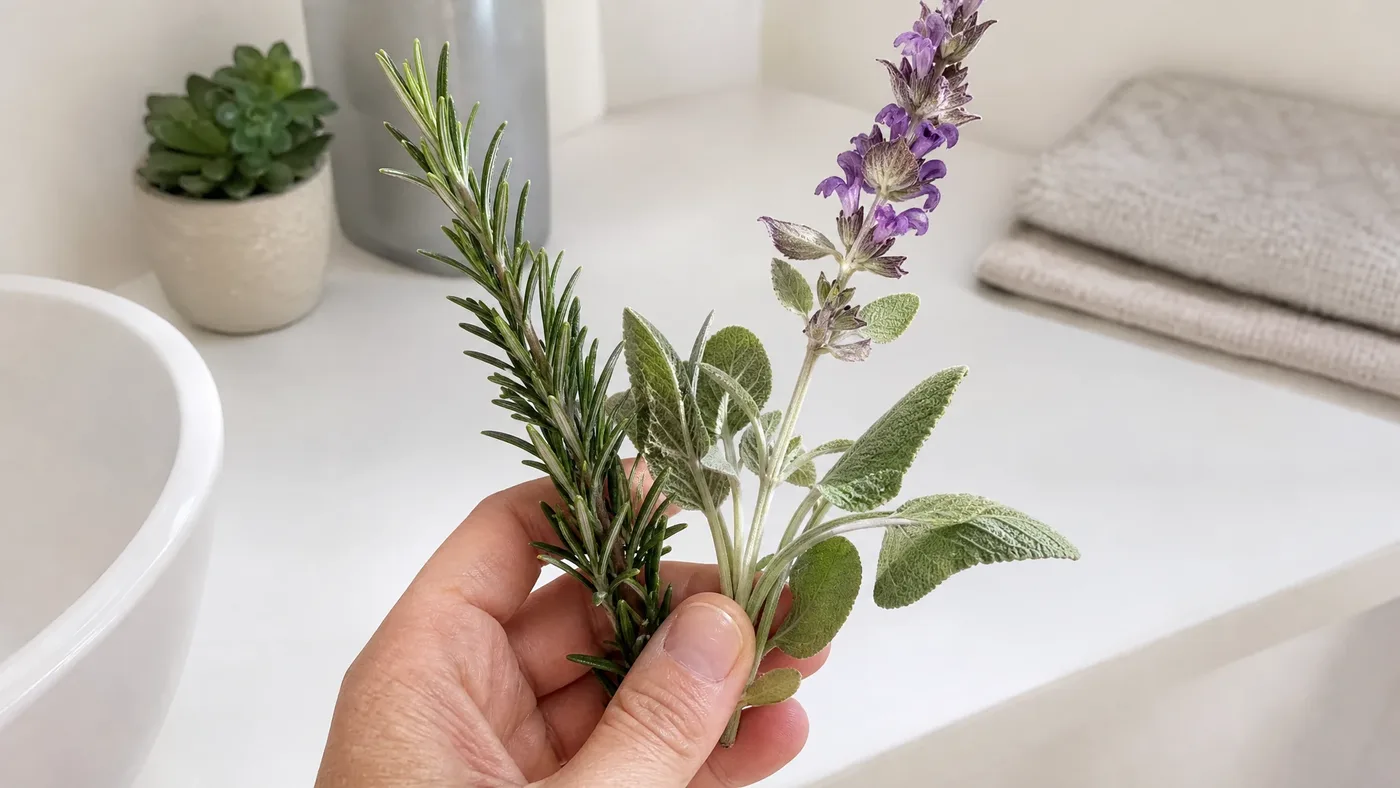
Clary Sage vs Rosemary Oil for Hair: What Has Been Tested
If the only question is which of the two has been tested on hair, rosemary wins, and it is not close: there is one randomized trial of rosemary oil on thinning hair, and we found no human study of clary sage oil on hair at all. We sell clary sage oil and no rosemary, so we have no stake in rosemary's result. We will lay out what that trial did and did not show, what clary sage adds to a hair routine (scent, mostly), and why neither oil should be used to put off seeing a dermatologist about hair loss.

Clary Sage Essential Oil
Our own Clary Sage Essential Oil, in sizes from 0.5 oz to bulk.
From $19.99
Shop Now →Start with what kind of hair problem you have
Most of the confusion in "best oil for hair" searches comes from treating all hair problems as one. The studies cover different conditions, and an oil that did something in one says little about another.
- Gradual thinning at the crown or part line (androgenetic alopecia): this is the condition the rosemary trial studied.
- Round, sudden bald patches (alopecia areata): this is the condition in the one aromatherapy trial that included rosemary in a blend.
- Heavy shedding after illness, surgery, childbirth or weight loss: the American Academy of Dermatology notes that hair may regrow on its own after events such as these, and that a person can have more than one cause at once (AAD, hair loss diagnosis and treatment).
- Dry, dull or limp hair with no loss: a scented carrier oil is a cosmetic choice here, and no trial is involved. Our hair care post covers that.
The AAD page says that effective treatment for hair loss "begins with finding the cause," and that a board-certified dermatologist can examine the scalp, ask about onset and, if a disease, vitamin deficiency, hormone imbalance or infection is suspected, order a blood test or scalp biopsy. No oil does that. If you are losing hair and do not know why, that visit comes before any bottle.
The rosemary trial, read closely
Panahi et al., Skinmed, 2015 randomly assigned 100 patients with androgenetic alopecia to rosemary oil (50) or 2% minoxidil (50) for six months, with photographs and hair counts at baseline, three months and six months. What they reported:
- At three months, neither group had a significant change in hair count.
- At six months, both groups had a significant increase over baseline, and the two groups did not differ significantly.
- Scalp itching rose significantly from baseline in both groups at both visits, and was more frequent with minoxidil.
What it did not show matters just as much. There was no placebo or carrier-only arm, so the trial can say rosemary did about as well as minoxidil 2% in this sample, but it cannot separate rosemary's effect from what happens with any scalp routine, or with time. The abstract does not report the rosemary concentration or the carrier, so there is no figure we could responsibly turn into a recipe. And one trial of 100 people is one trial. Note too that itching rose in the rosemary group: a scalp oil is an irritation question as well as an efficacy one.
The other studies people cite
Hay, Jamieson and Ormerod, Archives of Dermatology, 1998: 86 patients with alopecia areata were randomized, double-blind, over seven months. The active group massaged thyme, rosemary, lavender and cedarwood oils in a jojoba and grapeseed carrier into the scalp daily; the control group massaged with the carrier oils only. Nineteen of 43 patients (44%) in the active group improved against 6 of 41 (15%) in the control group (P = .008), judged on photographs by two dermatologists. Three cautions: the blend contained four oils, so nothing in it can be credited to rosemary alone; alopecia areata is a different condition from the thinning in the Panahi trial; and the control group also massaged their scalps, so scalp massage by itself was not what produced the gap.
Oh, Park and Kim, Toxicological Research, 2014: this one is peppermint, not rosemary or clary sage, and it was done in C57BL/6 mice. After four weeks of daily topical application, the 3% peppermint oil group showed the most prominent hair growth compared with saline, jojoba oil and 3% minoxidil. A mouse result is a reason to run a human trial, nothing more, and it shows up in "best oil for hair" lists as though it were one.
Where clary sage stands
We searched Europe PMC on 23 October 2026 for Salvia sclarea together with hair, alopecia and scalp and found no human trial and no animal hair-growth study. So the honest comparison is one thin evidence base against none. That does not mean clary sage does nothing; it means nobody has published the test, and we will not fill the gap with a claim. Our oils are Botanical and Purity (Salvia sclarea, with a published Certificate of Analysis). Both are sold as cosmetic oils, and we make no claim that either affects hair growth.
Clary sage also carries a skin caution. EFSA's 2024 opinion says the oil should be considered an irritant to skin and eyes and a dermal and respiratory sensitiser (a regulator's caution based on the supplier's safety data sheet, not a measured reaction rate). Scalp skin is skin, so the same applies. The Tisserand Institute dilution article gives 0.2% to 1% for sensitive or impaired skin and 1% to 3% for body oils; our own pages say 0.5% to 2% in a carrier oil. Our scalp oil post and our post on adding clary sage to shampoo do the arithmetic.
A fair way to choose
| Your goal | What the evidence supports | What we would do |
|---|---|---|
| Find out why hair is thinning or shedding | A dermatologist's examination (AAD) | Book that first; an oil cannot answer the question |
| Try an oil because of the rosemary result | One 100-person trial, no placebo arm, itching reported | Buy rosemary elsewhere; we do not sell it; tell your dermatologist |
| A hair or scalp oil you enjoy smelling | No hair outcome studied for clary sage | Our oil, diluted to 0.5% to 2%, patch tested; no hair claim |
If you do want rosemary, note that the Panahi trial ran six months and that scalp itching rose in both arms. If you would rather start with scent, clary sage is a reasonable cosmetic choice, with the understanding that you are choosing it for how it smells and not for a hair result. Who should skip clary sage altogether: anyone pregnant (our pages say avoid it; ask an OB-GYN or midwife), anyone with a scalp rash or open skin, and anyone who has reacted to fragrance before (ask a dermatologist or allergist).
Our position is simple. Rosemary has a small trial behind it, clary sage has none, and a dermatologist has an exam that neither can replace. For the broader cosmetic picture, see our hair and skin guide.
Clary Sage Essential Oil
Clary Sage Essential Oil from our own shop, in sizes from 0.5 oz to bulk.
From $19.99
Shop Now →Sources & Further Reading
- Panahi Y et al., 2015. Rosemary oil vs minoxidil 2% for the treatment of androgenetic alopecia: a randomized comparative trial. Skinmed. pubmed.ncbi.nlm.nih.gov/25842469
- Hay IC, Jamieson M, Ormerod AD, 1998. Randomized trial of aromatherapy. Successful treatment for alopecia areata. Archives of Dermatology. pubmed.ncbi.nlm.nih.gov/9828867
- Oh JY, Park MA, Kim YC, 2014. Peppermint Oil Promotes Hair Growth without Toxic Signs. Toxicological Research. pubmed.ncbi.nlm.nih.gov/25584150
- American Academy of Dermatology. Hair loss: diagnosis and treatment. aad.org/public/diseases/hair-loss
- EFSA FEEDAP Panel, 2024. Safety and efficacy of a feed additive consisting of an essential oil derived from the flowering stems of Salvia sclarea L. pmc.ncbi.nlm.nih.gov/PMC11561422
- Tisserand R, undated. Dilution for essential oils. Tisserand Institute. tisserandinstitute.org/safety/dilution