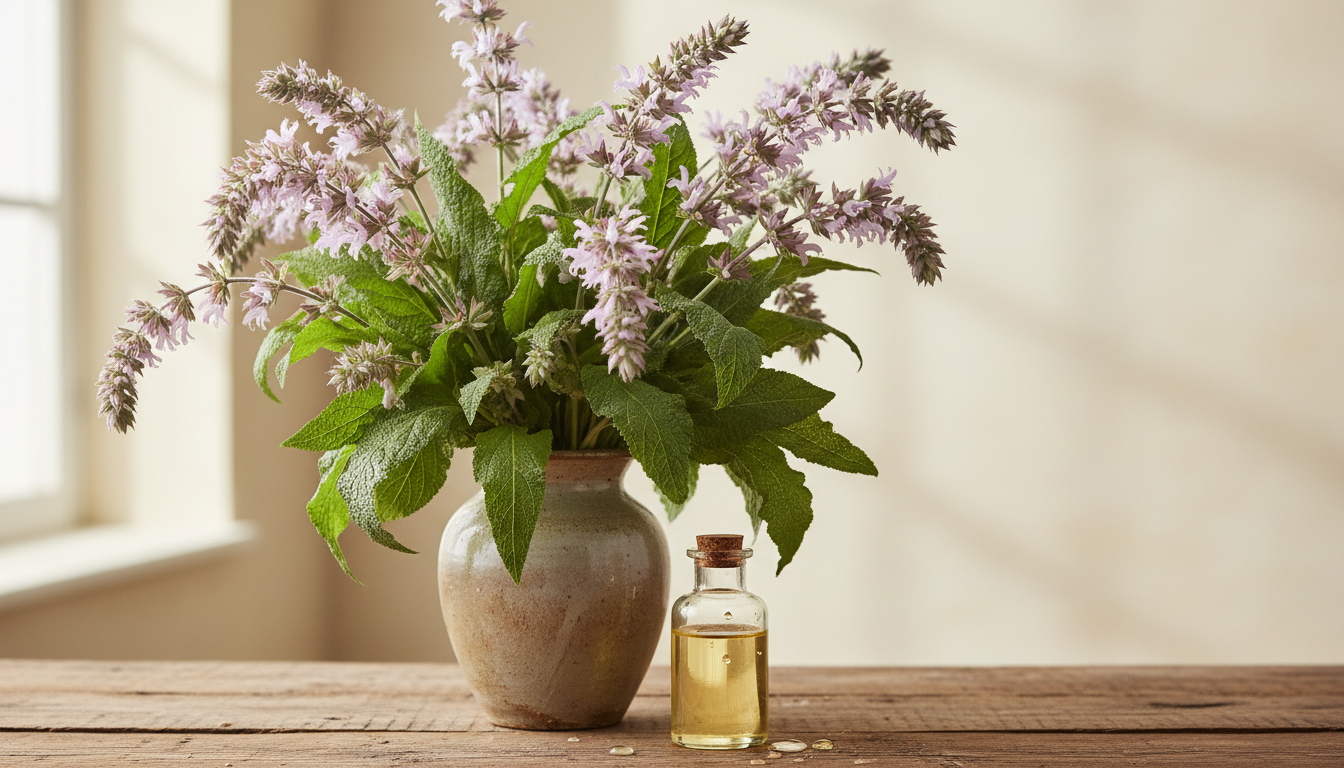
Clary Sage Oil vs Ylang Ylang: Comparing Two Classic Base Notes
Any time a clary sage vs ylang ylang comparison comes up in a blending forum, the conversation tends to stall out fast. Both oils get filed under "floral," both show up in perfume base notes, and both have a devoted following that swears nothing else comes close. But they smell almost nothing alike once you actually put them side by side, and they behave very differently in a formula. This guide walks through where each oil comes from, how it performs in a blend, what it costs, and which one is the better fit depending on what you're making.
Meeting the Two Oils
Clary Sage
Clary sage (Salvia sclarea) is a member of the mint family, grown widely across France, Russia, and Bulgaria. The oil is steam distilled from the plant's flowering tops and leaves, and it carries a scent that's herbal, slightly sweet, and a little dusty, somewhere between fresh-cut hay and a garden after rain. Old herbals called it "clear eye" for the mucilage once made from its seeds, and the name stuck even though modern use of the oil has nothing to do with that history. Today it's valued almost entirely for its scent profile and its role as a fixative in perfumery.
Ylang Ylang
Ylang ylang comes from the Cananga odorata tree, native to Southeast Asia and now grown commercially in Madagascar, the Comoros, and Indonesia. The oil is distilled from the tree's drooping yellow flowers, and distillers traditionally split the process into fractions: Extra, First, Second, and Third, pulled off at different points in a long distillation run. Extra is the brightest and most prized; Third and "Complete" (the whole run blended together) are heavier and less refined. The scent itself is lush, sweet, and distinctly tropical, with notes that read as banana, jasmine, and custard depending on the grade.
Clary Sage vs Ylang Ylang: Side-by-Side Comparison
| Attribute | Clary Sage | Ylang Ylang |
|---|---|---|
| Botanical source | Salvia sclarea (flowering tops) | Cananga odorata (flowers) |
| Primary origin | France, Bulgaria, Russia | Madagascar, Comoros, Indonesia |
| Scent family | Herbal, earthy, subtly sweet | Floral, sweet, tropical |
| Perfume note | Base to heart, strong fixative | Heart to base, depending on grade |
| Scent strength | Moderate, blends quietly into the background | Assertive, can dominate a blend if overdosed |
| Typical price point | Mid-range | Mid to high, Extra grade commands a premium |
| Grading system | Generally sold as a single grade | Extra, First, Second, Third, Complete |
| Common uses | Perfumery, soap, diffuser blends, hair care formulas | Perfumery, skin care, diffuser blends, hair care formulas |
| Blending role | Rounds out sharp top notes, adds depth | Adds richness and sweetness, softens green or herbal notes |
| Longevity on skin | Long, low volatility | Long, especially Third and Complete grades |
Ylang Ylang or Clary Sage for Perfume?
This is the question that actually drives most clary sage ylang ylang comparison searches, and the honest answer is that they solve different problems in a formula.
Clary sage works quietly. It doesn't announce itself the way ylang ylang does, and that's exactly its value: a small amount smooths out a blend, takes the edge off sharp citrus or herbal top notes, and stretches the life of a fragrance on skin without shifting the overall character much. Perfumers reach for it as a fixative and a bridge note, the thing that holds a composition together rather than the thing you notice first.
Ylang ylang does the opposite. It's a lead note, and it will take over a blend if you're not careful with the ratio. A drop or two in a diffuser blend or a few percent in a perfume concentrate delivers that lush, tropical floral character people specifically go looking for. Extra grade tends to sit higher in a composition, closer to a heart note, while Third and Complete grades lean more base-like and work well anchoring heavier floral or oriental blends.
If the goal is a fragrance built around a rich floral centerpiece, ylang ylang is the better lead. If the goal is a blend that needs structure and staying power without a strong personality of its own, clary sage does that job better.
Pros and Cons
Clary Sage
- Pros: Versatile fixative that works in small amounts, herbal-sweet scent pairs easily with citrus, lavender, and other florals, generally more affordable than high-grade ylang ylang, single grade keeps sourcing simple.
- Cons: Scent alone isn't the star of a blend, some people find the raw oil's aroma a little sharp or musty before it's diluted, quality varies more by distillation batch than by a formal grading system, so sourcing from a transparent supplier matters.
Ylang Ylang
- Pros: Rich, instantly recognizable floral character, grading system lets you dial in exactly how bright or heavy the note reads, long-standing reputation in perfumery going back over a century, small amounts go a long way in diffuser blends.
- Cons: Easy to overdose and end up with a blend that reads as one-note floral, Extra grade pricing adds up in larger batches, some people find the scent cloying at full strength, grading can be inconsistent between suppliers so it pays to ask which fraction you're actually buying.
Best For: Matching the Oil to Your Project
- Perfume formulation: ylang ylang for a floral lead note, clary sage as a supporting fixative underneath it.
- Cold process soap: clary sage tends to hold its scent better through saponification and cure; ylang ylang can fade faster in cold process but performs well in melt and pour or in leave-on products.
- Diffuser blends for a calm evening wind-down: either works, but clary sage pairs especially well with lavender and bergamot for a quieter, grounding atmosphere, while ylang ylang leans warmer and more indulgent.
- Hair and scalp oil blends: both have a long history in hair care formulas; ylang ylang's richer scent tends to dominate, so it's often used at a lower percentage than clary sage.
- Budget-conscious formulations: clary sage generally offers more scent mileage per dollar, since it's used at lower percentages and doesn't carry the grade premium ylang ylang Extra does.
- Bold, statement fragrance: ylang ylang, full stop. Nothing about clary sage is built to be the star of the show.
Blending Notes
The two actually pair nicely together, which is worth mentioning since so much of the online discussion frames this as an either-or choice. Clary sage's herbal quietness gives ylang ylang's sweetness somewhere to land, and the combination shows up in classic chypre and oriental perfume structures for exactly that reason. A common starting ratio for a diffuser blend is two parts clary sage to one part ylang ylang, adjusted from there depending on how prominent you want the floral note to read. For a leave-on skin formula, both should be diluted well below their concentrate strength, and a patch test is worth doing before committing to a full batch, since individual skin sensitivity varies and a small area on the inner forearm will tell you more than any general guideline can.
Sourcing and Quality Notes
Clary sage is fairly forgiving to source. Look for a supplier who lists the country of origin and the distillation method, and be wary of prices that seem too low for a steam-distilled botanical oil, since adulteration with cheaper synthetic sclareol-type materials does happen in the bulk market. Ylang ylang requires a bit more homework because of the grading system: ask specifically which fraction you're buying (Extra, First, Second, Third, or Complete) rather than trusting the word "ylang ylang" alone, since the difference between grades in both scent and price is significant. A reputable supplier will have a batch-specific GC/MS report or at least a clear country of origin and harvest date on request.
Safety and Dilution
Both oils are potent in their undiluted form and should never be applied to skin without dilution in a suitable carrier oil. A general guideline for leave-on skin use is 1 to 2 percent dilution (roughly 6 to 12 drops per ounce of carrier), and lower for facial applications. Always patch test a small area before broader use. Clary sage is generally advised against during pregnancy and for anyone managing a diagnosed condition without first checking with a qualified healthcare provider, since essential oils can interact with individual circumstances in ways that are easy to underestimate. Keep both oils away from the eyes, out of reach of children and pets, and stored in a cool, dark place to preserve their aromatic quality over time.
The Verdict
There isn't a single winner here, and pretending otherwise would misrepresent what these two oils actually do. For base note oils compared on pure structural role, clary sage wins on versatility and value: it's the workhorse that makes other notes last longer and sit better, and it rarely calls attention to itself. Ylang ylang wins on impact: nothing else in a floral blending kit delivers that specific lush, tropical richness, and if a project needs a scent people remember, this is the oil that does it.
If forced to pick one for a first purchase, the deciding question is simple: are you building a blend around a floral centerpiece, or are you trying to make an existing blend last longer and feel more finished? Centerpiece, buy ylang ylang. Finishing touch, buy clary sage. Most serious blenders end up owning both within their first year anyway, because the two solve different problems well enough that neither one makes the other redundant.