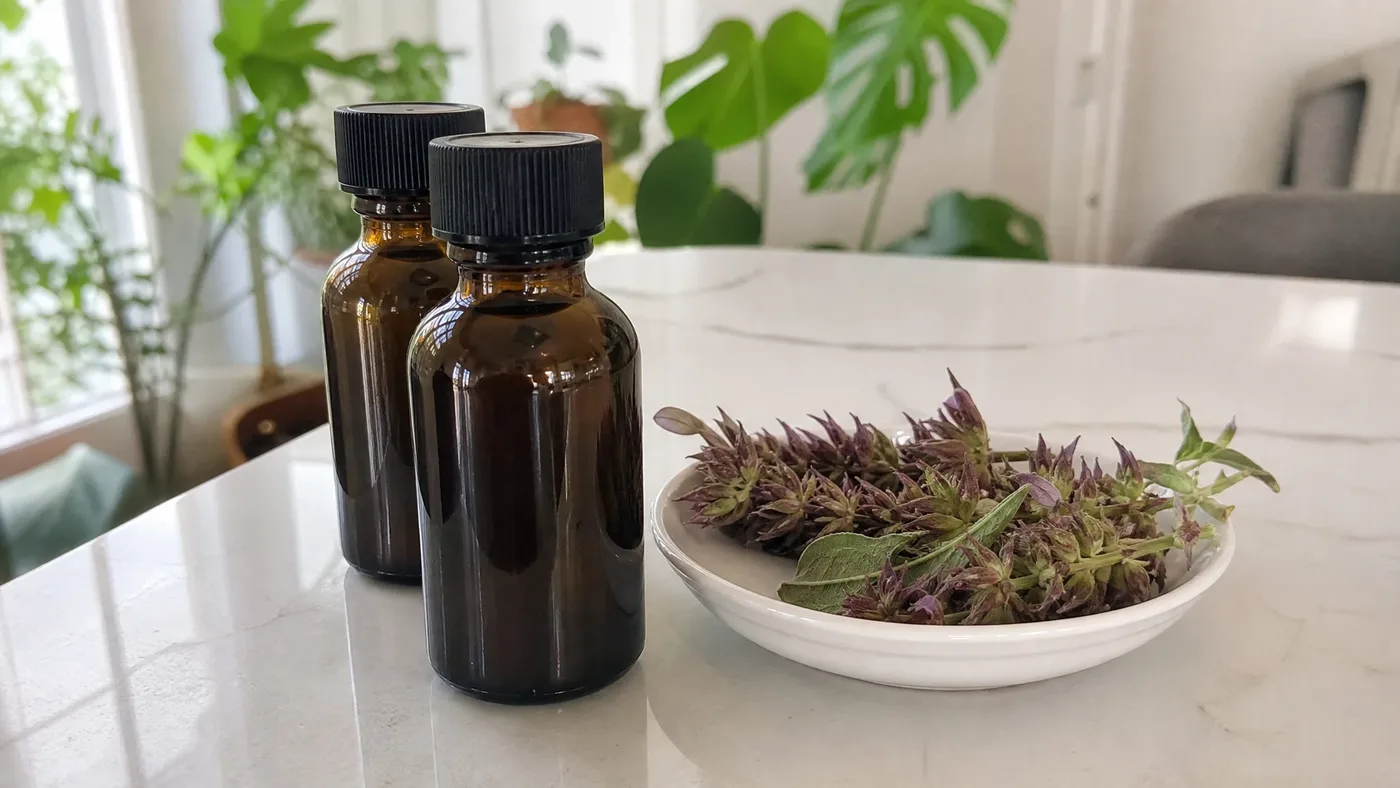
Clary Sage Oil vs Absolute vs CO2 Extract: Sclareol Numbers
Of the three things sold under the name clary sage, only one is an essential oil in the strict sense, and it is the one with the least sclareol. Steam distillation, solvent extraction and supercritical CO2 pull different parts out of the same flowering plant, so the products are not interchangeable at the same dilution. We sell only the distilled kind.

Clary Sage Essential Oil
Our own Clary Sage Essential Oil, in sizes from 0.5 oz to bulk.
From $19.99
Shop Now →Start from the question: what do you want to smell, and how will you use it?
- Diluted on skin, in a diffuser, in soap or a candle: you want a distilled essential oil, and the dilution guidance on our pages (0.5% to 2% in a carrier oil) is written for our oils only.
- A perfume fixative or a dense, waxy, amber-leaning material: an absolute or a CO2 extract is what perfumers reach for, and the supplier's data sheet, not ours, sets the usage rate.
- You are comparing for sclareol content: the next section is for you.
How each one is made and what it captures
A recent review defines an essential oil as a product of hydrodistillation, steam distillation or mechanical expression. Solvent products (concretes, absolutes, resinoids) it calls "essential oil-related aromatic extracts", because they carry non-volatile material such as waxes and pigments, and it warns that a higher yield does not mean higher quality (Youchret-Zallez et al., Plants, 2026). That review discusses other species, not clary sage, so the clary sage specifics come from the next two papers.
- Steam distillation carries off what is volatile and leaves the rest in the still. EFSA describes the clary sage oil it assessed as steam distilled from fresh or dried flowering stems, with condensed volatiles separated from water by decantation (EFSA FEEDAP Panel, 2024).
- Concrete, then absolute. A clary sage concrete is a waxy n-hexane extract. For rose, the review above says the absolute is made by treating the concrete with ethanol; we did not find a clary sage-specific description of that step, so treat it as the general pattern.
- Supercritical CO2 uses pressurised carbon dioxide as the solvent, and the same review notes it can also co-extract waxes, pigments and fatty acids. In one 2023 study the starting material was the clary sage concrete itself, and a two-step CO2 extraction at 90 bar/50 degrees C and then 100 bar/40 degrees C gave a first fraction of monoterpenes and sesquiterpenes and a second fraction of sclareol and related diterpenes. The cumulative yield was about 9.3% by weight, and the authors reported that residual n-hexane was removed in the process (Zanotti et al., Molecules, 2023). That is CO2 applied to a hexane concrete, a different route from CO2 applied directly to the plant, and we found no head-to-head clary sage study of the direct route.
The sclareol numbers, with the disagreement left in
| Product or source | Sclareol |
|---|---|
| Steam-distilled clary sage oil, 6 batches (EFSA, 2024) | mean 0.51%, range 0.32 to 1.18% |
| Clary sage oil by GC (Tisserand, 2010) | typically 0.1 to 0.4%; he argues GC may understate it |
| An older French text, as quoted by Tisserand | 1.6 to 7.0% |
| Clary sage absolute (Tisserand, 2010) | about 70% |
| CO2 second fraction from a hexane concrete (Zanotti et al., 2023) | 25.3% of GC-MS peak area |
The papers also quote earlier work that disagrees: a steam-distilled product reported as free of sclareol, a hydrodistilled oil with up to 5.9% (both as cited in Zanotti et al., 2023, not read by us in the original). Method, plant stage and what the lab counted all move the number. Our plain verdict: a distilled oil has a little sclareol, an absolute has a lot, and two sources that quote different figures for the same word are usually measuring different things.
Sclareol is also why the plant has an industrial life outside perfumery. A 2021 paper describes it as the starting plant molecule for the hemisynthesis of the fragrance ingredient ambroxide, and found that more than 90% of it is made by large capitate glandular trichomes in the calyces (Chalvin et al., Horticulture Research, 2021). In other words, the heavy, waxy end of the plant is a raw material for another ingredient, not a stronger version of the oil in our bottles.
A worked comparison
Take Tisserand's absolute figure (about 70% sclareol) and EFSA's distilled-oil mean (0.51%). Divide: 70 / 0.51 is about 137. By weight, a gram of that absolute carries as much sclareol as roughly 137 grams of that distilled oil. Using the upper EFSA batch (1.18%) the ratio is still about 59, and using the CO2 fraction (25.3%) it is about 50 against the mean. These are numbers from different studies, so the ratios are rough. The reasoning is simple, though: a product with fifty to a hundred times the sclareol has a different composition, and no dilution rule written for one can be assumed to fit the other.
What changes when you swap one for another
Linalyl acetate is the lead component of the distilled oil. In the CO2 study it was 13.4% in the first fraction and 2.5% in the second, so the sweet, tea-like character we describe for our Purity oil is a distilled-oil trait, and a heavy fraction will not smell the same. Concretes and absolutes can also hold solvent residue; the review says solvent extraction can leave "possible residual solvent traces", and the authors above say theirs was removed. If you buy one, ask the supplier for the solvent and a residual-solvent result.
On dilution, we have no verified usage figure for absolutes or CO2 extracts, and we are not going to borrow the 0.5% to 2% from our own pages for a product with 25% to 70% sclareol and a different composition. Treat any recipe that says "1 drop of absolute = 1 drop of oil" as untested. Ask the supplier and, for anything going on skin, consult Tisserand and Young's safety reference or a qualified aromatherapist. Our pages say to avoid our oil in pregnancy, and the same caution should be your starting point for the other two forms.
Who should buy which
- Soap, candle, diffuser, diluted massage oil, linen spray: distilled oil, which is what we sell. Our process post and the chemistry post cover it.
- Perfumery with a heavy, waxy base: an absolute or CO2 extract from a supplier who publishes solvent and composition. We do not sell either.
- Something called "clary sage" cheaply, with no species or method: ask what it is. See fragrance oil versus essential oil and seed oil versus essential oil.
Whichever you pick, make the supplier show a report for that exact product; here is how to read it.
Clary Sage Essential Oil
Clary Sage Essential Oil from our own shop, in sizes from 0.5 oz to bulk.
From $19.99
Shop Now →Sources & Further Reading
- Youchret-Zallez et al., 2026. Essential oil quality in medicinal and aromatic plants. pubmed.ncbi.nlm.nih.gov/42796803
- Zanotti et al., 2023. Supercritical fluid extraction of essential oil and sclareol from a clary sage concrete. pmc.ncbi.nlm.nih.gov/articles/PMC10179952
- EFSA FEEDAP Panel, 2024. Clary sage oil feed additive opinion. pmc.ncbi.nlm.nih.gov/articles/PMC11561422
- Tisserand, 2010. Is clary sage oil estrogenic? roberttisserand.com
- Chalvin et al., 2021. Sclareol and linalyl acetate are produced by glandular trichomes through the MEP pathway. journal.hep.com.cn