Clary Sage Oil and Children: What Exists, What Does Not
We do not have an age at which we can tell you clary sage oil is fine for a child, and no source we found gives one for this oil. Our own product pages say to keep both of our clary sage oils away from children, and this article explains what stands behind that line and what to do if a child gets into a bottle.

Clary Sage Essential Oil
Our own Clary Sage Essential Oil, in sizes from 0.5 oz to bulk.
From $19.99
Shop Now →What the evidence is, and what it is not
We searched PubMed on 23 October 2026 for Salvia sclarea or "clary sage" combined with child, children, infant or pediatric. The hits were a 2015 laboratory paper on clary sage oil and wound bacteria, a 2011 Russian-language report on a health facility for children, and some unrelated blood-disorder case reports. We found no trial, case series or dosing study of clary sage essential oil in children. That is the single most important fact on this page: every statement below about children is either a general essential-oil rule or reasoning, never a clary sage result.
The nearest hard data on the oil itself is chemical. In a 2024 European Food Safety Authority opinion on clary sage oil as an animal feed additive, the oil averaged 68.28% linalyl acetate and 14.81% linalool by GC-FID peak area, and the panel concluded it should be considered an irritant to skin and eyes and a dermal and respiratory sensitiser (EFSA FEEDAP Panel, EFSA Journal, 2024). That opinion concerned animals, and the irritant and sensitiser finding rested on the applicant's safety data sheet. It is still the most specific regulatory statement on the hazards of the undiluted oil, and nothing in it carves out an exception for young skin.
Decision tree: which situation are you in?
A child has swallowed some, or got it in the eyes
This is the only branch where speed matters. In the US, call Poison Control at 1-800-222-1222, which the National Capital Poison Center lists as free, confidential and open 24 hours (poison.org, essential oils article). Outside the US, use your national poison line or emergency number. Do not wait for symptoms. The same page describes an 18-month-old who swallowed a small amount of lavender extract and was very drowsy and confused three hours later, back to normal in about six hours. That is a different oil and an extract, so it is not a prediction for clary sage. Reasoning from the composition above, lavender and clary sage oils both contain linalool and linalyl acetate, which is a reason not to assume clary sage would behave more mildly, not evidence that it behaves the same.
The scale matters here. Our smallest size is half an ounce, about 14.8 ml of undiluted oil, which at the common rough figure of 20 drops per ml is nearly 300 drops. Even a bottle a toddler has only partly emptied is a large amount of concentrated oil relative to a small body. We sell the oil undiluted, so the bottle in your cupboard is the concentrated form.
You want to put it on a child's skin
Our answer is no, and the reason is a gap, not a ceiling we measured. Our own 0.5% to 2% range is written for adult skin. The Tisserand Institute safety guidelines say that for the three age groups up to age 6 its age-based dilution table "applies to any topical application", while for the older groups the percentages are for full-body use and stronger blends can go on small areas. That table is published as an image, and we could not read the percentages in the text, so we will not quote them. The author, Hana Tisserand, labels the table as general guidelines drawn from Essential Oil Safety 2e, with possible exceptions in either direction. Read the table itself, and ask your pediatrician before using any oil on an infant or a child with eczema.
Because our oils carry no child-specific dilution, we cannot give you drops per ml for a child. A figure from us would be invented. Where a child-age dilution exists for another oil, it does not transfer to this one without a source that names it.
You want to diffuse it in a room a child uses
Tisserand Institute writers say that dilution percentages "don't apply to diffusion" and that exposure depends on the amount of oil, the diffuser, the room size and how long it runs. The "2-3 drops over several hours" guide on that page was given in a discussion of peppermint and eucalyptus, so it is not a clary sage figure. Peppermint is singled out there because it can slow breathing in small children, which shows that individual oils differ.
For clary sage the open question is the sedating effect. In a 2013 randomized trial of 34 adult women with urinary incontinence, Seol et al., J Altern Complement Med, 2013 had participants inhale 5% clary sage, 5% lavender or almond oil for 60 minutes; the clary group had lower systolic blood pressure than control (p=0.048) and a lower respiratory rate (p<0.001). The study involved adults, one specific clinical setting and an inhalation concentration of 5%, which is not a home-diffusion figure. Reasoning from it, the practical consequence is that clary sage can change measurable body signals in adults, nobody has measured it in a sleeping infant, and so we would not run it in a nursery. Our inhalation article covers adult use and our own page says the aroma is unusually relaxing and not for before driving.
The child is old enough to want to help
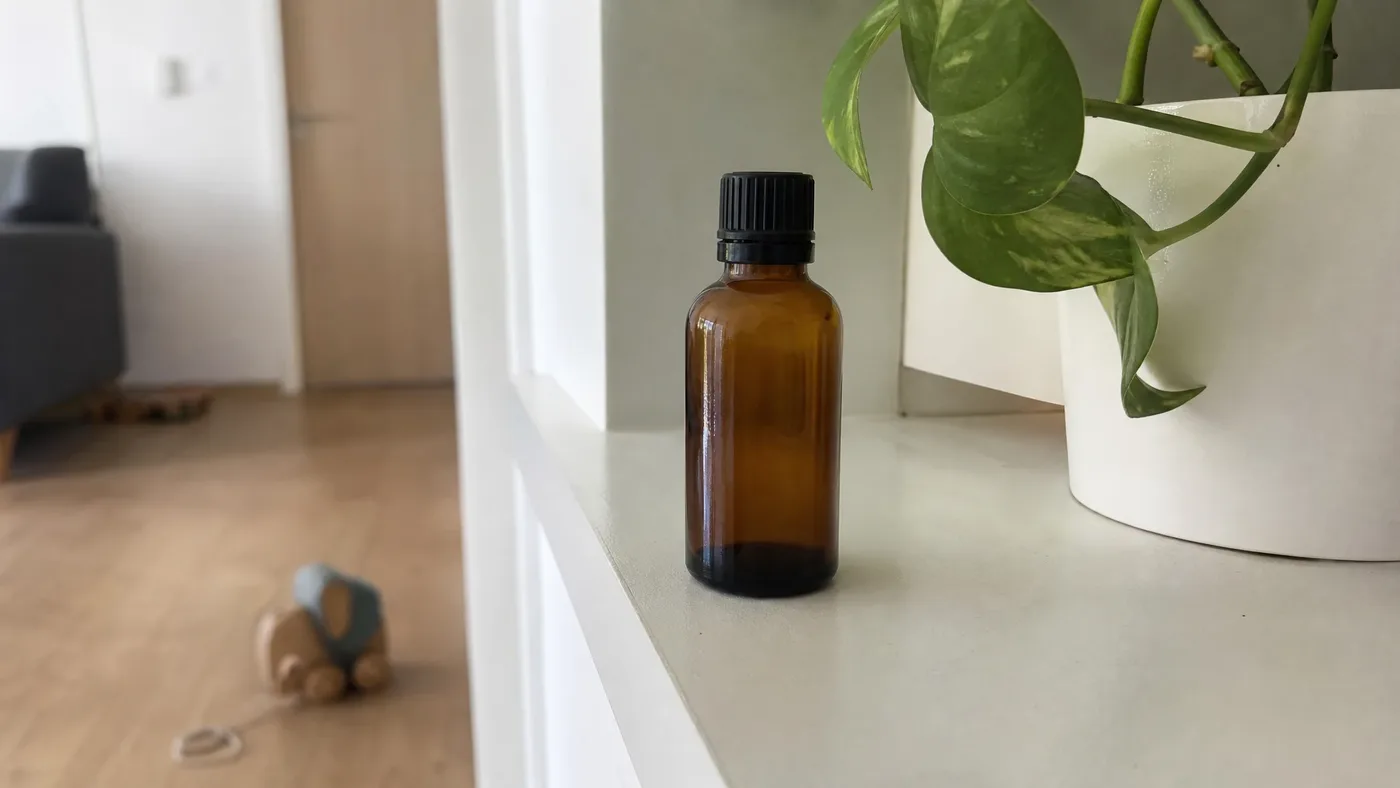
Children copy adults and love droppers. The Tisserand Institute guidelines say bottles with orifice reducers help only "a little", that all oils should be sold with child-resistant caps, and that "even two-year old kids have been known to unscrew caps on essential oil bottles and drink the contents". We have not documented the closure on the bottle you will receive, so check the cap when it arrives and do not assume it is child-resistant. Store it high, locked if you can, and capped, which also helps shelf life (see storage and shelf life).
What we could not source
We could not retrieve a US national count of essential oil exposures in children from a primary source this session, so we do not quote one. What we could read: the National Capital Poison Center says children's thin skin and immature livers may make them more vulnerable than adults, and advises locking oils away and considering discarding oils you do not need if young children live in the home. The Tisserand Institute's age table is the one place a dilution-by-age answer exists, and its author calls it general guidance. Neither source is about clary sage. The distance between "keep it away" and "a low dilution is fine for this child" is the part a pediatrician, not a seller, should close.
Who should skip this entirely
Skip clary sage oil on or near infants, on children with eczema or reactive skin, and in any home where a child could reach an open bottle. If a child has had a reaction to a scented product, ask an allergist. If you are pregnant or nursing, the questions change, and we cover them in pregnancy and side effects. For the adult dilution maths, see our dilution guide, and read it as adult-only.
Our oils are made for adults who want a scent and who will dilute and store them properly. For anything about a child's health or exposure, your pediatrician or poison center is the right call, not a shop.
Clary Sage Essential Oil
Clary Sage Essential Oil from our own shop, in sizes from 0.5 oz to bulk.
From $19.99
Shop Now →Sources & Further Reading
- EFSA FEEDAP Panel, 2024. Safety and efficacy of a feed additive consisting of an essential oil derived from the flowering stems of Salvia sclarea L. EFSA Journal 22(11):e9016. pmc.ncbi.nlm.nih.gov/articles/PMC11561422
- National Capital Poison Center, n.d. Essential oils: poisonous when misused. poison.org/articles/essential-oils
- Tisserand Institute, n.d. Safety guidelines. tisserandinstitute.org/safety-guidelines
- Hana Tisserand, n.d. Recommended dilutions for children. tisserandinstitute.org/learn-more/recommended-dilutions-for-children
- Tisserand Institute, n.d. Peppermint and eucalyptus for children. tisserandinstitute.org/learn-more/kids-inhalation-safety
- Seol GH et al., 2013. Randomized controlled trial for Salvia sclarea or Lavandula angustifolia. J Altern Complement Med. pubmed.ncbi.nlm.nih.gov/23360656