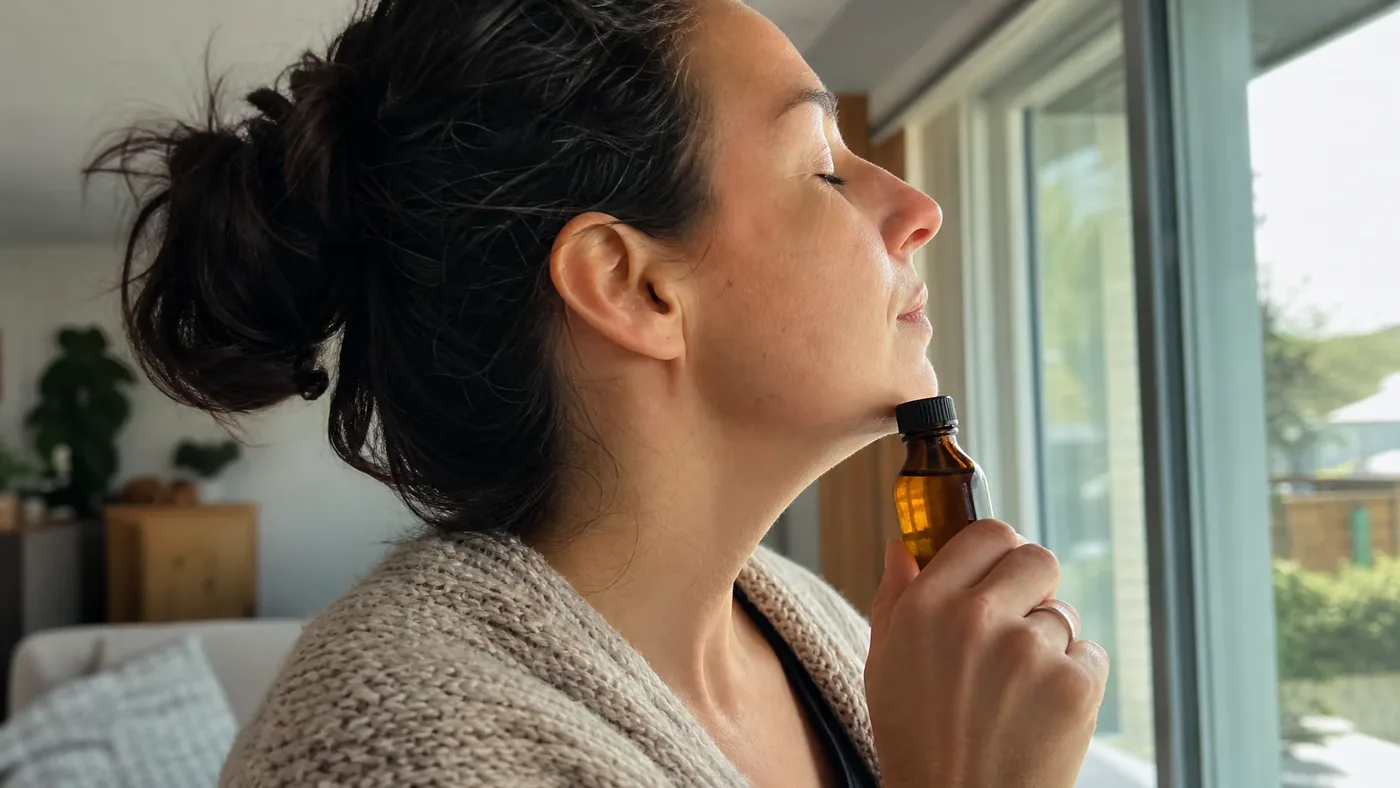
How to Inhale Clary Sage Oil: Methods Ranked by Hazard
The least hazardous way to inhale clary sage oil is also the least equipment: a drop on a tissue or cotton pad, held near but not on your face. The most hazardous is the one many guides still suggest, a bowl of hot water with oil added. We sell no diffusers, inhalers or steam devices, only two undiluted clary sage oils, so this page ranks the methods by documented hazard and tells you where the evidence runs out.

Clary Sage Essential Oil
Our own Clary Sage Essential Oil, in sizes from 0.5 oz to bulk.
From $19.99
Shop Now →What the human trials used, and why it is not a recipe
Two studies give a picture of what "inhaled" meant in research. In a double-blind trial of 34 women, clary sage oil at 5% vol/vol in the vapour was inhaled for 60 minutes (Seol et al., J Altern Complement Med, 2013). In a Vienna pilot, 32 healthy volunteers inhaled the oil for 30 minutes against a pure-water control (Mitic et al., Planta Medica, 2020). Both were controlled exposures with defined vapour or a set setup; neither tells you how many drops to use in your living room. We have not measured room concentrations from any device, and no source we fetched gives a drops-per-room figure.
Method 1: tissue or cotton pad (lowest hazard)
Put one or two drops on a tissue, keep it a hand's width from your nose, and take a few breaths. Those drop numbers are our reasoning, not a studied dose. The oil is undiluted, so it should never touch skin directly: the clary sage pages on our site say to dilute to 0.5% to 2% in a carrier oil before it reaches skin and to keep it away from eyes. Use the tissue, then put it somewhere you will not touch it, and wash your hands. Passive inhalation from a tissue has the benefit that you can stop in one second, which cannot be said of a diffuser running in a closed room.
Method 2: personal inhaler or scent stick
A personal inhaler is a small tube with a wick that holds the oil. It confines the scent to your own breath, which keeps it out of other people's air. We do not sell these. If you buy one, check that the wick holder can be capped, as our storage guidance for the oil is tightly capped, cool and dark. For how oil changes with age and exposure to air, see our storage article.
Method 3: diffusers, and what has been measured
This is where the sourced evidence is more useful than the marketing. A chamber study of an ultrasonic diffuser run for 15 minutes with lemon, lavender, eucalyptus and grapeseed oils measured volatile organic compounds and particles, and the authors' modelling suggested that reasonable use can contribute substantially to indoor particulate matter, depending on the oil and the water (Schwartz-Narbonne et al., Indoor Air, 2021). Particle output with tap water was fivefold higher than with deionised water in one test with eucalyptus. None of those oils was clary sage.
A 2025 pilot-scale household simulation used tea tree oil in an ultrasonic diffuser and a heat diffuser, and the terpene levels during the heat-diffuser run were generally an order of magnitude higher than with the ultrasonic one, exceeding some long-term derived no-effect levels, while the ultrasonic run stayed under the applicable limits (Zisook et al., J Occup Environ Hyg, 2025). Another oil, one simulated household, a pilot design. Reasoning from it: heat diffusers are the method for which this one paper found the larger air concentrations, so for a small room we would favour the cool methods, and keep sessions short and ventilated. We did not fetch any manufacturer manuals, so we make no claim about nebulizing diffusers.
The American Lung Association says concentrated essential oils can emit volatile organic compounds, that inhaling certain oils can trigger asthma symptoms in sensitive individuals, and that if you use a diffuser you should follow the manufacturer's instructions in a well-ventilated space (American Lung Association, 2024, updated 2025). Its stated position is that adding anything to the air you breathe, essential oils included, is not recommended, and that people with asthma or COPD should ask a healthcare professional first. We will not argue with that: if you have asthma or COPD, ask first, and if you notice wheeze, cough or chest tightness, stop. For recipes, our existing diffuser blends article is the place; we are not repeating them.
Method 4: the steam bowl (highest documented hazard)
Hot water plus oil in a bowl, head under a towel. The bowl is the problem, not the oil. A Dutch prospective database study found about three people a year admitted to burn centres for steam-inhalation burns, most of them children, who needed skin grafting more often than adults, and the authors called steam inhalation a dangerous procedure with no proven benefit (Baartmans et al., Br J Gen Pract, 2012). A Brisbane series of 27 scalded children over six years (2001 to 2006) included two who needed grafts and had a modal age of 1 year, mostly from spills from containers of hot water and from commercial vapour devices (Wallis et al., Burns, 2008).
The Newcastle Hospitals burn centre, with the British Burn Association, advises avoiding bowls of boiling water, and suggests sitting in a steamy bathroom with a hot shower or bath running instead (Newcastle Hospitals NHS Foundation Trust). Our recommendation is simply not to add clary sage oil to steam at all. Reasoning rather than sourced fact: undiluted oil floating on hot water is also a splash-to-the-eyes risk when you lean in. And the benefit of steam for a cold is, per those same sources, unproven.
How long, and when to stop
The two trials above ran 30 and 60 minutes of controlled exposure, but that is a research setting and not guidance for you. We have no source for an ideal session length, so our own working rule, reasoned from the Lung Association's ventilation advice, is short sessions in a room with an open window or door. Stop if you get a headache, dizziness, wheeze, a cough or nausea. Our own page says clary sage is unusually relaxing to sit with and not the oil to reach for before driving, so do not inhale it before getting behind the wheel.
Children, pets and others in the room
Our pages say to keep oils away from children and pets. For animals, read our dog article and our cat article, and ask a veterinarian about any animal in a diffused room, particularly birds and small animals, whose needs we have not researched. For an infant or a toddler, a pediatrician is the right person to ask, and a steam bowl is never the answer. For pregnancy, our own page says to avoid clary sage; ask an OB-GYN or midwife. What clary sage inhalation is studied for is covered in our stress, mood and sleep article; none of it makes inhalation a medical measure.
Clary Sage Essential Oil
Clary Sage Essential Oil from our own shop, in sizes from 0.5 oz to bulk.
From $19.99
Shop Now →Sources & Further Reading
- Seol et al., 2013. Randomized controlled trial for Salvia sclarea or Lavandula angustifolia. pubmed.ncbi.nlm.nih.gov/23360656
- Mitic et al., 2020. Clary Sage Essential Oil and Its Effect on Human Mood and Pulse Rate. pubmed.ncbi.nlm.nih.gov/32688401
- Schwartz-Narbonne et al., 2021. VOC and particulate matter emissions from an ultrasonic essential oil diffuser. pubmed.ncbi.nlm.nih.gov/33905580
- Zisook et al., 2025. VOC and particle emissions from the use of tea tree oil in essential oil diffusers. pubmed.ncbi.nlm.nih.gov/41004428
- American Lung Association. Essential Oils: More Harmful Than Helpful? lung.org/blog/essential-oils-harmful-or-helpful
- Baartmans et al., 2012. Steam inhalation therapy: severe scalds as an adverse side effect. pubmed.ncbi.nlm.nih.gov/22781995
- Wallis et al., 2008. Scalds as a result of vapour inhalation therapy in children. pubmed.ncbi.nlm.nih.gov/17954012
- Newcastle Hospitals NHS Foundation Trust. Burns specialists issue public safety warning about the risks of steam inhalation. newcastle-hospitals.nhs.uk