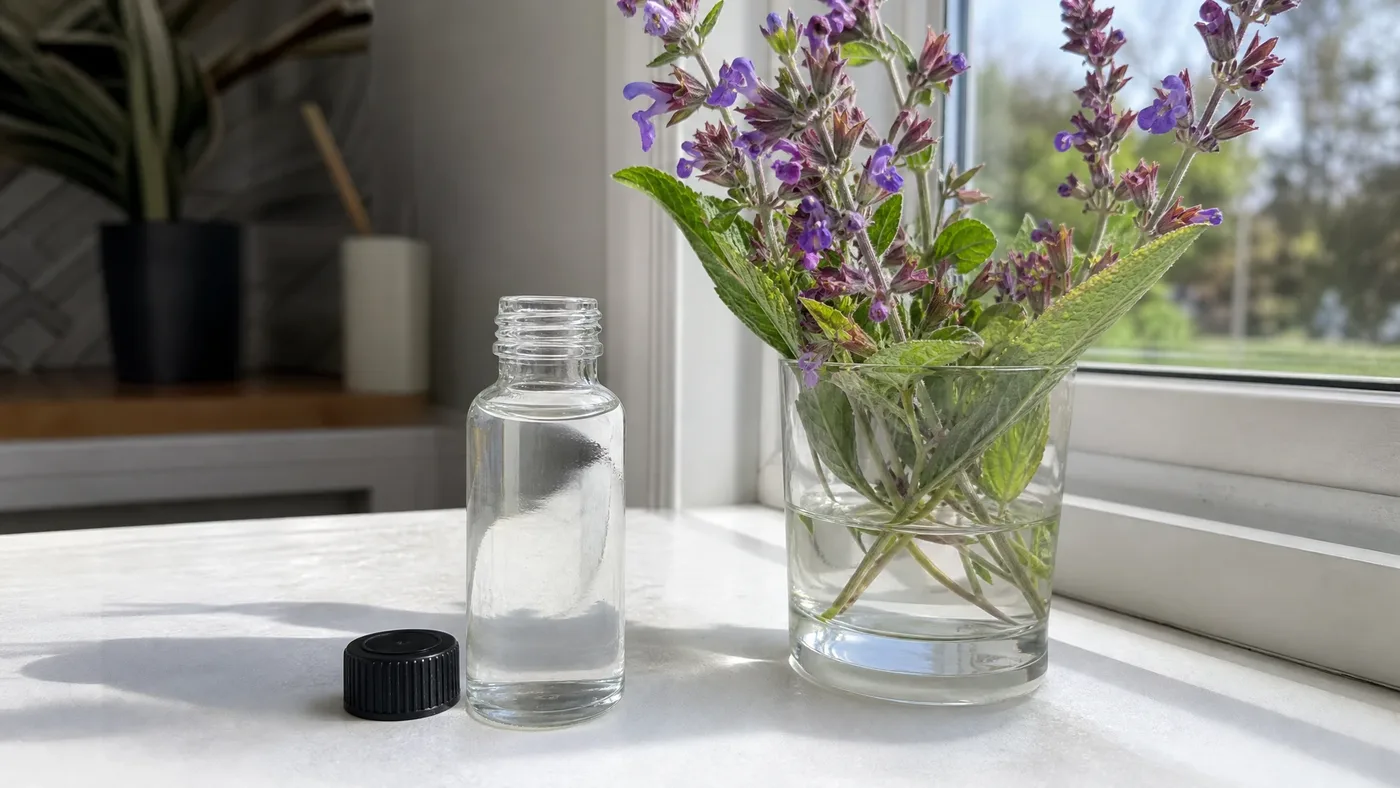
Clary Sage Hydrosol vs Essential Oil: Chemistry and Spoilage
A clary sage hydrosol is not a weak version of clary sage oil. It is a different liquid with a different chemistry, and the main thing it has in common with the oil is the plant. We sell only the oils, and the arithmetic below explains why none of our dilution advice carries over to a hydrosol.

Clary Sage Essential Oil
Our own Clary Sage Essential Oil, in sizes from 0.5 oz to bulk.
From $19.99
Shop Now →Start with what you are actually holding
Hydrosols are what is left after the oil is separated: the distillation water. A 2015 study of 22 orange blossom and rose hydrosols describes them as hydrodistillation products of aromatic plants that contain less than 1 g/L of dispersed essential oil (Labadie et al., Food Research International, 2015). A 2024 review calls them aqueous solutions containing a complex mixture of essential oil traces and water-soluble compounds (Almeida et al., Molecules, 2024).
Do the unit conversion. One gram per litre is 0.1% by weight per volume. So the ceiling for those hydrosols was about 0.1% oil, against the 0.5% to 2% that our own pages give for oil in a carrier oil. Even at the ceiling, a hydrosol is five to twenty times lower in oil than the weakest to strongest dilution we advise for the oil, and the study's median values were lower still: 677 mg/L for orange blossom (about 0.07%), 205 mg/L and 116 mg/L for the two rose types. Those are other plants. We found no oil-content figure for a clary sage hydrosol, so treat 0.1% as an upper bound borrowed from a different species.
The chemistry is different, not just weaker
Two studies analysed clary sage hydrolate, and they disagree with the oil and a little with each other.
- A Tuscan study distilled inflorescences with steam for three hours and analysed the hydrolate by headspace GC/MS: 89.5% linalool and 10.5% alpha-terpineol, with no linalyl acetate. The oil from the same distillation was led by linalyl acetate (62.6% by liquid analysis) (Ovidi et al., Plants, 2021).
- A Serbian study of hydrolate from steam extraction of aerial parts reported 63.3% linalool and 26.8% alpha-terpineol, citing earlier work for those values (Smiljanic et al., Antioxidants, 2023).
The two hydrolates do not match each other, which is expected from different plants and methods, but both are linalool-led and neither has the oil's linalyl acetate headline. If you were buying a hydrosol hoping for the profile of the oil, the data say you would not get it. Reasoning from those values: the scent of a hydrosol will be fainter and different, and we have not smelled one for this post.
The risk that decides the purchase: microbial growth
This is the part a spray-bottle recipe usually skips. In the 2015 study, microbial proliferation appeared in all the hydrosols stored in a non-sterile container, at room temperature and at 5 degrees C. Contaminated samples reached about 7 log10 CFU/mL, against a French pharmacopoeia recommendation of 2 log10 CFU/mL, and the organisms were environmental Gram-negative bacteria such as Pseudomonas and the Burkholderia cepacia complex. The authors concluded that the essential oil content and cold storage were not enough to ensure microbiological stability and that chemical preservatives or aseptic packaging would be needed (Labadie et al., 2015). A follow-up found that preservatives such as isothiazolinone, chlorphenesin, parabens, benzyl alcohol and sodium benzoate at pH 5.0 controlled spoilage bacteria for more than 90 days at 30 degrees C, but only at concentrations close to the authorised limits, and that without aseptic conditions only preservatives could stabilise hydrosols for several months (Labadie et al., J. Appl. Microbiol., 2016).
Antimicrobial activity would not rescue it either. In the Tuscan paper the clary sage hydrolate was not active against any tested strain at the concentrations used. And in the Serbian study the hydrolates were bottled without preservatives and the text we read reports no sterility or microbial testing. All of this was studied on orange blossom and rose, or on hydrolate in a lab, so applying it to a retail clary sage hydrosol is an inference. It is a cautious one: an unpreserved water with plant solids in it should be treated as perishable until the seller shows otherwise.
Decide: when a hydrosol is the wrong tool, and when it fits
- Wrong tool: anything stored for months, a spray kept in a warm bathroom, anything near eyes or broken skin. The preservative evidence above is the reason.
- Wrong tool: a baby, a pet, ingestion. Our pages say to keep our oils away from children and pets and that they are not for internal use; we have no data on hydrosols for any of these, so ask a pediatrician or veterinarian rather than a shop.
- Possible fit: a short-life mist you make in small quantities, or a linen water. Our room spray post covers an oil-based version. It is a different product, and a hydrosol would change its water phase.
- Possible fit: a skin product from a maker who declares a preservative system and a batch date. A cell study tested nine Lamiaceae hydrolates at 10-fold dilution on skin fibroblasts and reported that four, clary sage among them, raised viability or proliferation by 10 to 30% over the control, and called for further research (Smiljanic et al., 2023). That is a cell-culture result with the hydrolate, not a trial on people, and it says nothing about irritation on a face. Patch test anything new, and see a dermatologist for a skin condition.
What to ask a hydrosol seller
- Is it the distillation water from Salvia sclarea, or water scented with oil? The two are different products.
- What preservative, if any, at what pH, and what is the batch or distillation date?
- Has a microbial count been run, and what was the limit?
- What container and what storage does the seller recommend?
A seller who cannot answer the first question has told you something. We cannot answer it for anyone else, because we sell no hydrosol, absolute or CO2 extract, only two distilled oils. How the oil comes off the still is in our process post, and the oil's own dilution maths is in the dilution post.
If what you want is the aroma, the oil, diluted properly, is the product we can speak to, and you supply the carrier oil. If you want the water, buy it from a distiller who will show you the preservative and the date.
Clary Sage Essential Oil
Clary Sage Essential Oil from our own shop, in sizes from 0.5 oz to bulk.
From $19.99
Shop Now →Sources & Further Reading
- Labadie et al., 2015. Hydrosols of orange blossom and rose flower support the growth of a heterogeneous spoilage microbiota. pubmed.ncbi.nlm.nih.gov/28455040
- Labadie et al., 2016. Fate and control of pathogenic and spoilage micro-organisms in orange blossom and rose flower hydrosols. pubmed.ncbi.nlm.nih.gov/27618523
- Ovidi et al., 2021. Laurus nobilis, Salvia sclarea and Salvia officinalis essential oils and hydrolates. pmc.ncbi.nlm.nih.gov/articles/PMC8067454
- Smiljanic et al., 2023. Hydrolates from nine Lamiaceae medicinal plants on human skin fibroblasts. pubmed.ncbi.nlm.nih.gov/38001841
- Almeida et al., 2024. Unlocking the potential of hydrosols. pubmed.ncbi.nlm.nih.gov/39407589