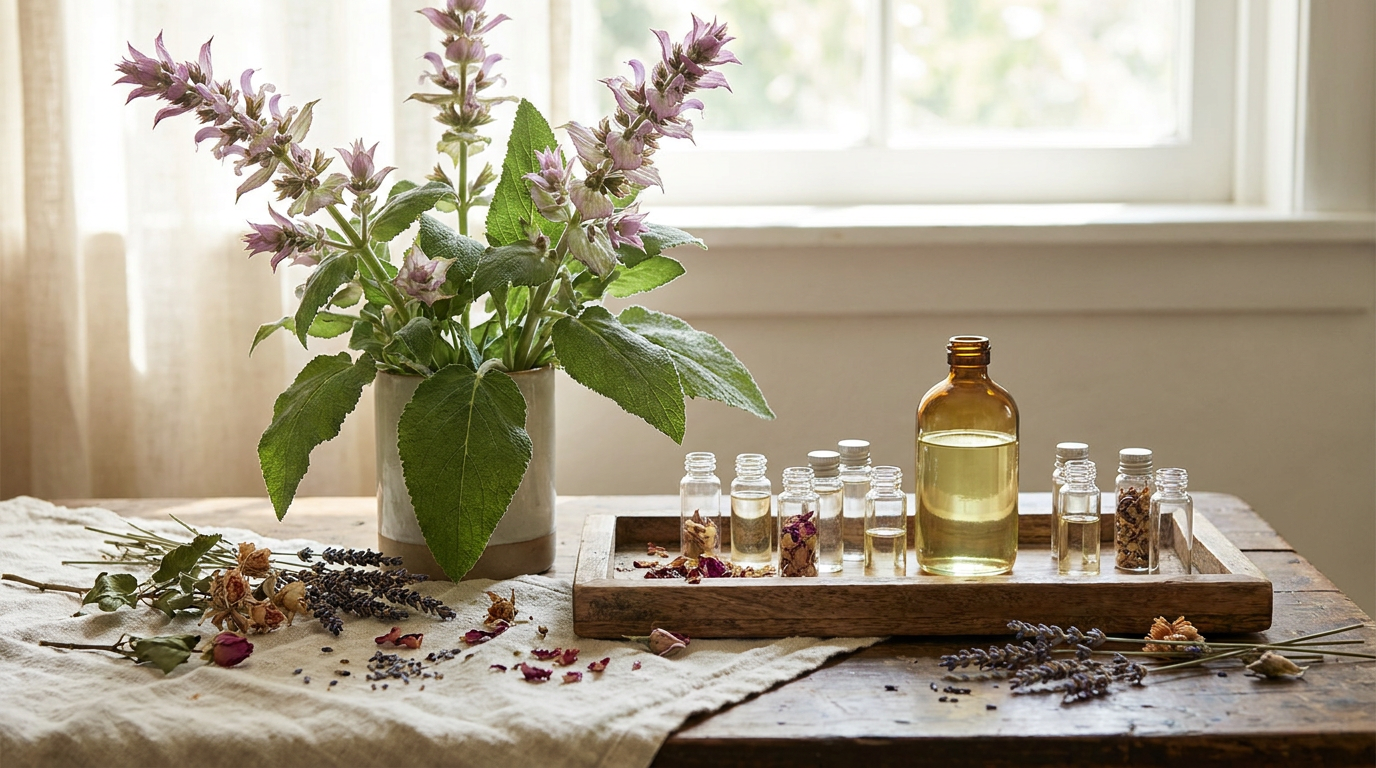
Clary Sage for Autumn: Why This Herbal Note Turns Up in Fall Blends
Walk past a candle display or a diffuser blend list in October and you'll notice a pattern: clary sage keeps showing up next to the cedar, the clove, and the orange peel. It isn't a coincidence, and it isn't just because the word "sage" sounds seasonal. Clary sage has a genuinely herbal, faintly sweet, almost tea-like character that behaves differently than the bright citrus and floral notes people reach for in spring and summer. As the air cools and rooms start smelling like cinnamon everything, clary sage offers something a little more grounded, a note that rounds out the sharper spice oils instead of competing with them.
This piece looks at why clary sage fall scent pairings have become a recurring theme in seasonal aromatherapy content, how to build autumn essential oil blends around it, and a few practical diffuser recipes to try as the leaves turn.
Why Clary Sage Reads as an Autumn Scent
Clary sage's aroma profile sits in an unusual middle ground. It has an herbal, slightly earthy backbone (thanks in part to naturally occurring linalyl acetate and linalool) but also a soft, nutty sweetness that keeps it from smelling purely medicinal or grassy. People often describe it as somewhere between a dried herb garden and a warm, slightly musky tea. That combination of "herbal" and "sweet" is exactly the middle note fall blends tend to be missing.
Think about the oils that define autumn: cinnamon bark, clove bud, sweet orange, ginger, and cedarwood. Most of them are either sharp top notes (citrus, spice) or heavy base notes (woods, resins). Clary sage lives in the middle, which is why blenders lean on it. It softens the bite of clove and cinnamon while giving cedarwood and vetiver something to hold onto. In a well-built blend, clary sage is rarely the star. It's the note that keeps everything else from feeling one-dimensional.
There's also a seasonal association worth naming honestly: the word "sage" itself carries a strong autumnal, harvest-time connotation in a lot of Western fragrance culture, right alongside pumpkin and apple. Some of clary sage's fall popularity is genuinely about scent chemistry, and some of it is about the cultural shorthand the name carries. Both are valid reasons people reach for it this time of year.
Building an Autumn Blend Around Clary Sage
If you're new to blending, clary sage is a forgiving oil to start with because it doesn't overpower easily. A good rule for herbal fall diffuser trends is to treat clary sage as a "bridge" note: pick one bright top note, one warm spice, one woody or resinous base, and let clary sage connect them.
A Few Reliable Pairings
- Clary sage + sweet orange + clove bud: A classic harvest combination. The orange keeps things from feeling heavy, the clove brings the spice, and clary sage smooths the transition between them.
- Clary sage + cedarwood + bergamot: A quieter, more "study and library" blend for cooler evenings, less spiced, more woodland.
- Clary sage + cinnamon bark + vanilla-adjacent oils (like benzoin, if you have it): A cozy, bakery-leaning combination, but use cinnamon bark sparingly. It's a skin irritant and a strong diffuser note even in small amounts.
- Clary sage + ginger + grapefruit: A brighter option for people who want fall warmth without heaviness, good for daytime rooms that get a lot of natural light.
A general starting ratio for a diffuser blend is 3 to 4 drops of clary sage as your "bridge" note, paired with 2 to 3 drops of your bright top note and 1 to 2 drops of your spice or resin. From there, adjust to your nose. Fall blends tend to skew a little heavier on drops overall than spring blends, since people want the scent to carry through a whole room on a closed-window day.
Seasonal Diffuser Recipes to Try
Harvest Evening Blend
- 4 drops clary sage
- 3 drops sweet orange
- 2 drops clove bud
Quiet Study Blend
- 4 drops clary sage
- 3 drops cedarwood
- 2 drops bergamot
Cozy Morning Blend
- 3 drops clary sage
- 3 drops grapefruit
- 2 drops ginger
Run any of these in a standard ultrasonic diffuser for 30 to 60 minutes at a time rather than continuously. Essential oils are potent, and a room can go from pleasantly scented to overwhelming faster than people expect, especially once several oils are layered together.
Beyond the Diffuser: Other Seasonal Uses
Clary sage's fall popularity isn't limited to diffusers. A few other places it shows up this time of year:
- Room sprays: A simple blend of clary sage, cedarwood, and a splash of witch hazel in distilled water makes an easy linen or room spray for guest rooms during holiday visits. Shake before each use since essential oils don't fully dissolve in water.
- Simmer pots: A stovetop simmer of sliced orange, cinnamon sticks, and a couple drops of clary sage oil added toward the end of simmering gives a similar effect to a diffuser blend, though the scent tends to be shorter-lived.
- Bath soaks: Combined with a carrier like Epsom salt or a bit of jojoba oil, clary sage can be part of a warm evening bath ritual as the nights get longer. Always mix essential oils into a carrier or dispersant before adding them to bathwater; oil floats undiluted on the surface and can irritate skin directly.
A Few Practical Notes on Sourcing and Safety
Not all clary sage oil smells the same, and that matters more in autumn blending than people expect, since you're relying on the middle notes to do real work in a busy blend. Steam-distilled clary sage from mature plants tends to have a rounder, less sharp aroma than oil distilled from younger stock or lower-grade sources. If a bottle smells thin, overly grassy, or almost solvent-like, it's worth trying a different supplier before assuming the recipe itself is off.
A short list of practical safety points worth keeping in mind:
- Always dilute essential oils in a carrier oil before any skin contact. A common general dilution is around 2 percent for adult skin use, roughly 12 drops of essential oil per ounce of carrier oil, though guidance varies by use and by person.
- Do a patch test on a small area of skin and wait 24 hours before using a new blend more broadly.
- Keep essential oils away from pets and out of reach of children. Some oils that are fine for adult use are not appropriate around cats, dogs, or young children.
- Pregnant or nursing individuals, and anyone managing a medical condition or taking prescribed medications, should speak with a qualified healthcare provider before adding new essential oils to a routine.
- Essential oils are for aromatic and cosmetic use. They are not a substitute for professional medical or veterinary guidance.
Why This Trend Keeps Coming Back Each Year
Fragrance trends in aromatheromy are cyclical, and clary sage's autumn resurgence has been consistent enough that it's worth paying attention to. Part of it is genuinely about how the oil behaves chemically in a blend: it bridges sharp and warm notes better than most single oils on the market. Part of it is cultural, tied to the same "harvest herb" associations that make sage bundles a familiar autumn image. And part of it is simply that people gravitate toward warmer, deeper scent profiles as daylight shortens, and clary sage fits that mood without tipping into the heaviness of a pure resin or wood oil.
If you've mostly used clary sage in lighter, floral-leaning blends up to now, autumn is a good season to experiment with pairing it against spice and citrus instead. Start with small batches, four or five drops total, and adjust from there. The blends above are a starting point, not a fixed formula, and the best fall diffuser combination is usually the one you tweak until it matches your own space and preferences.