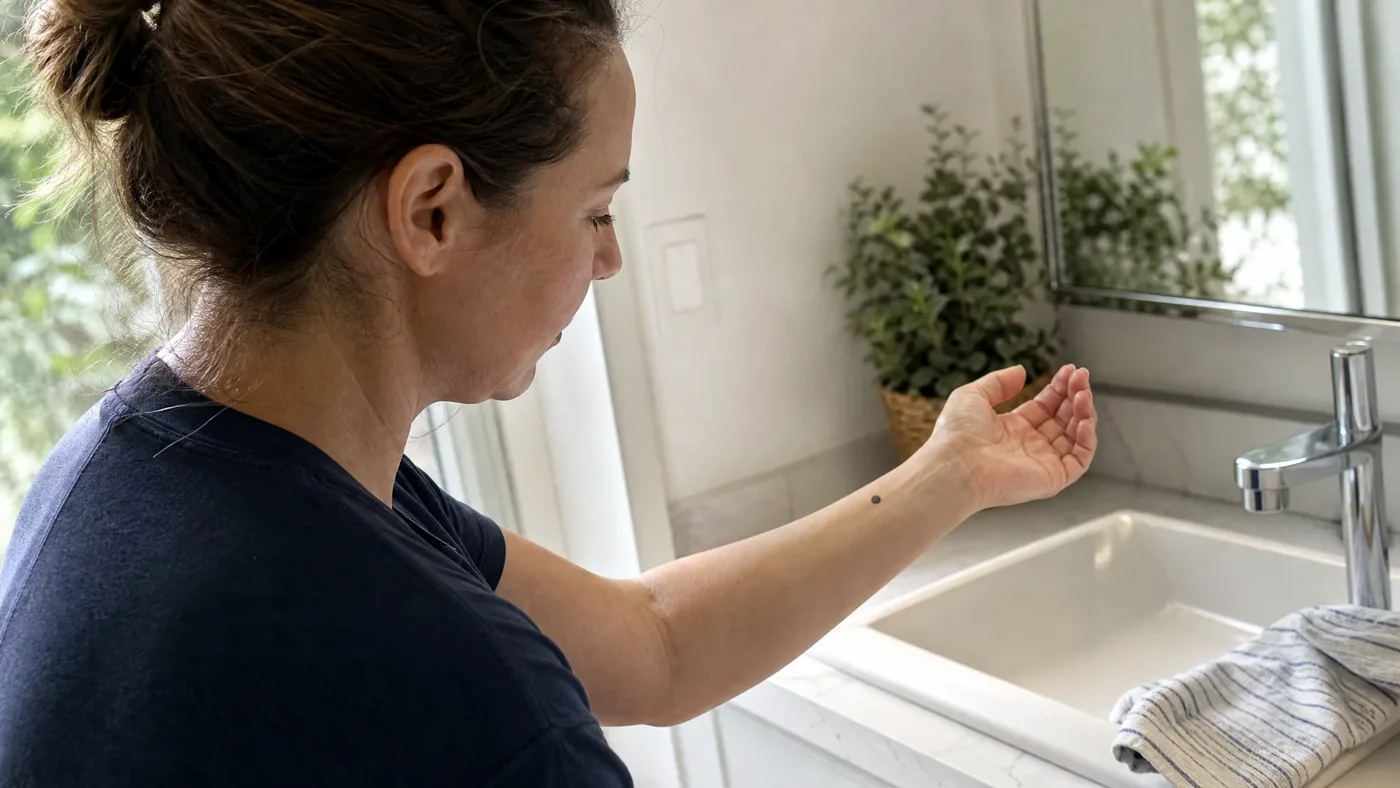
How to Patch Test Clary Sage Oil and Read the Result
A home patch test is worth ten minutes, but it is a weaker instrument than the bottle's label implies. Our product pages tell you to patch test before using either clary sage oil on skin, and the Tisserand Institute says "in general we don't recommend it." Both are defensible, and the way to hold them together is to know what a home test can catch, what it cannot, and what to do with the answer.

Clary Sage Essential Oil
Our own Clary Sage Essential Oil, in sizes from 0.5 oz to bulk.
From $19.99
Shop Now →What you are testing for, and when it shows up
Two different things can happen on skin. Irritation is a direct reaction to the material and tends to appear soon after contact. Allergic contact dermatitis is an immune reaction that builds with exposure. The Tisserand Institute's page on skin reactions says allergy is "also called delayed hypersensitivity because it does not occur the first time the skin is exposed," and that it "often will not happen the first time an essential oil is used" (Tisserand Institute, irritation and allergic reactions). The same page adds that patch testing "is not 100% reliable" and that "intensive patch testing itself occasionally produces allergic reactions that would not otherwise have occurred."
The clinic version shows how slow the allergic answer can be. DermNet, the New Zealand dermatology resource, describes allergens applied to the back for 48 hours and the skin inspected again at 96 hours, because reactions "usually take 48 to 96 hours to develop." It also says that sensitisation caused by the test itself, a rare adverse effect, may appear about 10 to 14 days later (DermNet, patch tests). In Danish registry data on 6,719 patch-tested patients, most reactions to linalool hydroperoxide peaked on day 3 or 4 (Botvid et al., Contact Dermatitis, 2026). Clary sage oil is rich in linalool, and the hydroperoxides are what linalool turns into on exposure to air; the study tested those, not clary sage oil.
The reasoning consequence: a dab on the arm that you check after an hour or the next morning will catch a strong irritant and probably misses a slow allergy. A longer, repeated test is closer to how the problem actually arrives.
A version built from DermNet's repeat open application test
DermNet describes a repeat open application test (ROAT) for a suspect product: apply it twice a day to a 5 cm area of forearm skin for 5 to 10 days; no visible redness or swelling makes contact allergy to that product unlikely, in DermNet's words. Notice the wording: unlikely, not excluded. The steps below are our adaptation of that schedule, worked out from DermNet's description and ordinary maths. We have not tested this procedure on anyone, and it is no substitute for a clinic test.
- Mix a small batch at the bottom of our range. Our pages give 0.5% to 2%. Start at 0.5%. Using the Tisserand Aromatherapy company's conversion (1% is 1 drop per 5 ml, so 0.5% is about 1 drop per 10 ml), put 1 drop of oil into 10 ml of the carrier oil you plan to use. We do not sell carrier oils. The Tisserand Institute's own "start low and increase the concentration only if needed" is the same logic (Tisserand Institute, dilution). Dilution maths in full is in our dilution guide.
- Test the carrier on its own too. Reasoning: if the skin reacts, you want to know whether it was the oil or the base. Put a second 5 cm patch of plain carrier beside the first.
- Pick intact skin. Inner forearm, not broken, shaved that day, or already irritated.
- Apply twice a day for 7 days (inside DermNet's 5 to 10 day window), then look once more at day 10 to 14 in case something shows late. Leave it uncovered, since this is an open test.
- Look each morning in good light for redness, raised bumps, blisters, swelling or itching, and note the day.
Reading the result: decision rules
| What you see | What to do |
|---|---|
| Nothing on either patch through day 7, and nothing by day 14 | Go ahead at 0.5%. It is a lower chance of a problem, not a guarantee. Any increase should be in small steps; the Tisserand Institute suggests dose escalation from about 1% in 0.5% steps for people at higher risk. |
| Both patches, carrier and oil, are pink or itchy | The base is the likely culprit. Stop and change the carrier before judging the oil. |
| Only the oil patch is pink and it fades within hours | Possible irritation. Stop. If you try again, use a lower percentage, and ask a pharmacist if you are unsure. |
| Redness that persists or spreads, itch, bumps, blisters or swelling, at any day | Stop and do not re-test. Wash the area. Ask a pharmacist or doctor, and a dermatologist if it recurs. Treat it as a reason not to use the oil on skin until a professional says otherwise. |
| Swelling of the face, lips or throat, hives, or trouble breathing | Emergency care now. |
Reactions seen in a skin test can also be false alarms. A German network testing linalool hydroperoxides on 5,511 consecutive patients logged 578 doubtful and 178 irritant reactions alongside 483 positive ones to the linalool preparation, and concluded the test preparation itself can irritate (Schubert et al., Contact Dermatitis, 2023). That is a clinical test of an oxidation product, not a home test of a diluted oil, but it is a reminder that an ambiguous mark is common and should be interpreted, ideally by someone who reads these for a living.
Why a clear result is not a safety certificate
- Sensitisation can start later. The Tisserand Institute points out that allergy often does not appear the first time. A test lasting a week samples your exposure for a week.
- The bottle changes. Linalool oxidises with air, so a test done on a fresh bottle does not describe the same oil two years on. Our stated typical shelf life is 2 to 3 years for the Botanical oil and 3 to 4 years for the Purity oil, kept capped and away from heat and light. Storage details: how to store clary sage oil.
- A forearm result covers the forearm. Reasoning: a test at one site says little about another. If you plan to use the oil near the face, the Tisserand Institute's facial band is 0.5% to 1.2%, so stay at the bottom of our range.
When to see a dermatologist instead
If you have ever reacted to perfume, a fragrance-containing product or another essential oil, or you get unexplained hand or face dermatitis, a clinic patch test is the better route. DermNet notes that the standard series "will pick up about 70% of contact dermatitis" and that results need interpretation by experts. A review of fragrance patch testing in Acta Dermato-Venereologica notes that choosing suitable fragrance materials is challenging, which is one more reason a professional does it better than a bottle at home (Sukakul et al., Acta Derm Venereol, 2024). We cannot tell you whether your skin will react to clary sage; no seller can. Our page on the oil's wider risk profile is clary sage oil side effects, and one on the skin use itself is clary sage oil for skin.
Clary Sage Essential Oil
Clary Sage Essential Oil from our own shop, in sizes from 0.5 oz to bulk.
From $19.99
Shop Now →Sources & Further Reading
- Tisserand Institute, undated. Irritation and allergic reactions. tisserandinstitute.org/safety/irritation-allergic-reactions
- Tisserand Institute (R. Tisserand), undated. Dilution for essential oils. tisserandinstitute.org/dilution-essential-oils
- DermNet, undated. Patch tests. dermnetnz.org/topics/patch-tests
- Botvid S et al., 2026. Ten years of patch testing to hydroperoxides of limonene and linalool. pubmed.ncbi.nlm.nih.gov/41638887
- Schubert S et al., 2023. Patch testing hydroperoxides of limonene and linalool in consecutive patients (IVDK 2018-2020). pubmed.ncbi.nlm.nih.gov/37177844
- Sukakul T, Bruze M, Svedman C, 2024. Fragrance contact allergy: a review focusing on patch testing. pubmed.ncbi.nlm.nih.gov/39140486