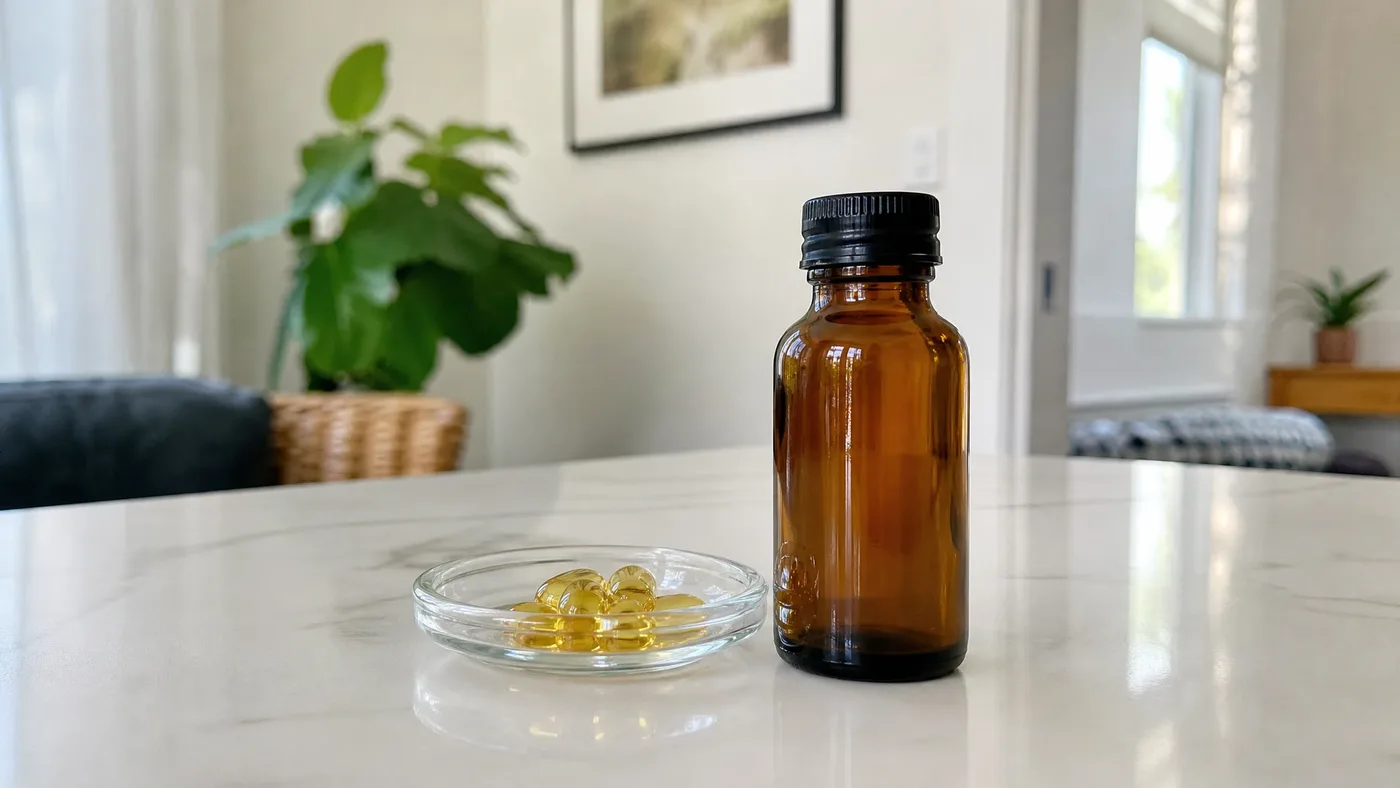
Evening Primrose vs Clary Sage: A Mix-Up Worth Untangling
Clary sage oil and evening primrose oil keep turning up in the same searches, usually from people thinking about hormones and wondering whether one stands in for the other. They do not, and the reason is the most useful thing to know: they belong to completely different product categories.

Clary Sage Essential Oil
Our own Clary Sage Essential Oil, in sizes from 0.5 oz to bulk.
From $19.99
Shop Now →A supplement and an aroma
Evening primrose oil is pressed from the seeds of Oenothera biennis and sold mostly as a capsule to swallow. The National Center for Complementary and Integrative Health (NCCIH) says that, for the conditions people ask about, there is not enough evidence to support its use for any health condition, and that the evidence on menopause symptoms and PMS is insufficient. It names stomach upset, nausea and diarrhea as the most common side effects, and advises anyone taking medicine to talk to a health care provider first (NCCIH).
Clary sage oil is a steam-distilled aromatic oil. We sell one, Salvia sclarea, as an external cosmetic oil: it is for scent, or for diluted skin use at 0.5% to 2% in a carrier oil with a patch test first. We recommend keeping it away from eyes, children and pets, avoiding it during pregnancy, and never swallowing it. That swallowed-versus-smelled difference is why numbers for one cannot be converted into the other. Our ingestion post explains the arithmetic.
What research exists on the clary sage side
If you came looking for evidence on menopause or PMS, here is the honest picture. The best-known clary sage study in menopausal women had 22 participants inhale the oil and measured cortisol and serotonin levels, not hot flashes (Lee et al., 2014). It was a small study without a control group described in its abstract, and it does not tell us what a bottle of oil will do for anyone. We sell a cosmetic oil and make no claims about hormones, cycles or symptoms. Our menopause review and PMS article report what has been studied.
That is also why we would never frame these two as rivals. They are not two tools for the same job. One is a dietary supplement with its own questions about interactions and side effects; the other is a fragrance material with its own questions about skin tolerance.
Where to take the real question
If hot flashes, cycle changes or PMS are what prompted your search, the right person to ask is an OB-GYN or a midwife. A pharmacist can check a supplement against any medicine you take, and that matters more for something swallowed than for an aroma. If you are pregnant or breastfeeding, check with your clinician before using either one; our pregnancy sources collect what the authorities say about clary sage.
If it is the scent you are after
Clary sage oil is lovely for what it is. Ours has a sweet, dry, softly herbal scent with nutty, tea-like undertones, and it is classed as a middle note. It is not the oil to reach for before driving. You will need your own carrier oil, such as jojoba or sweet almond, available from a craft or supply shop, because we sell the oil only. A worked example: 1% in 10 mL of carrier is 0.1 mL of oil.
So the short answer to "which one?" is that they answer different questions, and the person to ask about the medical one is a clinician, not a product page.
Clary Sage Essential Oil
Clary Sage Essential Oil from our own shop, in sizes from 0.5 oz to bulk.
From $19.99
Shop Now →Sources & Further Reading
- NCCIH. Evening primrose oil. nccih.nih.gov/health/evening-primrose-oil
- Lee KB, Cho E, Kang YS, 2014. Changes in 5-hydroxytryptamine and cortisol plasma levels in menopausal women after inhalation of clary sage oil. Phytother Res. pubmed.ncbi.nlm.nih.gov/24802524