Clary Sage Oil for Period Cramps: What the Trials Used
Two trials put clary sage near period pain, and both used a blend rubbed onto the lower abdomen, so what they tested was a mix of scents plus a massage. Before you buy any oil for cramps, we would put a heating pad and a conversation with an OB-GYN ahead of it. If you still want to try a diluted massage oil, the arithmetic below shows what the trials actually used and how it compares with our 0.5% to 2% range.

Clary Sage Essential Oil
Our own Clary Sage Essential Oil, in sizes from 0.5 oz to bulk.
From $19.99
Shop Now →Decode the two recipes first
Han et al. (Korea, 2006) enrolled 67 college students who rated their cramps above 6 on a 10-point scale, with no systemic or reproductive disease and no contraceptive pills. The aromatherapy group (25 women) was massaged on the abdomen with two drops of lavender, one drop of clary sage and one drop of rose in 5 cc of almond oil. A placebo group (20) got almond oil alone; a control group (22) got nothing.
Take the 5 cc as 5 mL and assume 20 drops to the milliliter (drop size varies, so treat the result as approximate). Four drops is 0.2 mL, and 0.2 mL in 5 mL is about 4% total. Clary sage was one of the four drops, so about 1%. That is inside our stated skin range, but the blend as a whole is double the top of it.
Ou et al. (Taiwan, 2012) studied 48 outpatients whose primary dysmenorrhea was confirmed by a gynecologist, with pain scores above 5. The oil group (24) used lavender, clary sage and marjoram in a 2:1:1 ratio at 3% in unscented cream; the other 24 used a cream with synthetic fragrance. Everyone massaged the lower abdomen daily from the end of one period until the next began. Clary sage is one quarter of 3%, about 0.75%, again inside our range.
What the comparison groups say
Han's placebo group was also massaged, with almond oil, so massage alone does not explain the gap Han reported: the aromatherapy group's cramp scores were lower than both other groups on the first and second day of menstruation (first day: beta -2.48, 95% CI -3.68 to -1.29). One reservation is mine, not the authors': almond oil has little scent, so participants may have known which group they were in.
Ou's result is harder to read as support for the oils. Pain scores fell significantly in both arms (P < 0.001), the fragrance cream included. The one reported difference was duration: pain days fell from 2.4 to 1.8 in the essential-oil group. Reasoning from that, the practical consequence is that a daily abdominal rub for a month can lower scores whatever is in the cream, and a trial this size (48 people) cannot separate the blend from the ritual.
The reviews disagree on how consistent this is
A 2018 systematic review from Korea pooled placebo-controlled trials of any aromatherapy: for massage, 11 studies and 793 participants gave a standardized mean difference of -0.87, with I² of 70%, and the authors graded the evidence "moderate." A 2021 meta-analysis from Iran accepted any control group, pooled 13 trials at -0.795 with I² of 19%, and found the effect strongest when oil was combined with massage or when a mixture of oils was used. Both lean positive. They differ on how much the trials agree with each other (70% versus 19% heterogeneity), and neither isolates clary sage. Both reviews are about aromatherapy as a category: lavender, rose, marjoram, ginger and others are pooled alongside clary sage.
What has firmer footing: heat, and the ordinary medical route
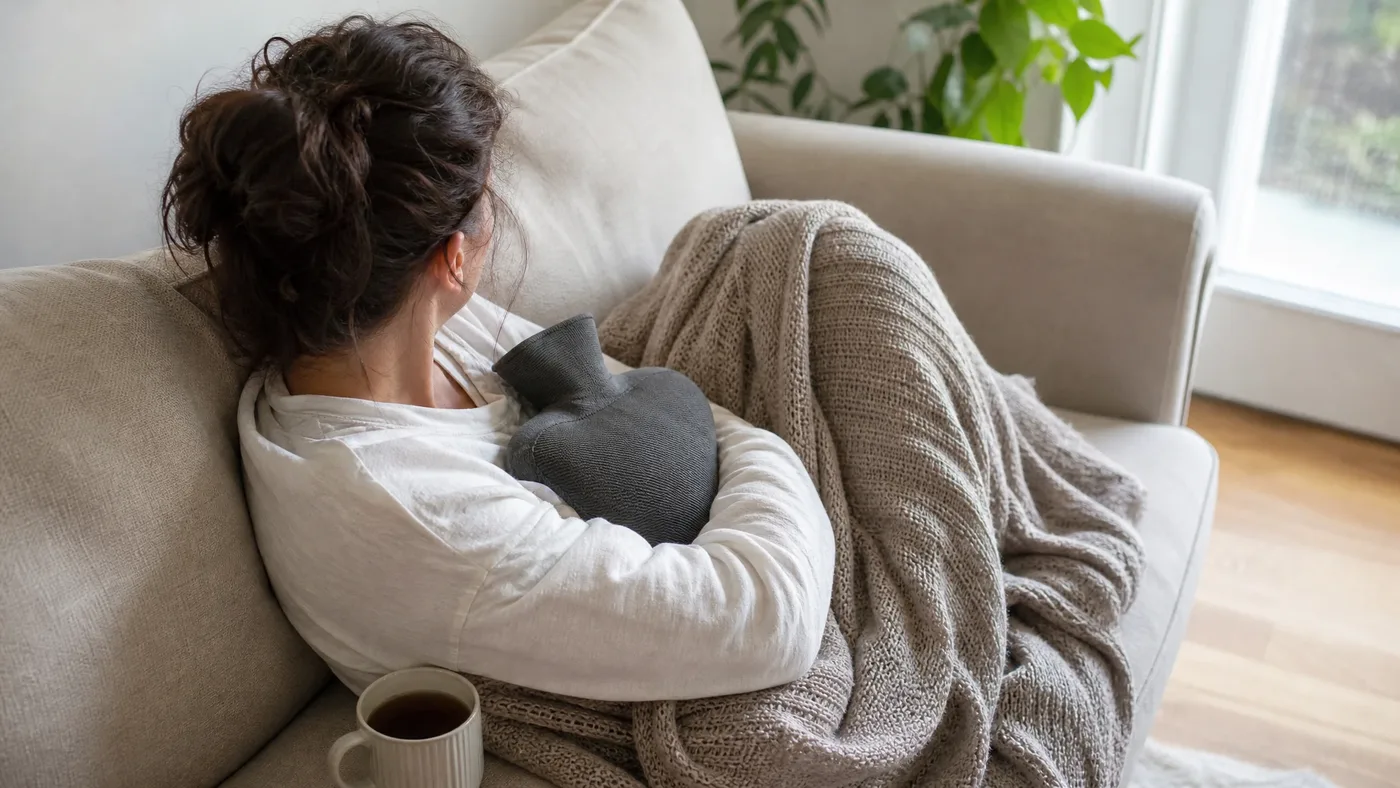
ACOG's page on painful periods names NSAIDs taken at the first sign of pain, hormonal birth control, exercise, sleep, and "a warm bath or placing a heating pad or hot water bottle on your abdomen." It also says vitamin B1 and magnesium may help but that not enough research exists to recommend them. As we read the page on 23 October 2026, it does not mention aromatherapy or essential oils.
Heat has its own trial record. A 2004 trial by Akin et al. compared a wearable heat wrap with 1,000 mg of oral acetaminophen in 344 evaluable women over one day; the wrap scored higher on the trial's 0 to 5 pain scale over 8 hours (2.48 against 2.17, P = 0.015). A 2018 review found six randomized trials and called the evidence "suggestive" because the trials were few and small. So heat is not proven either, but it has been compared against an active drug, which the aroma trials above were not. That is why we rank it first.
Check it is primary dysmenorrhea before any oil
Both trials enrolled women with primary dysmenorrhea, meaning cramps without a pelvic cause. ACOG describes the other kind, secondary dysmenorrhea, as pain that tends to worsen over time, may begin days before a period and may not stop when it ends, with causes including endometriosis, fibroids and adenomyosis. Nothing above applies to that kind. Book an OB-GYN visit if your pain is getting worse, interferes with daily life for days, does not respond to ordinary medication, or comes with very heavy bleeding. We sell oil, not medical advice, and no oil is a stand-in for finding the cause.
If you still want a massage oil: arithmetic, untested by us
We have not made or tested any recipe. What follows is ordinary maths on our stated range and the 20-drops-per-mL assumption. Our oils are sold undiluted, so the carrier (a plain vegetable oil or unscented lotion) comes from you.
- 10 mL of carrier at 0.5% needs 0.05 mL of oil, about 1 drop.
- At 1%, 0.1 mL, about 2 drops.
- At 2%, 0.2 mL, about 4 drops.
That reproduces the clary sage share of both trials (about 0.75% and 1%) but not the lavender, rose or marjoram, which we do not sell, so it is not a replica of either study. Patch test on a small patch of forearm first, keep it off broken skin and away from eyes, and see our dilution guide for the method. Formulas for rolling and massage oils in more detail are planned in our massage oil post and our roll-on post.
Who should skip this
- Anyone who might be pregnant: our /our-oil/ page says to avoid clary sage oil in pregnancy, and a late period is a reason for a pregnancy test, not an oil. See the irregular periods post.
- Teenagers and children: our pages say keep it away from children. Han's participants were college students (aged 19 to 26, as tabulated in the 2018 review); for a younger person with severe cramps, see a pediatrician or adolescent gynecology clinician.
- Anyone with skin that reacts to fragranced products, or who is on medication for pain: ask a pharmacist or physician.
- Not for internal use, and, per our page, not the oil to reach for before driving.
For the wider picture of what clary sage trials do and do not cover, see our women's health evidence map, and for the mood side of the cycle, our PMS post.
Clary Sage Essential Oil
Clary Sage Essential Oil from our own shop, in sizes from 0.5 oz to bulk.
From $19.99
Shop Now →Sources & Further Reading
- Han et al., 2006. Effect of aromatherapy on symptoms of dysmenorrhea in college students. PubMed 16884344
- Ou et al., 2012. Aromatic essential oil massage on outpatients with primary dysmenorrhea: a randomized, double-blind trial. PubMed 22435409
- Lee et al., 2018. Aromatherapy for managing pain in primary dysmenorrhea: a systematic review of randomized placebo-controlled trials. PubMed 30423839
- Najaf Najafi et al., 2021. Aromatherapy alone or in combination with massage on dysmenorrhea: systematic review and meta-analysis. PubMed 34933391
- Akin et al., 2004. Continuous, low-level, topical heat wrap therapy as compared to acetaminophen for primary dysmenorrhea. PubMed 15493566
- Jo and Lee, 2018. Heat therapy for primary dysmenorrhea: systematic review and meta-analysis. PubMed 30389956
- ACOG. Dysmenorrhea: painful periods (patient FAQ). acog.org/dysmenorrhea