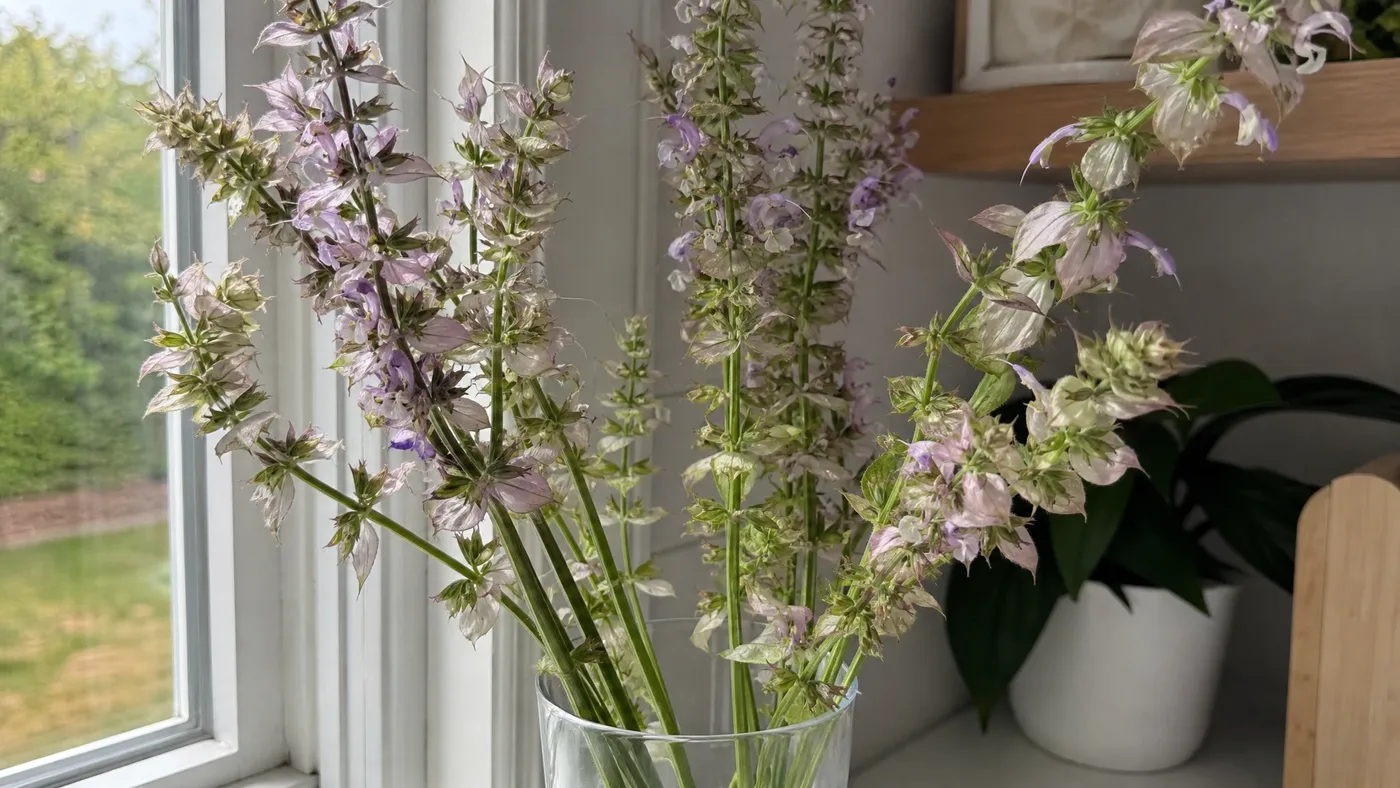
Is Clary Sage Oil Really Estrogen-Like? Tracing the Idea
Search for clary sage and you will soon meet the phrase "estrogen-like". It sounds scientific and it gets repeated everywhere, so it is worth asking where it started. The trail turns out to be short, and it ends at a single sentence about a molecule.

Clary Sage Essential Oil
Our own Clary Sage Essential Oil, in sizes from 0.5 oz to bulk.
From $19.99
Shop Now →A 1990 sentence that keeps getting retold
Aromatherapy author Robert Tisserand traced the idea to a 1990 book by Franchomme and Pénoël, which called clary sage oil estrogen-like because of a compound named sclareol, said to resemble human estrogens in shape. In a 2010 post he noted that the claim had since split into four different versions: that the oil mimics estrogen, that it does so only when you are low, that it makes your body produce more, and that it "balances hormones". Only the first matches what the book said (Tisserand, 2010).
His own look at the chemistry went the other way. Estrogens, and the chemicals known to act like them, share a particular ring structure with a hydroxyl group attached. Sclareol has no such ring; it belongs to a family of molecules called labdane diterpenes, which are not known for estrogen-like behavior. On structure alone, he concluded, an estrogenic effect is unlikely, and he knew of no research showing one.
How much sclareol is actually in the oil
This is the part that surprises people. Sclareol is a heavy, slow-to-evaporate molecule, so the gas chromatography used on most lab reports tends to undercount it, and published figures vary from a fraction of a percent to a few percent. Tisserand put it at roughly 4% of the oil. What gives clary sage its sweet, herbal, softly tea-like scent is mostly lighter material: linalyl acetate and linalool, which together make up most of the oil (EFSA, 2024).
Sclareol is still a genuinely interesting molecule. Perfumers prize it, and it is a well-known starting material for making ambergris-type fragrance ingredients (Caniard et al., 2012). That is where its real reputation lies: in scent, not in hormones.
What the lab and animal work on sclareol did
Researchers have studied sclareol, but not in the way the hormone claim implies. A 2020 study in Taiwan applied sclareol to rat uterine tissue and tested it in mice, and found it dampened muscle contractions set off by several chemical triggers (Wong et al., 2020). That is smooth-muscle pharmacology on tissue and animals. It is not a measurement of estrogen, and it says nothing about what an aroma or a diluted skin oil does in a person.
The human study people point to
The one human study cited again and again is from Korea: 22 menopausal women inhaled clary sage oil, and the researchers measured cortisol, serotonin and thyroid stimulating hormone (Lee, Cho and Kang, 2014). Estrogen was not on the list. Cortisol and serotonin are stress chemistry, so the leap from that result to "it acts like estrogen" is one the paper does not make. If you want the full story of that study, we go through it in our cortisol study post.
A handy test for the next hormone claim
You will meet more claims like this one, for clary sage and for other oils. Four quick questions sort most of them. Which hormone, and measured in what: blood, saliva, something else? In whom, and how many people? Compared with what? And by which route: inhaled, on the skin or swallowed? "Balances hormones" fails at the first question, because it names no hormone and no direction.
Where we land
We sell our clary sage oil for its scent and for diluted skin use, and we make no hormonal claims for it. Our recommendation for skin is 0.5% to 2% in a carrier oil, with a patch test first, and we advise avoiding it during pregnancy. If you have, or have had, a hormone-sensitive condition, or you take hormone therapy or a hormonal contraceptive, your OB-GYN or care team is the right person to ask before you add any new scented oil to your routine. Our women's health overview and our PCOS post cover the neighboring questions.
The honest summary is a pleasant one: clary sage earned its place in perfumery for the way it smells, and that is a good enough reason to enjoy it.
Clary Sage Essential Oil
Clary Sage Essential Oil from our own shop, in sizes from 0.5 oz to bulk.
From $19.99
Shop Now →Sources & Further Reading
- Tisserand R, 2010. Is clary sage oil estrogenic? roberttisserand.com
- EFSA FEEDAP Panel, 2024. Safety and efficacy of clary sage oil as a feed additive. pmc.ncbi.nlm.nih.gov/articles/PMC11561422
- Caniard A et al., 2012. Discovery and functional characterization of two diterpene synthases for sclareol biosynthesis in Salvia sclarea. pmc.ncbi.nlm.nih.gov/articles/PMC3520730
- Wong J et al., 2020. Salvia sclarea L. essential oil extract and its antioxidative phytochemical sclareol inhibit oxytocin-induced uterine hypercontraction. pubmed.ncbi.nlm.nih.gov/33066489
- Lee KB, Cho E, Kang YS, 2014. Changes in 5-hydroxytryptamine and cortisol plasma levels in menopausal women after inhalation of clary sage oil. pubmed.ncbi.nlm.nih.gov/24802524